

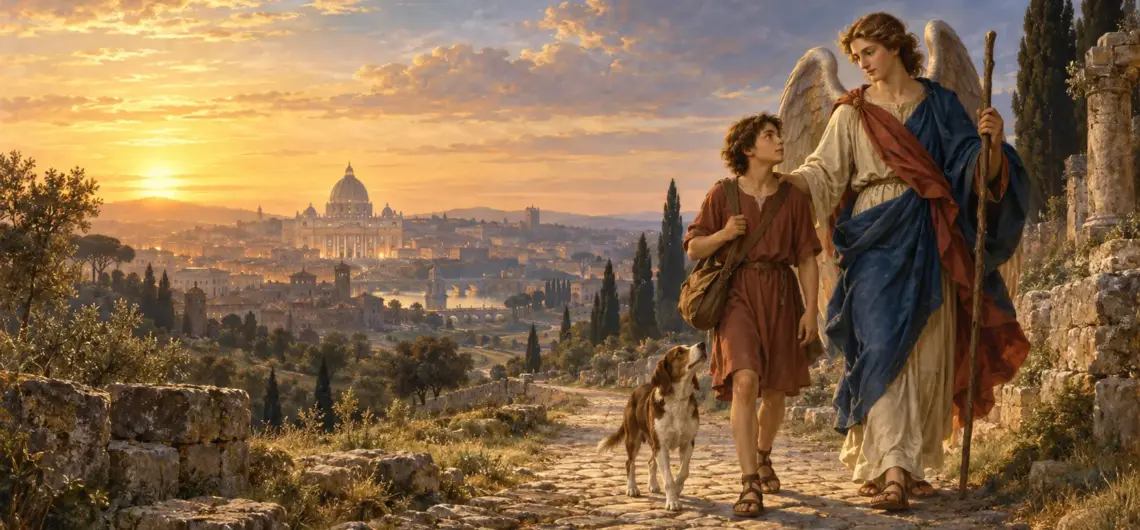
Saint Raphael is the heavenly companion of pilgrims: the archangel whom God sent to walk beside Tobias, guard him on an unknown road, guide his decisions, overcome spiritual danger, heal his family and bring him safely home. For Catholics preparing for a pilgrimage to Rome, his mission in the Book of Tobit offers much more than a prayer for trouble-free travel. It reveals how a journey can become an school of providence, conversion and thanksgiving.
His traditional feast is celebrated on 24 October; in the modern Roman calendar he is commemorated with Saints Michael and Gabriel on 29 September. The older October feast is a timely invitation to recover Saint Raphael as patron, guide and intercessor for everyone setting out toward the tombs of the Apostles.
Saint Raphael in seven inspiring lessons
- God’s providence is already at work before the pilgrim recognizes it.
- An angelic guide strengthens rather than replaces human prudence and freedom.
- Danger can become an instrument of healing when met with faith and obedience.
- A true pilgrimage concerns vocation, chastity and family life as well as geography.
- Prayer, fasting and almsgiving prepare the soul to receive grace.
- The journey reaches its proper end in worship and thanksgiving.
- A pilgrim should return home with clearer spiritual sight and greater charity.
Contents
- The meaning of Raphael’s name
- The guide who knows the road
- Courage beside the river
- Guardian of chastity and marriage
- The angel who presents prayer
- Saint Raphael in Catholic liturgy
- Why invoke Saint Raphael before Rome?
- A practical pilgrimage preparation
- Prayer for a pilgrimage to Rome
- Frequently asked questions
“God has healed”: the name of Saint Raphael
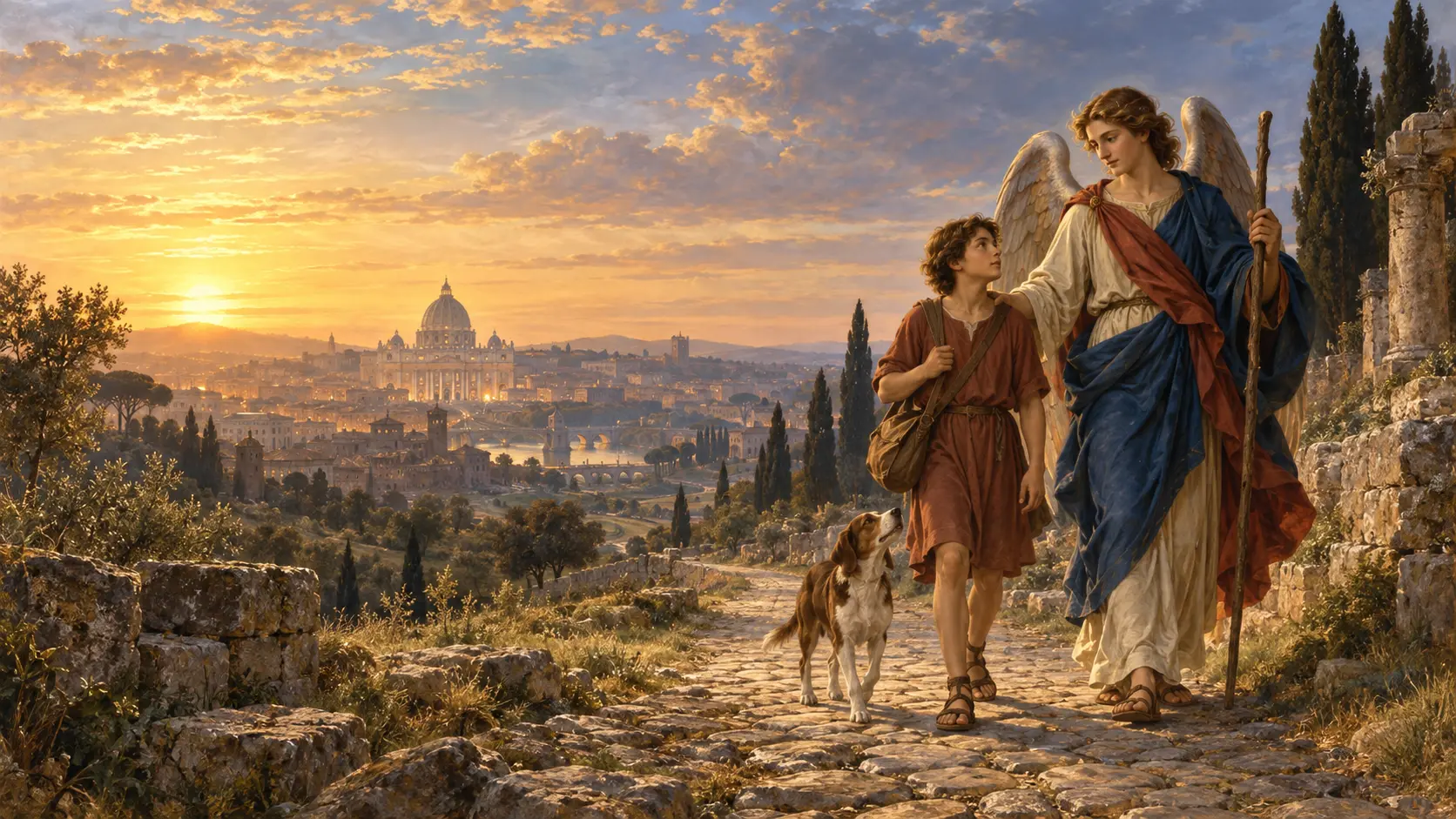
The name Raphael, from the Hebrew Rāfāʾēl, means “God heals” or “God has healed.” The name identifies not an independent power, but a servant through whom God’s healing providence is manifested.
Raphael enters the biblical narrative after two afflicted people have prayed in profound distress. Tobit, a righteous Israelite living in exile, has become blind. Sarah, living far away, has suffered grief and humiliation because the demon Asmodeus has killed each of her seven husbands before the marriage could be consummated. Their prayers rise before God together, although neither household knows the other’s sorrow.
In the Vulgate and Douay-Rheims numbering, Scripture then gives the key to everything that follows: “The holy angel of the Lord, Raphael, was sent to heal them both” (Tobit 3:25). Providence is already at work before either household can perceive it. The answer to prayer has been dispatched, but it approaches in an ordinary and unrecognized form.
This is the first lesson Raphael offers every pilgrim: God’s assistance often precedes our awareness of it.
Saint Raphael, the guide who knows the road
When Tobit sends his son Tobias to Media to recover money entrusted to a relative, Tobias asks how he can make the journey when he does not know the way. He goes out to seek a trustworthy companion and meets Raphael, appearing in the guise of a man called Azarias.
Tobit questions the stranger carefully. Raphael assures him that he knows both the road and the man whom Tobias must visit. The father then entrusts his son to this apparently human guide. His parting blessing expresses the faith underlying every Christian journey: “May you have a good journey, and God be with you in your way, and his angel accompany you” (Tobit 5:21).
The irony is tender and profound. Tobit asks that an angel accompany his son while the angel is already standing before him.
Raphael does not carry Tobias effortlessly to his destination. He accompanies him. Tobias must walk, listen, obey, act courageously and persevere. Catholic devotion to the angels is therefore neither fatalism nor passivity. Angelic assistance works within divine providence to strengthen human prudence and freedom.
Saint Thomas Aquinas explains that God governs creatures through an ordered providence and employs angels in the protection and direction of human beings. Their ministry does not compete with God’s care; it is one of the ways His care reaches us. Aquinas cites Raphael’s mission when explaining how an angel who stands before God may also be sent to minister on earth (Summa Theologiae I, q. 112).
Courage beside the river
During the journey, a great fish suddenly threatens Tobias in the River Tigris. The young man cries out in fear. Raphael answers with a command: take hold of it.
What first appears to be only a danger becomes, under divine direction, an instrument of deliverance and healing. Parts of the fish will later be used in freeing Sarah from the demon and restoring Tobit’s sight. The pilgrim is taught not that danger is imaginary, but that no danger lies outside God’s providence. What frightens us may become, through obedience and grace, part of the remedy.
Pilgrimage always involves vulnerability. One leaves familiar surroundings, ordinary routines and the illusion of control. The road exposes impatience, fear, vanity and self-reliance. For that very reason, pilgrimage can become an ascetical school. Saint John Paul II described it as an exercise in repentance, vigilance, practical asceticism and interior conversion in Incarnationis Mysterium.
Guardian of chastity and Christian marriage
Raphael’s guidance leads Tobias to Sarah. Yet Tobias is understandably afraid when he learns what befell her previous husbands. Raphael directs him away from fear and toward a marriage founded upon prayer, chastity and reverence for God.
Tobias and Sarah pray together before living as husband and wife. Their prayer recalls that marriage was instituted by God and asks for mercy rather than the gratification of disordered desire. Raphael meanwhile binds the demon that had tormented Sarah.
Traditional Catholic devotion therefore invokes Saint Raphael not only for travel and healing but also for courtship, discernment and holy marriage. These aspects of his patronage belong together. The good guide does not merely bring a traveller to a geographical destination; he helps that person recognize and embrace a vocation.

The angel who presents prayer
At the end of the journey, Raphael reveals that he was not simply a capable travelling companion: “I am the angel Raphael, one of the seven, who stand before the Lord” (Tobit 12:15). He also tells Tobit and Sarah that he presented their prayers before God. His ministry is both descending and ascending: he is sent from God with help, and he bears human prayer before God.
Raphael then gives a concise rule of spiritual life: prayer joined to fasting and almsgiving. These are not incidental counsels. They disclose the moral atmosphere of the whole book. Tobit practised mercy toward the poor and buried the dead at great risk. Sarah turned to God in affliction. Tobias learned obedience, courage and chastity. Their pilgrimage bears fruit because it belongs to a life being offered to God.
A pilgrim preparing for Rome should therefore do more than arrange flights, hotels and visits. Preparation should include Confession, prayer, voluntary penance, almsgiving and definite spiritual intentions. Our Catholic pilgrim preparation checklist for Rome can help with both the spiritual and practical details.
Saint Raphael in Catholic liturgy and tradition
The traditional Roman liturgy interprets Saint Raphael through companionship upon the road. The Collect for 24 October asks God, who gave the archangel to Tobias as a companion on his journey, that His servants may always be protected by Raphael’s guardianship and strengthened by his help. The Latin phrase comitem in via is especially beautiful: “a companion on the way.”
Raphael does not replace Christ, who alone is the Way and the final end of every pilgrimage. As a faithful minister of Christ, he assists those travelling toward Him. The traditional Mass takes its Epistle from Tobit 12 and associates Raphael’s healing ministry with the angel at the pool of Bethesda in John 5. This is a venerable liturgical association rather than an explicit identification made by Scripture itself.
The Catechism of the Catholic Church, 328–336, places this devotion within the Church’s wider faith. The existence of angels is a truth of faith; the liturgy joins their worship of God and invokes their assistance; and human life is surrounded by their watchful care and intercession.
Why invoke Saint Raphael before a pilgrimage to Rome?
Rome is not merely an outdoor museum or a collection of famous churches. For the Catholic pilgrim, it is the city sanctified by the blood of Peter and Paul, the witness of innumerable martyrs and the visible centre of communion in the Church.
Saint Raphael’s patronage helps preserve this supernatural purpose. He may fittingly be invoked for protection during the outward and return journeys; prudence in planning; healing of spiritual blindness; worthy reception of the sacraments; chastity, patience and charity among companions; and discernment of the graces God wishes to give.
The happy conclusion of Tobit is not merely that everyone arrives safely. Sight is restored, a household is delivered, a marriage is blessed, prayer is answered, alms are praised and God is publicly thanked. That is the measure of a successful pilgrimage: not how many places were visited, but whether one returns seeing more clearly and loving God more faithfully.
Those discerning an itinerary can compare our Catholic Rome pilgrimage plans for one to four days, learn the tradition of the Seven Pilgrim Churches of Rome, or explore the Four Major Basilicas two-day pilgrimage.
A practical preparation with Saint Raphael
In the days before departure, read one chapter of Tobit each day, giving particular attention to chapters 3–6 and 11–12. On or near 24 October, attend Mass if possible, make a good Confession and perform an act of almsgiving.
- Before booking: ask Raphael for prudence, honest expectations and wise use of money.
- Before departure: entrust every traveller, guide, driver and host to his intercession.
- Each morning in Rome: pray the traditional Collect and name the grace being sought that day.
- During difficulty: ask for patience before asking merely for the inconvenience to disappear.
- At each basilica: imitate Raphael’s command to bless God and proclaim His works.
- After returning: give thanks, record the graces received and decide how the pilgrimage will change ordinary life.
Prayer to Saint Raphael for a pilgrimage to Rome
Saint Raphael the Archangel, faithful companion of Tobias and minister of the healing providence of God, we entrust to your guardianship our pilgrimage to the holy city of Rome.
Go before us upon the way. Protect us from dangers of body and soul. Obtain for us prudence in preparation, patience in difficulty, charity toward our companions and purity of intention.
As you guided Tobias, guide us. As you brought healing to Tobit and Sarah, present our needs before the throne of God. Heal our spiritual blindness, defend us from the snares of the enemy and teach us to recognize the hidden mercies by which divine Providence accompanies us.
Lead us to the tombs of the Apostles with penitent and grateful hearts. May we receive the sacraments worthily, venerate the martyrs devoutly and return home strengthened in faith, more faithful in duty and more ardent in the love of Jesus Christ.
Saint Raphael, medicine of God and companion on the way, pray for us. Amen.
Frequently asked questions about Saint Raphael
Why is Saint Raphael the patron of pilgrims and travellers?
In the Book of Tobit, Raphael accompanies Tobias through an unknown country, protects and instructs him, helps him fulfil his mission and brings him safely home. The Church’s traditional Collect explicitly calls Raphael the companion given to Tobias on the way.
When is the feast of Saint Raphael?
Saint Raphael has a proper feast on 24 October in the traditional Roman calendar. In the modern General Roman Calendar, Saints Michael, Gabriel and Raphael are celebrated together on 29 September.
Is the Book of Tobit part of the Catholic Bible?
Yes. Tobit is a deuterocanonical book received by the Catholic Church as inspired Sacred Scripture. Its account of Raphael provides the biblical foundation for his patronage of travellers, healing and Christian marriage.
Should pilgrims invoke their guardian angel as well?
Yes. Devotion to Saint Raphael complements rather than replaces prayer to one’s guardian angel. Saint Thomas teaches that angelic guardianship belongs to God’s providential care for every human life.
Traditional Catholic sources and further reading
- Sacred Scripture: Tobit 3–6 and 11–12; Psalm 90:11; John 5:1–4; Revelation 8:2–4.
- Saint Thomas Aquinas, Summa Theologiae, I, q. 112, on the missions of the angels.
- Saint Thomas Aquinas, Summa Theologiae, I, q. 113, on angelic guardianship.
- Catechism of the Catholic Church, 328–336.
- James F. Driscoll, “St. Raphael,” The Catholic Encyclopedia.
- Pontifical Council, The Pilgrimage in the Great Jubilee.
The generated illustrations in this article are devotional editorial artwork. They are not claimed to reproduce a historical appearance or a particular miraculous event photographically.
Comments