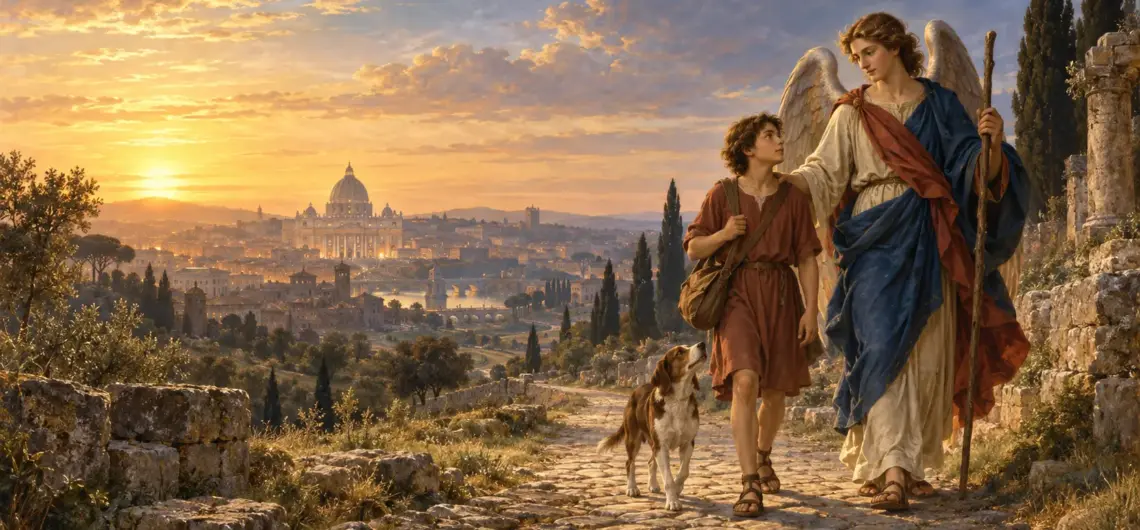
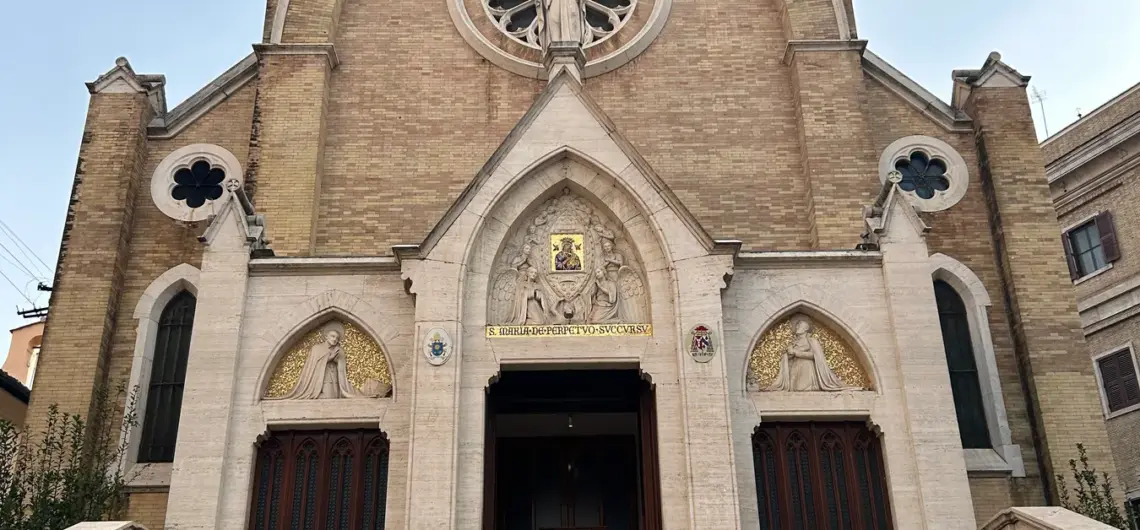
Meet Saint Raphael, heavenly companion of pilgrims, and prepare for a pilgrimage to Rome through Scripture, Catholic tradition and prayer.
Saint Raphael is the heavenly companion of pilgrims: the archangel whom God sent to walk beside Tobias, guard him on an unknown road, guide his decisions, overcome spiritual danger, heal his family and bring him safely home. For Catholics preparing for a pilgrimage to Rome, his mission in the Book of Tobit offers much more than a prayer for trouble-free travel. It reveals how a journey can become an school of providence, conversion and thanksgiving.
His traditional feast is celebrated on 24 October; in the modern Roman calendar he is commemorated with Saints Michael and Gabriel on 29 September. The older October feast is a timely invitation to recover Saint Raphael as patron, guide and intercessor for everyone setting out toward the tombs of the Apostles.
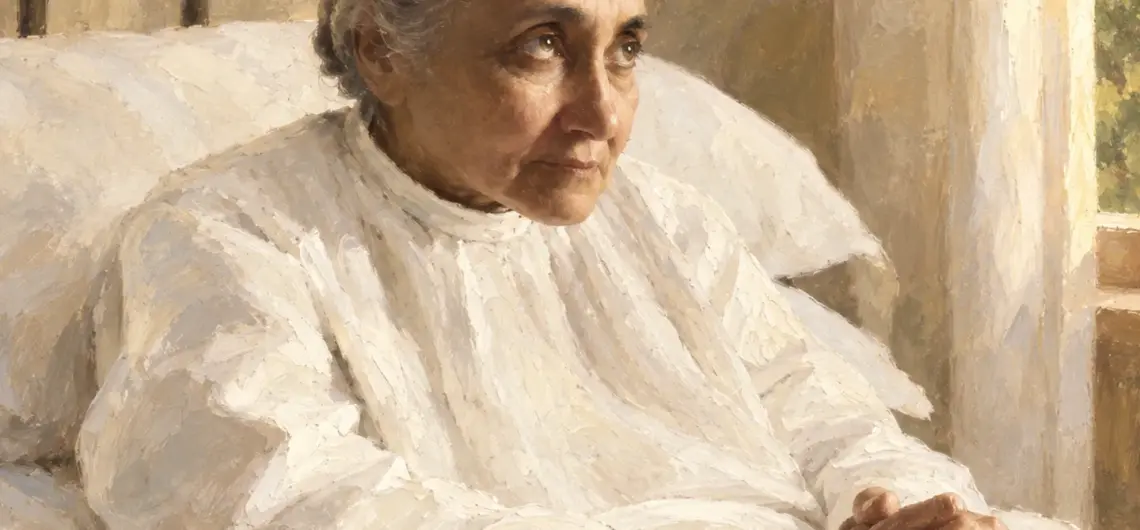
Prepare for Santa Maria Greca and a confirmed Association visit in Corato, with practical advice and a careful explanation of Luisa Piccarreta’s ecclesial status.
Featured image: AI-generated illustration of Servant of God Luisa Piccarreta.
To visit Luisa Piccarreta’s Corato, plan time for Santa Maria Greca, where her remains rest, and contact the Luisa Piccarreta Association in advance about a guided Casa Museo visit. Allowing a morning gives space for historical context, prayer and questions rather than a brief stop at a doorway. Keep any museum appointment separate from general church access, and describe Luisa accurately as a Servant of God whose cause remains in progress.
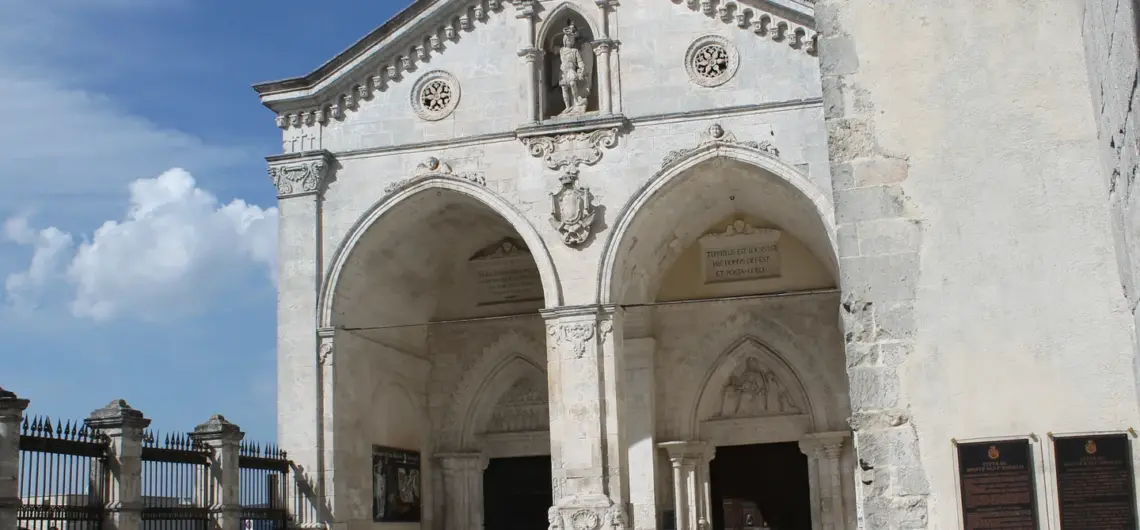
Plan the practical side of a pilgrimage through Monte Sant’Angelo, San Giovanni Rotondo and Corato: route order, venue appointments, travel and overnight arrangements.
Featured photograph: Patrick Nouhailler, CC BY-SA 3.0. Cropped, resized and converted to WebP; the adapted photograph is shared under the same licence.
A Puglia pilgrimage linking St Michael’s sanctuary, Padre Pio and Luisa Piccarreta’s Corato works well over two days when travel is arranged in advance: Monte Sant’Angelo in the first morning, San Giovanni Rotondo that afternoon, and Corato the following morning. Allow an additional arrival night if you cannot comfortably reach the first meeting point. This guide explains the planning decisions behind that sequence, including worship, appointments and the journeys between towns.
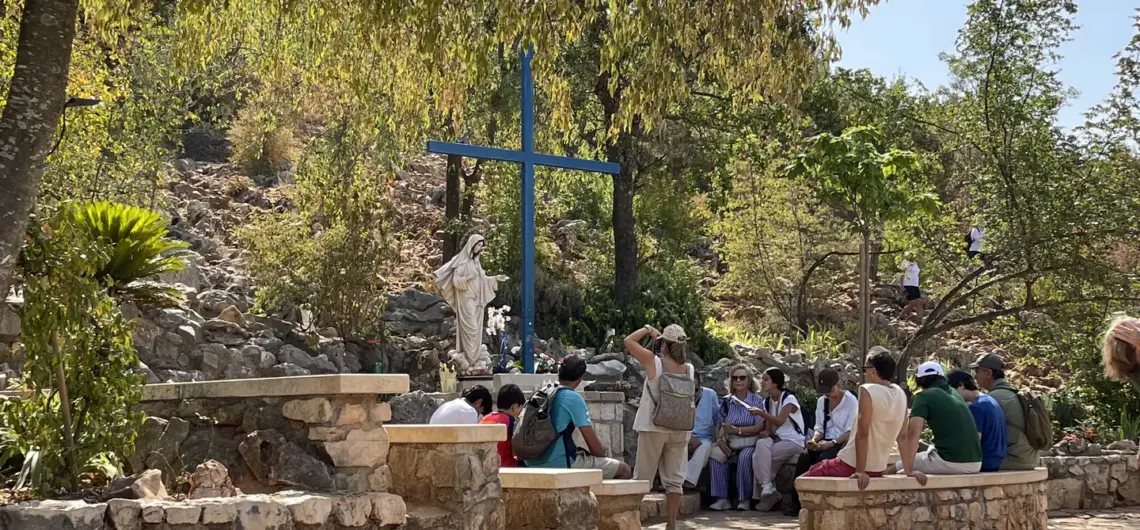
Prepare for Apparition Hill in Medjugorje and the Blue Crosses with a Catholic guide to the Rosary, walking conditions and respectful visiting.
Apparition Hill in Medjugorje, also called Podbrdo, is a place of Rosary prayer, with the Blue Cross prayer area near its foot. Visit with time for reflection and footwear suited to steep, uneven ground. The hill, the Blue Crosses and Cross Mountain are not interchangeable names: understanding the different places will help you choose a visit that matches your intentions and walking ability.
A practical Catholic guide to your first pilgrimage to Medjugorje: preparing spiritually, allowing time for prayer, choosing suitable walks and arranging guided visits.
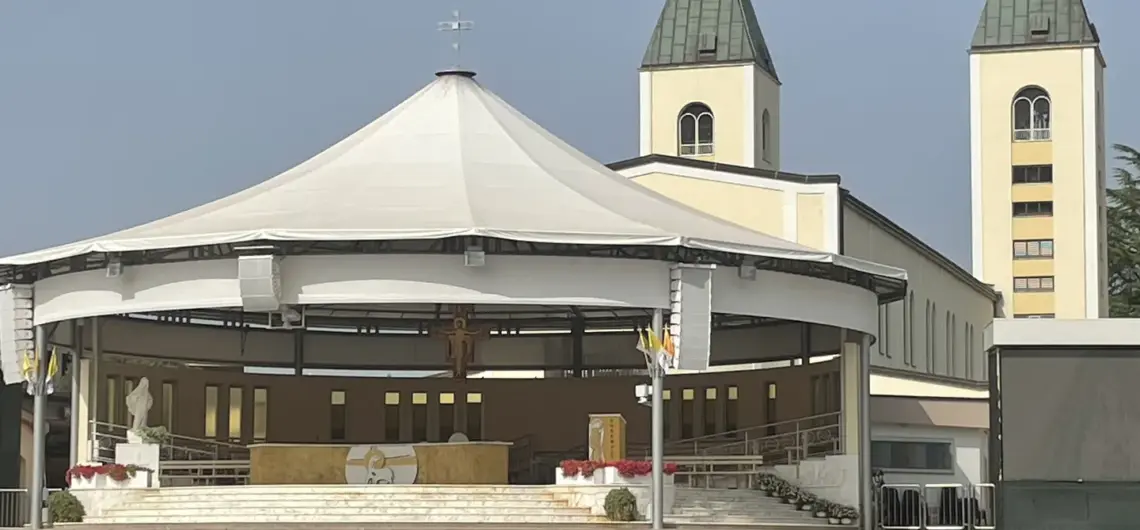
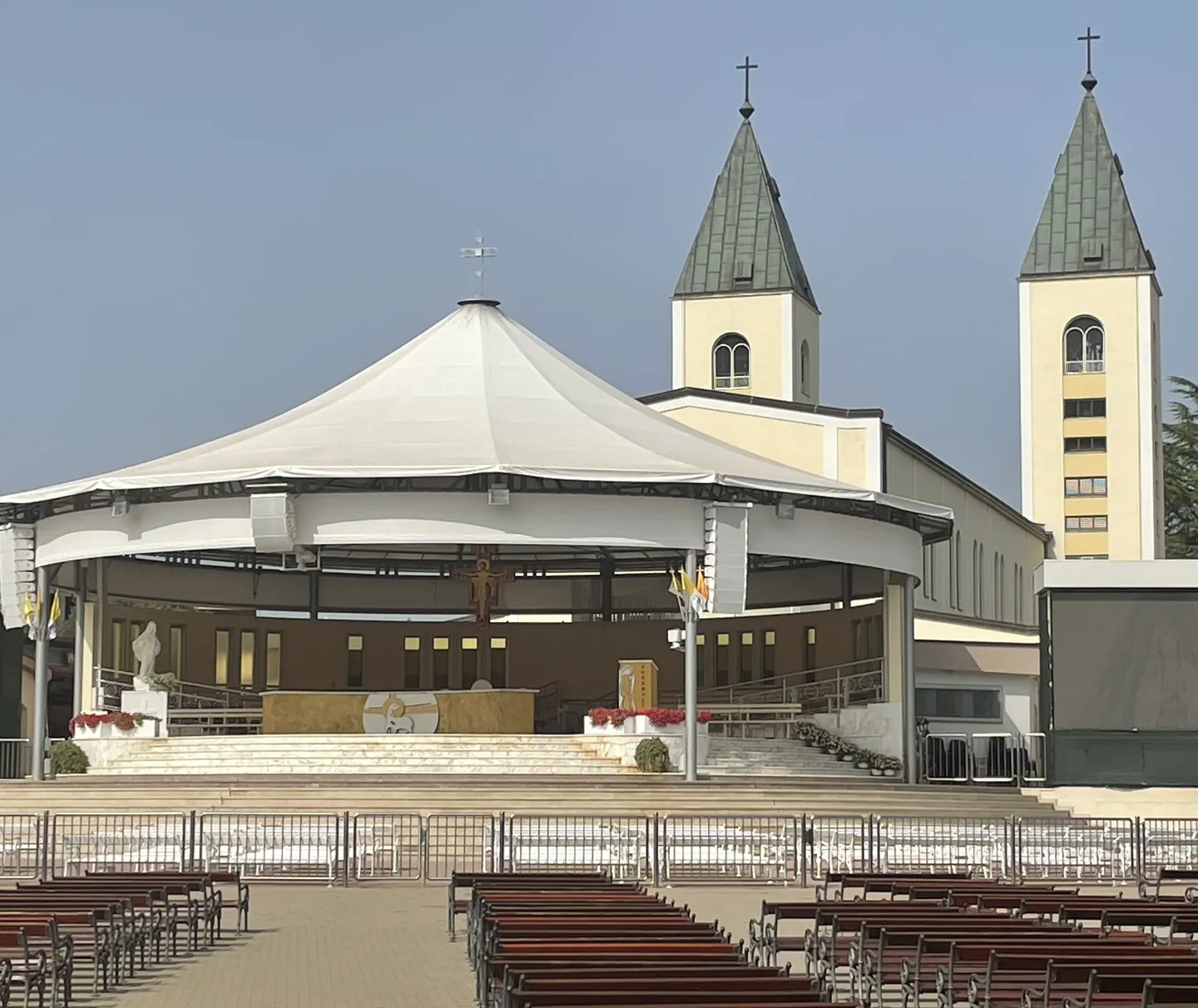
Outdoor altar and church towers of St James’s Church, Medjugorje.
Plan your first pilgrimage to Medjugorje around prayer, realistic walking and enough unhurried time. Begin with the parish of St James, leave room for Mass and personal reflection, and choose hill visits that suit your abilities. Three days provide a useful framework for combining an orientation, Apparition Hill and a visit to Široki Brijeg, with travel days and accommodation arranged around them.
How to see Pope Leo XIV in Rome: compare the Wednesday Papal Audience, Sunday Angelus and Papal Masses; get free official tickets; and discover the first American Pope’s life, Augustinian vocation and Roman connections.
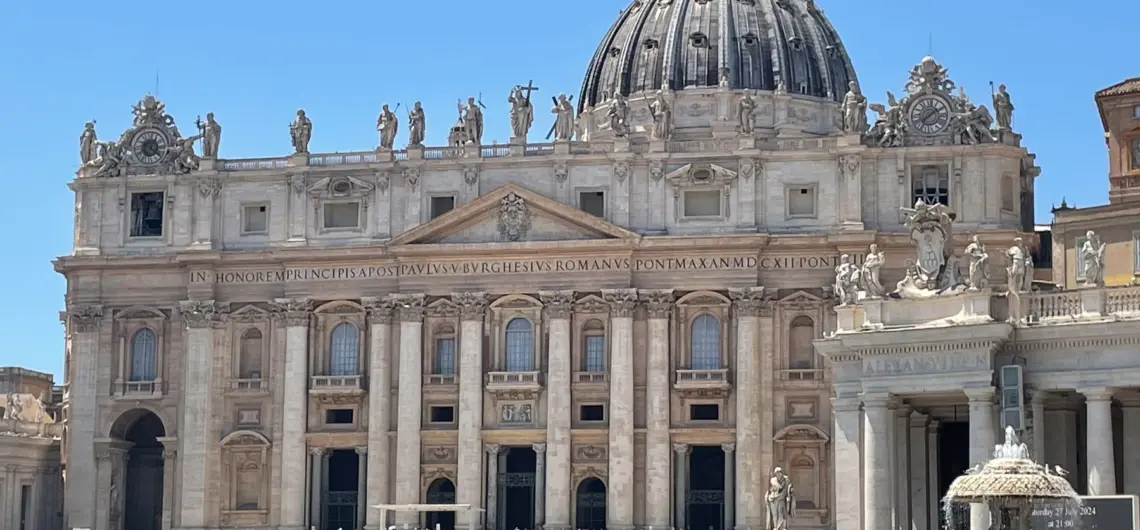
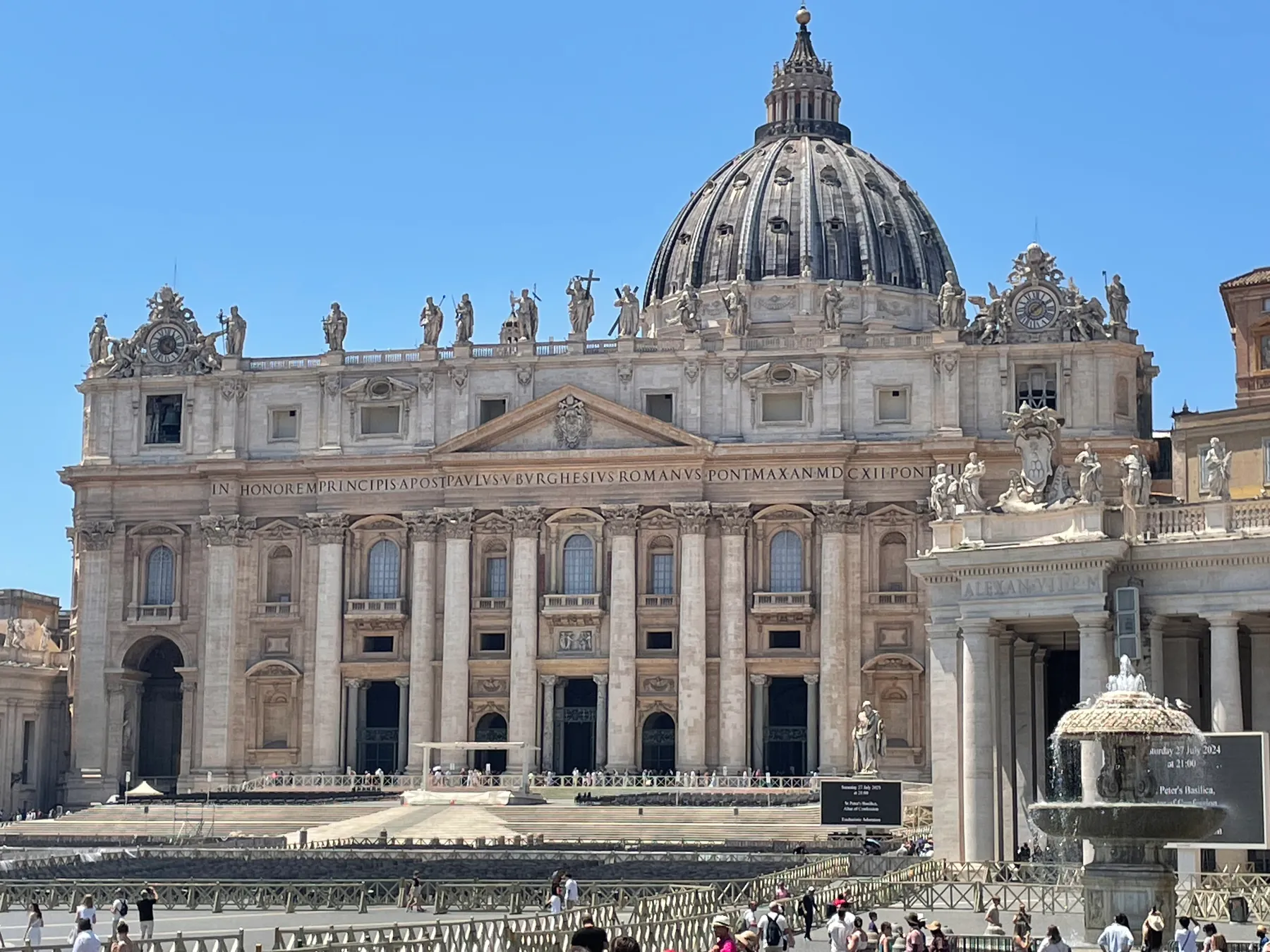
Facade and dome of St Peter’s Basilica seen from St Peter’s Square, Vatican City.
Updated and verified: 24 August 2026 · Official Vatican links and practical details can change, so always recheck the Holy See calendar before travelling.
The two most reliable ways to see Pope Leo XIV in Rome are the Wednesday General Audience and the Sunday Angelus in St Peter’s Square. General Audiences usually require a free ticket; the Sunday Angelus normally does not. Papal Masses and special celebrations offer further opportunities, but dates, venues and ticket arrangements vary.
This Catholic guide explains how to see Pope Leo XIV, how to request official tickets without paying a fee, what each event is really like, and how to plan a visit responsibly. It also introduces Robert Francis Prevost—Chicago-born missionary, Augustinian friar, Bishop of Rome and the first pope from the United States—and the Roman churches that illuminate his office and vocation.
Where are the popes buried? Explore St Peter’s, St John Lateran, St Mary Major, San Clemente, St Sebastian, St Lawrence and Rome’s catacombs in this authoritative Catholic guide.
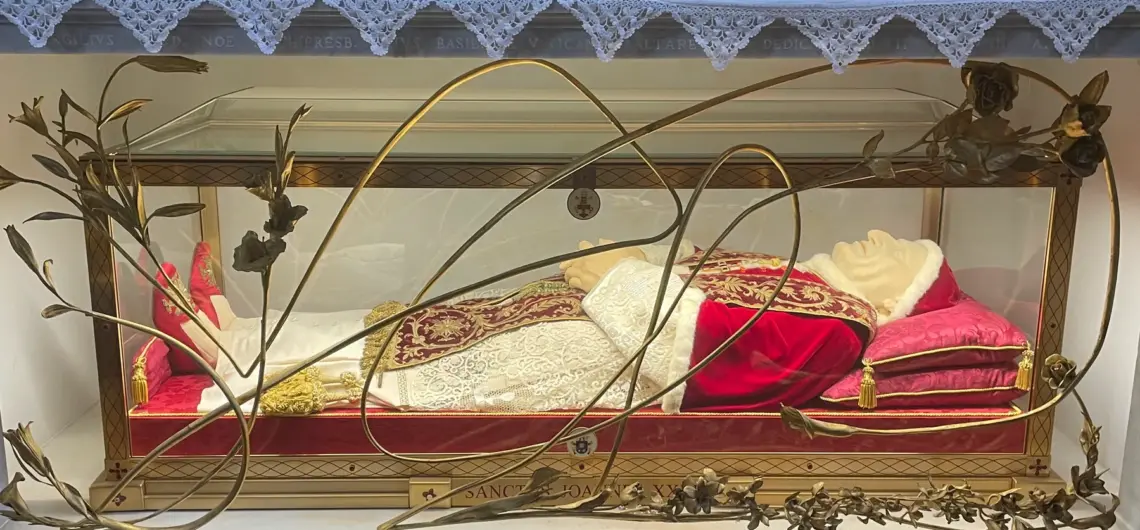
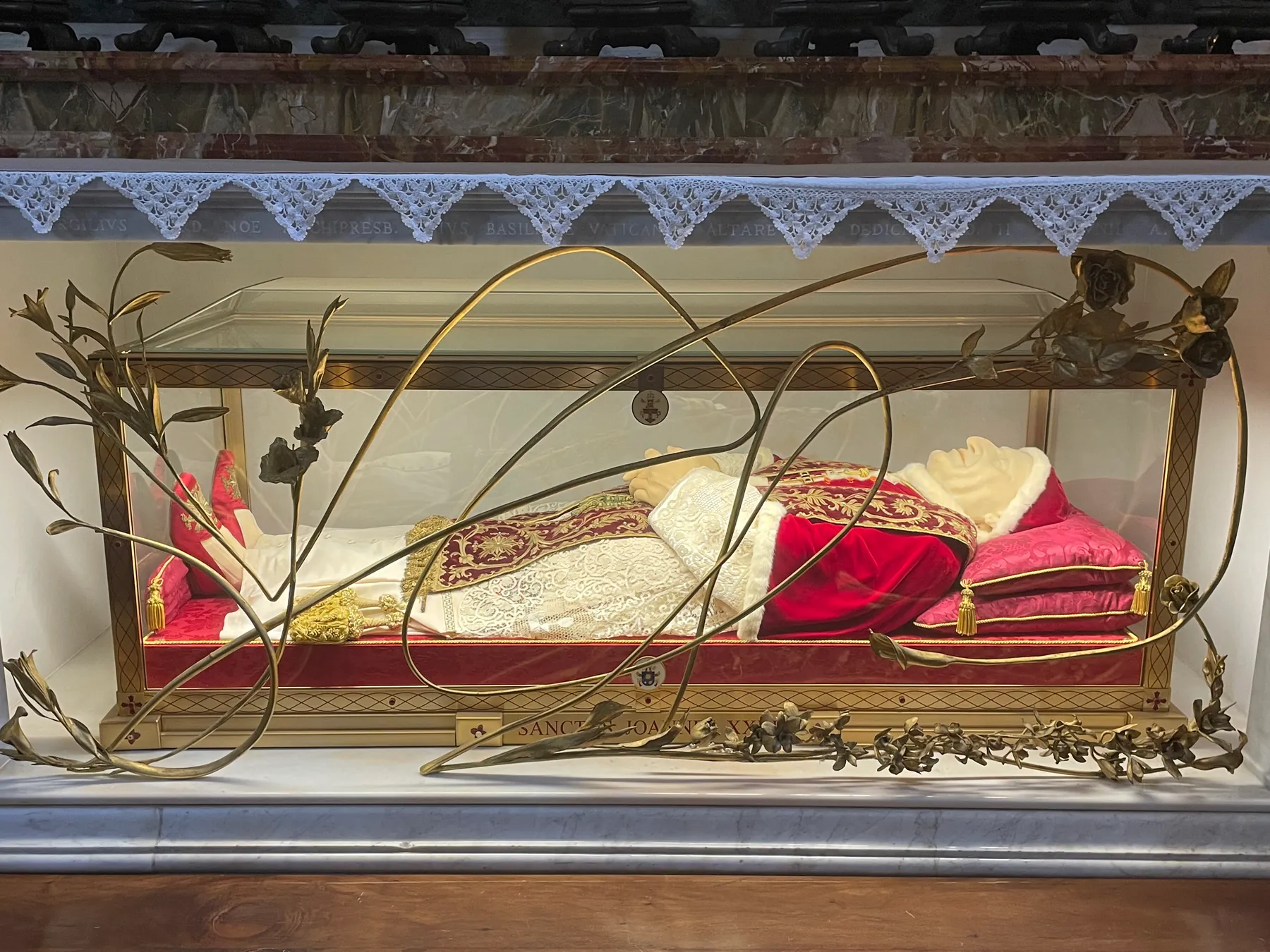
Tomb of Pope Saint John XXIII in St Peter’s Basilica, Vatican City.
Where are the popes buried? Most of the surviving papal tombs are in Rome, above all in St Peter’s Basilica. Yet the burial places of the successors of St Peter form a sacred map extending across the Eternal City—from the Vatican Grottoes to St John Lateran, St Mary Major, St Lawrence Outside the Walls, San Clemente and the ancient catacombs.
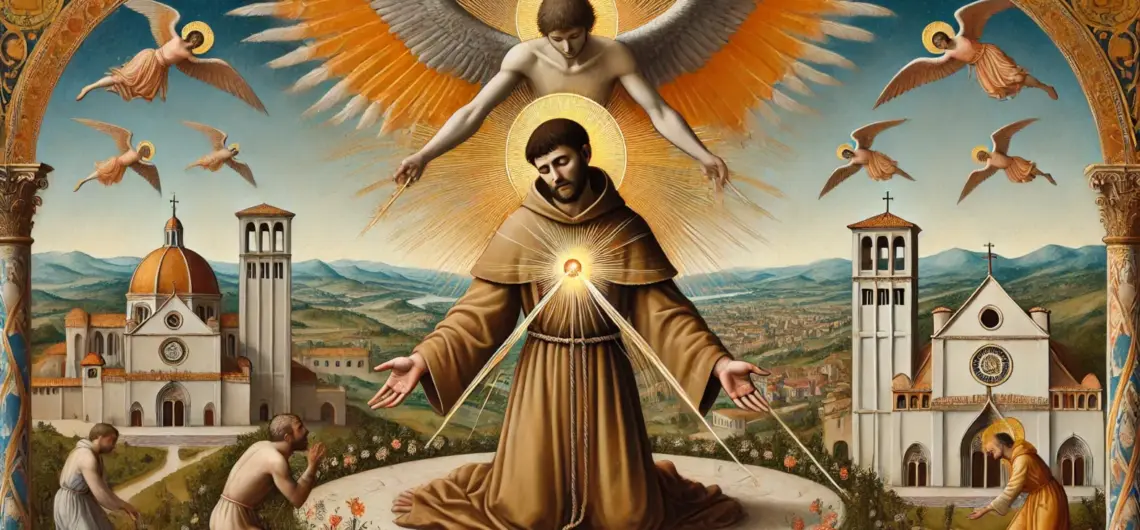
Plan a Catholic pilgrimage to Assisi with this guide to St Francis, St Clare, the principal sacred places and the four Crucis Tours experiences.
Updated 20 August 2026
A Catholic pilgrimage to Assisi brings pilgrims into the city shaped by St Francis, St Clare and centuries of Franciscan prayer. The basilicas, medieval streets, convents and sacred places are not simply reminders of two admired historical figures. They bear witness to lives transformed by Jesus Christ and to a Catholic vocation of poverty, penance, charity and fidelity to the Gospel.
Assisi can be encountered in one focused hour, several hours or a full day. The right choice depends upon whether the principal desire is to pray at the tomb of St Francis, understand the city connected with Francis and Clare, or make a fuller Catholic pilgrimage through the places that formed their lives.
Discover the four Major Basilicas of Rome—St Peter’s, St John Lateran, St Mary Major and St Paul Outside the Walls—and learn how to visit them as a Catholic pilgrim.
Facade and dome of St Peter’s Basilica seen from St Peter’s Square, Vatican City.
Updated 20 August 2026
The four Major Basilicas of Rome are St Peter’s Basilica, the Archbasilica of St John Lateran, St Mary Major and St Paul Outside the Walls. Together they stand at the heart of Catholic Rome, joining the tombs of the Apostles, the Cathedral of the Pope, the Church’s devotion to Our Lady and the living pilgrimage tradition of the Eternal City.
For Catholic pilgrims, these are not simply four famous churches to place on a sightseeing list. Each basilica expresses a distinct part of the Church’s history and identity. Visiting all four creates a coherent pilgrimage through apostolic memory, sacred relics, Catholic worship, mosaics, architecture and the continuity of the Church in Rome.
Facade and dome of St Peter’s Basilica seen from St Peter’s Square, Vatican City. A Catholic pilgrimage to Rome begins before you arrive in the Eternal City. Prayerful preparation, realistic planning and a clear understanding of what you hope to encounter will help you receive Rome as a place of apostles, martyrs, basilicas, relics and living Catholic worship. This Catholic Rome checklist covers spiritual preparation, packing, church etiquette, mobility and tour choices. It provides practical value without turning pilgrimage into a hurried route plan or revealing the interpretative work properly reserved for your Catholic guide. Download the Catholic Rome Pilgrim Planner Print the free three-page Catholic Rome Pilgrim Planner and use it for your intentions, packing, church etiquette, tour choices and pilgrimage notes. Download the Catholic Rome Pilgrim Planner 1. Begin with a pilgrimage intention Rome can overwhelm even experienced travellers. The city contains more churches, saints, relics and works of sacred art than anyone can encounter properly in one visit. A written intention helps prevent the pilgrimage from becoming a collection of photographs and exhausted memories. Write down the people and intentions you will carry to Rome.Identify the saints, mysteries or periods of Church history that draw you most.Decide whether Mass, Confession, Adoration or private prayer should shape particular days.Ask for the grace to accept necessary changes with patience. A pilgrimage intention does not require a rigid timetable. It gives spiritual unity to the days while leaving room for the life of the Church and the needs of the people travelling with you. 2. Choose packages or individual Catholic tours A pilgrimage package is appropriate when you want a coherent Catholic programme across several days. Individual tours work better when you have a particular interest, limited time or an existing Rome itinerary to which you want to add Catholic
Facade and dome of St Peter’s Basilica seen from St Peter’s Square, Vatican City.
A Catholic pilgrimage to Rome begins before you arrive in the Eternal City. Prayerful preparation, realistic planning and a clear understanding of what you hope to encounter will help you receive Rome as a place of apostles, martyrs, basilicas, relics and living Catholic worship.
This Catholic Rome checklist covers spiritual preparation, packing, church etiquette, mobility and tour choices. It provides practical value without turning pilgrimage into a hurried route plan or revealing the interpretative work properly reserved for your Catholic guide.
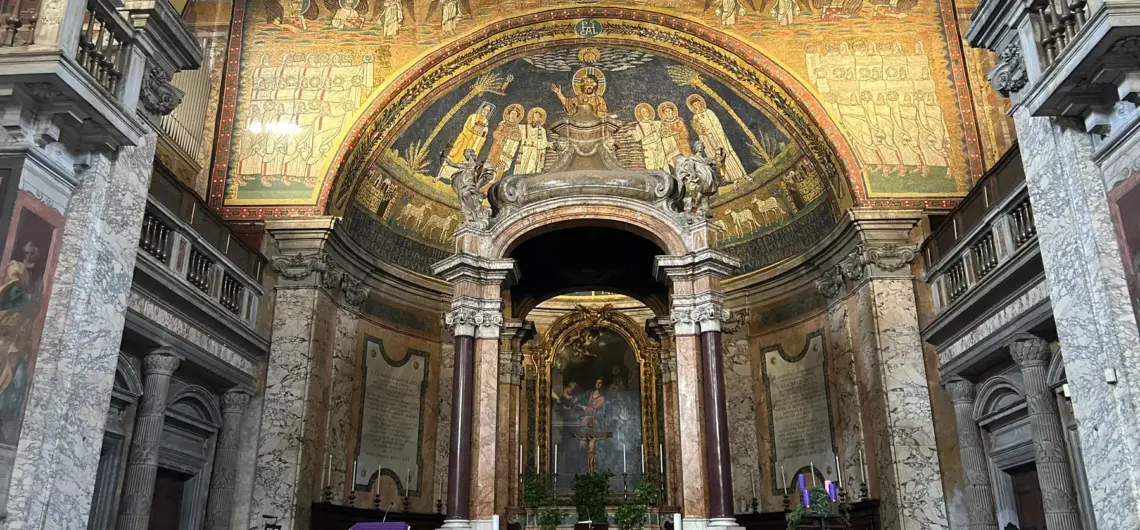
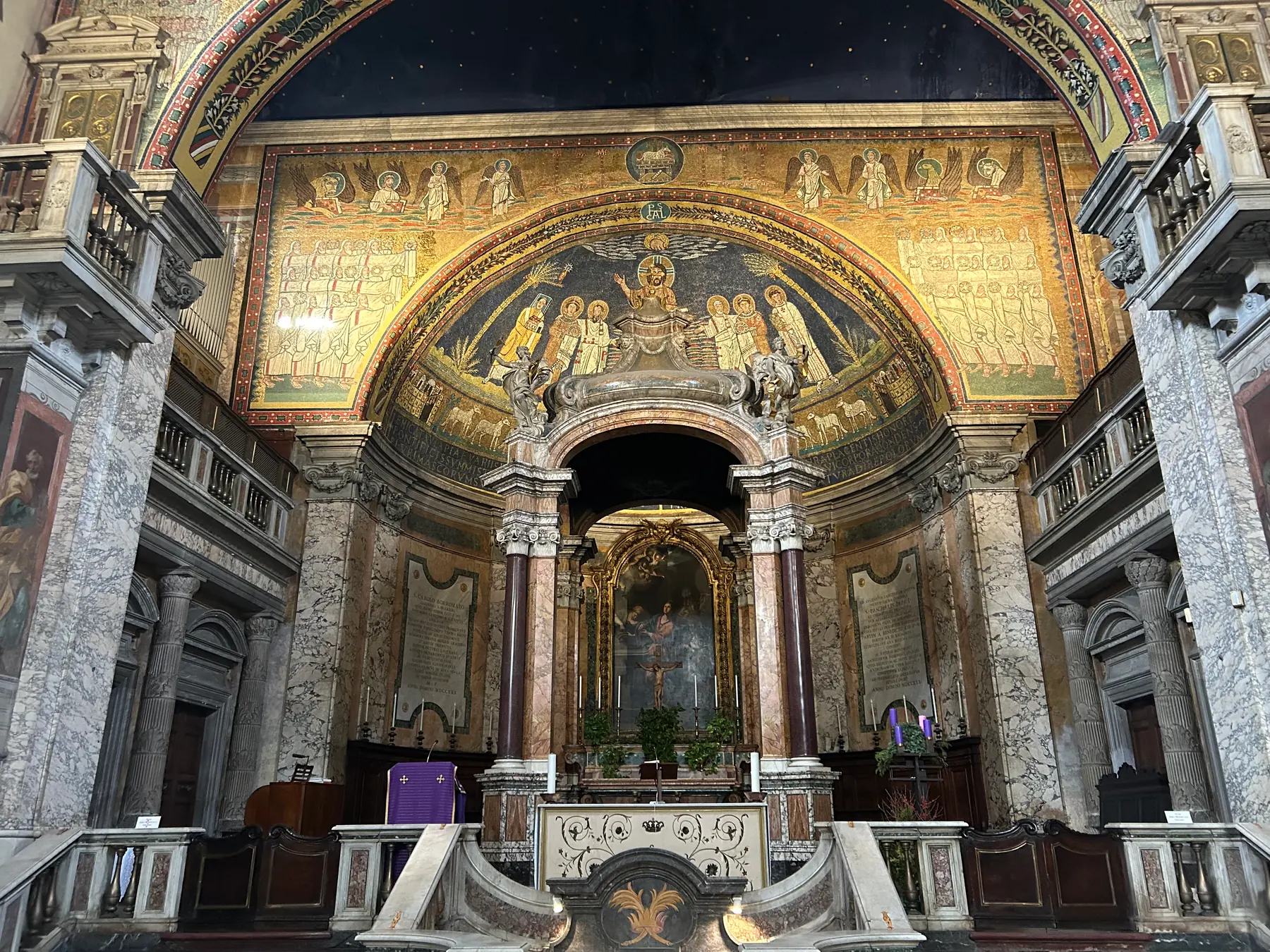
Apse mosaics and high altar of Santa Prassede, Rome. Choosing among Catholic church tours in Rome becomes much easier once you decide what kind of pilgrimage you want to make. Rome offers papal basilicas, relics associated with Christ and the apostles, early Christian sites, underground archaeology, martyrs, saints and sacred art. No single tour can explore all of these well. This guide compares Crucis Tours products transparently by pilgrimage purpose. It is not a supposedly neutral ranking: the best Catholic tour in Rome is the one that fits your spiritual interests, available time and mobility. Start with the purpose of your pilgrimage Some pilgrims arrive in Rome wanting to encounter the four great papal basilicas. Others are drawn particularly to the Passion of Christ, the witness of St Peter and St Paul, the age of persecution, the catacombs or the development of Catholic sacred art. A family making its first visit may need a different experience from a parish group returning for a second or third pilgrimage. Begin by asking what you most want to understand and pray with. That answer is more useful than looking for a generic list of the “top” churches. Pilgrimage interestCrucis tour to considerWhy it fitsA first Catholic pilgrimage4 Major Basilicas in 1 DayBrings together Rome’s four Major Basilicas in one coherent Catholic experience.Relics of Christ and the PassionVia Crucis – Relics of Christ TourFollows the Incarnation and Passion through six sacred sites and Rome’s principal relic traditions.St Peter, St Paul and martyrdomSts Peter & Paul in Chains TourConcentrates upon the apostles, their chains and Roman martyrdom traditions.The earliest centuries of the ChurchEarly Christianity Tour RomeExplores the movement from the Apostolic Age and underground Church to public Christian Rome.Christian Rome undergroundSt Clement’s Basilica – Apostolic Rome Underground TourDescends through the successive religious and historical levels
Apse mosaics and high altar of Santa Prassede, Rome.
Choosing among Catholic church tours in Rome becomes much easier once you decide what kind of pilgrimage you want to make. Rome offers papal basilicas, relics associated with Christ and the apostles, early Christian sites, underground archaeology, martyrs, saints and sacred art. No single tour can explore all of these well.
This guide compares Crucis Tours products transparently by pilgrimage purpose. It is not a supposedly neutral ranking: the best Catholic tour in Rome is the one that fits your spiritual interests, available time and mobility.
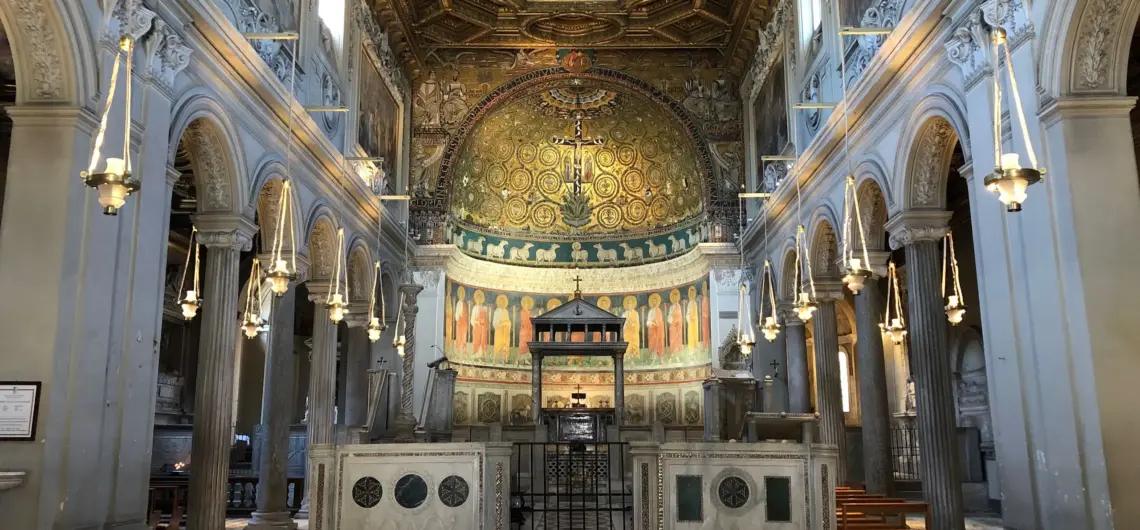
Updated 20 August 2026 San Clemente in Rome is one of the clearest places in the city to encounter the continuity of Catholic history. Near the Colosseum, a twelfth-century basilica stands above a fourth-century church and first-century Roman buildings. Descending through the complex is therefore not simply an archaeological experience: it is a journey from imperial Rome, through the age of the early Church, into the public and enduring worship of Catholic Rome. The Basilica of St Clement matters because its layers bring together apostolic memory, persecution, pagan Rome, Christian freedom, sacred art and the veneration of saints. Few churches allow pilgrims to see so vividly how the Catholic faith took root in Rome and remained present through the centuries. Explore San Clemente with an expert Catholic guide on the St Clement’s Basilica Underground Tour. San Clemente Rome: key facts QuestionAnswerWhere is San Clemente?About five minutes on foot from the Colosseum, on the road towards St John LateranWho is the basilica dedicated to?Pope St Clement I, an early successor of St PeterWhat are its principal levels?The present twelfth-century basilica, a fourth-century basilica and first-century Roman buildingsWhy is it important to Catholic history?It preserves evidence of Christian worship, sacred art and devotion across many centuriesWhich saints are especially connected with it?St Clement, St Ignatius of Antioch and St CyrilWho rediscovered the buried basilica?The Irish Dominican Fr Joseph Mullooly began the excavations in 1857 Who was Pope St Clement? The basilica takes its name from Pope St Clement I, traditionally counted among the earliest successors of St Peter. He lived close to the Apostolic Age and is remembered as one of the Apostolic Fathers: Christian writers whose lives and teaching form a bridge between the Apostles and the generations that followed them. That connection gives San Clemente a significance deeper than its
Updated 20 August 2026
San Clemente in Rome is one of the clearest places in the city to encounter the continuity of Catholic history. Near the Colosseum, a twelfth-century basilica stands above a fourth-century church and first-century Roman buildings. Descending through the complex is therefore not simply an archaeological experience: it is a journey from imperial Rome, through the age of the early Church, into the public and enduring worship of Catholic Rome.
The Basilica of St Clement matters because its layers bring together apostolic memory, persecution, pagan Rome, Christian freedom, sacred art and the veneration of saints. Few churches allow pilgrims to see so vividly how the Catholic faith took root in Rome and remained present through the centuries.
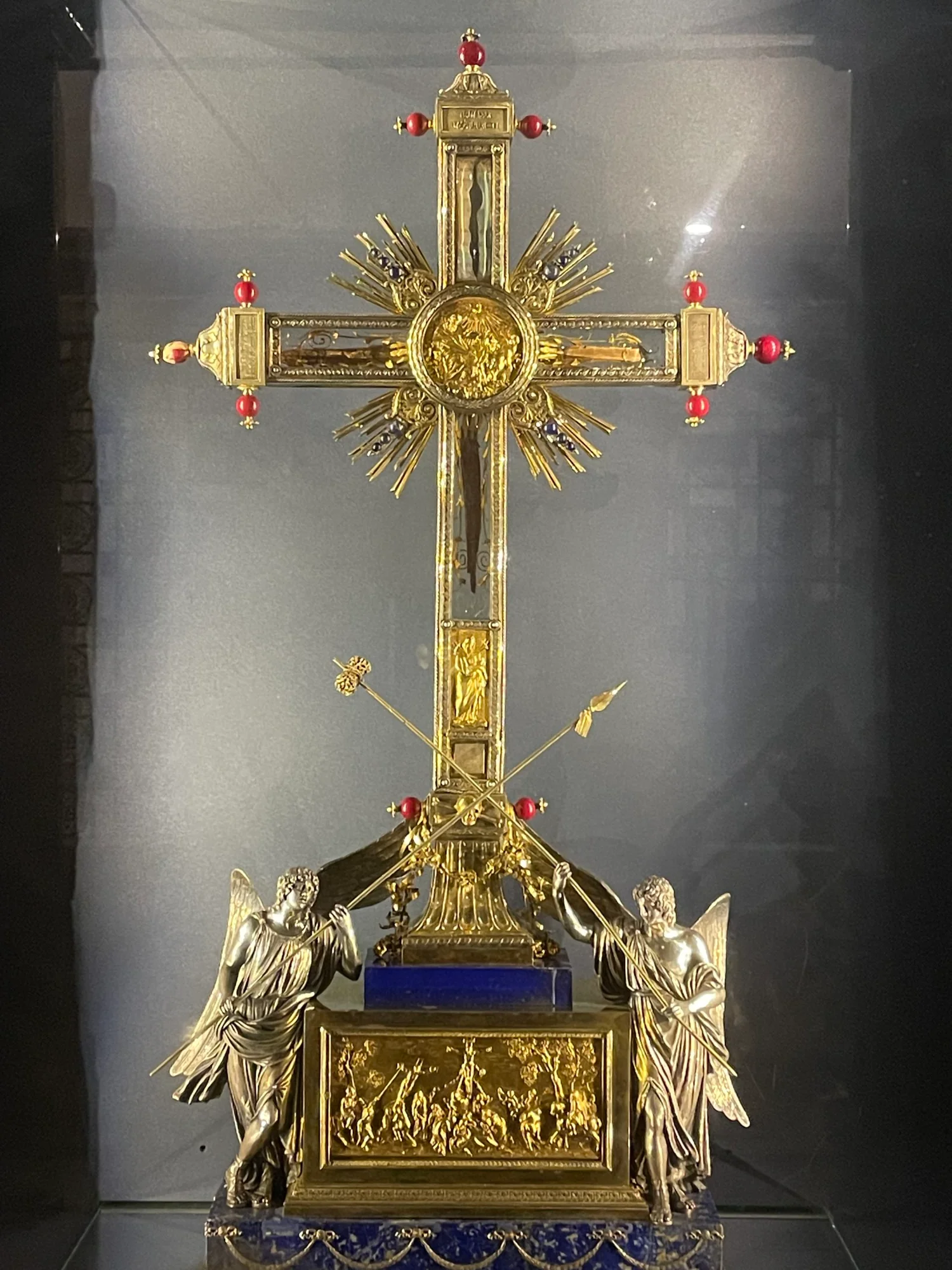
Cross-shaped reliquary with angels at Santa Croce in Gerusalemme, Rome. The Instruments of the Passion are the objects associated with the suffering and Crucifixion of Jesus Christ. They include the Cross, Crown of Thorns, nails, column and scourges, Holy Lance, sponge, seamless garment, dice, ladder, pincers and the inscription placed above Christ. In Catholic art they are also known as the Arma Christi—the “arms” or weapons of Christ. The paradox is deliberate: instruments used to humiliate and kill Him became signs of His victory over sin and death. Which objects are Instruments of the Passion? The precise selection varies between artworks and devotional traditions. The most frequently represented include: the Cross; the Crown of Thorns; the nails; the column and scourges of the Flagellation; the lance that pierced Christ’s side; the sponge raised to His lips; the seamless garment and the dice used to cast lots; the ladder used at the Deposition; the hammer and pincers; the Titulus bearing the charge against Him. Other symbols may refer to the betrayal, arrest, trial, mocking or burial of Christ. Why call them the “Arma Christi”? The Latin expression presents the Passion as Christ’s triumph. The objects appear to belong to His enemies, but through His voluntary sacrifice they become the insignia of the victorious King. This reversal is central to Christian faith. The Cross, once a sign of shame, becomes the sign of salvation. The wounds of the risen Christ are not erased; they reveal the identity of the One who conquered through love. The Instruments of the Passion in Catholic art Medieval and Baroque artists used the instruments to compress the entire Passion into a single image. A viewer who recognised them could move mentally from the betrayal and trial to Calvary and the tomb. They appear around crucifixes, in angels’
Cross-shaped reliquary with angels at Santa Croce in Gerusalemme, Rome.
The Instruments of the Passion are the objects associated with the suffering and Crucifixion of Jesus Christ. They include the Cross, Crown of Thorns, nails, column and scourges, Holy Lance, sponge, seamless garment, dice, ladder, pincers and the inscription placed above Christ.
In Catholic art they are also known as the Arma Christi—the “arms” or weapons of Christ. The paradox is deliberate: instruments used to humiliate and kill Him became signs of His victory over sin and death.
Cross-shaped reliquary with angels at Santa Croce in Gerusalemme, Rome. Major relics associated with Jesus Christ are preserved in Rome, Turin, Oviedo, Paris, Trier, Valencia and other historic Christian centres. They include objects traditionally connected with the Nativity, Last Supper, Passion and burial of Christ. No single location contains every tradition. Rome is exceptional because several relics associated with different moments of Christ’s life can be encountered within one Catholic pilgrimage. Why are there few bodily relics of Christ? Catholics believe that Jesus rose bodily from the dead and ascended into Heaven. Relics associated with Him are therefore principally objects He touched or objects connected with His life, suffering and burial. These are sometimes called relics of the Passion or Instruments of the Passion when they relate specifically to His suffering and Crucifixion. Rome: relics from the Crib to the Cross Sacred Crib reliquary beneath the high altar of St Mary Major, Rome. Rome preserves traditions associated with the Holy Crib at St Mary Major, the Column of the Flagellation at Santa Prassede, the Holy Stairs, the True Cross and other Passion relics at Santa Croce, the Holy Lance and Veronica’s Veil at St Peter’s, the Holy Sponge and the Quo Vadis footprints. This concentration reflects Rome’s role as the centre of the Western Church and its long history as a destination for pilgrims. Read the complete Crucis introduction to the relics of Jesus Christ in Rome. The Shroud of Turin The Shroud of Turin is a linen cloth bearing the faint image of a crucified man. It is venerated as the burial shroud of Christ, and scientific examination has repeatedly drawn attention to its remarkable image and correspondence with the wounds of the Crucifixion. The Catholic Church honours the Shroud as a powerful witness to the wounds and burial
Cross-shaped reliquary with angels at Santa Croce in Gerusalemme, Rome.
Major relics associated with Jesus Christ are preserved in Rome, Turin, Oviedo, Paris, Trier, Valencia and other historic Christian centres. They include objects traditionally connected with the Nativity, Last Supper, Passion and burial of Christ.
No single location contains every tradition. Rome is exceptional because several relics associated with different moments of Christ’s life can be encountered within one Catholic pilgrimage.
Cross-shaped reliquary with angels at Santa Croce in Gerusalemme, Rome. Catholic relics are authentic witnesses to the Incarnation, the Passion of Christ and the holy lives of the saints. The Church has preserved them through continuous custody, ancient tradition, ecclesiastical seals, reliquaries and public veneration. Catholics honour relics because they direct the believer towards Christ and the saints. What is a Catholic relic? A relic is a physical object associated with a saint or with the life and Passion of Christ. Traditionally, relics are classified according to whether they are bodily remains, objects used by the holy person, or objects brought into contact with another relic. Relics arise from the Catholic conviction that God works through the material world. Christianity is founded upon the Incarnation: the Word became flesh. Matter is therefore capable of serving as a sign and instrument of grace. Is relic veneration biblical? Scripture includes occasions when God works through physical objects associated with holy people. The bones of Elisha, the hem of Christ’s garment and cloths associated with St Paul all appear within biblical accounts of healing or divine power. Catholics do not understand the object as possessing independent magical power. God is the source of grace; the relic bears witness to His work in a human life. Does the Church worship relics? No. Adoration belongs to God alone. Catholic theology distinguishes the worship owed to God from the honour shown to saints and the respectful veneration given to their relics. When Catholics kneel before a relic of the Cross, their devotion is directed to Jesus Christ and His saving Passion. The material sign helps focus memory, prayer and gratitude. How are relics authenticated? The Church authenticates relics through written records, seals, reliquaries, ecclesiastical documentation and continuity of custody. Scientific analysis can further establish the age,
Cross-shaped reliquary with angels at Santa Croce in Gerusalemme, Rome.
Catholic relics are authentic witnesses to the Incarnation, the Passion of Christ and the holy lives of the saints. The Church has preserved them through continuous custody, ancient tradition, ecclesiastical seals, reliquaries and public veneration. Catholics honour relics because they direct the believer towards Christ and the saints.
Cross-shaped reliquary with angels at Santa Croce in Gerusalemme, Rome. St Helena and the True Cross belong at the heart of Catholic pilgrimage history. The mother of Emperor Constantine discovered the Cross of Christ during her pilgrimage to Jerusalem in the fourth century. Her story links the Holy Land with Rome and lies behind several of the Eternal City’s most important relic traditions. For a wider overview of the sacred objects and churches, see our guide to the relics of Jesus Christ in Rome. Who was St Helena? Helena rose from relatively obscure origins to become the mother of Constantine the Great. After Constantine gained imperial power, she received the title Augusta and used her position to support Christian worship and charitable works. Ancient Christian authors remembered her for her piety and for a journey to the Holy Land late in life. She is honoured as a saint in both the Catholic and Orthodox Churches. Constantine and the transformation of Christian Rome Constantine’s reign marked a decisive change in the public position of Christianity. After periods of persecution, Christians could worship legally and build monumental churches. In Rome and Jerusalem, imperial patronage created basilicas at places associated with the apostles and with the life of Christ. This did not make the empire instantly or uniformly Christian, but it changed the physical visibility of the Church. Helena’s pilgrimage to Jerusalem Helena travelled through the Holy Land during the period in which the site of Christ’s tomb was uncovered and the Church of the Holy Sepulchre was established. The Church’s ancient accounts honour Helena’s pilgrimage, her building of churches and her discovery of the True Cross. Fourth- and fifth-century Christian writers preserved and developed the record of these sacred events for succeeding generations. Catholic tradition receives this testimony with gratitude. Helena’s pilgrimage
Cross-shaped reliquary with angels at Santa Croce in Gerusalemme, Rome.
St Helena and the True Cross belong at the heart of Catholic pilgrimage history. The mother of Emperor Constantine discovered the Cross of Christ during her pilgrimage to Jerusalem in the fourth century. Her story links the Holy Land with Rome and lies behind several of the Eternal City’s most important relic traditions. For a wider overview of the sacred objects and churches, see our guide to the relics of Jesus Christ in Rome.
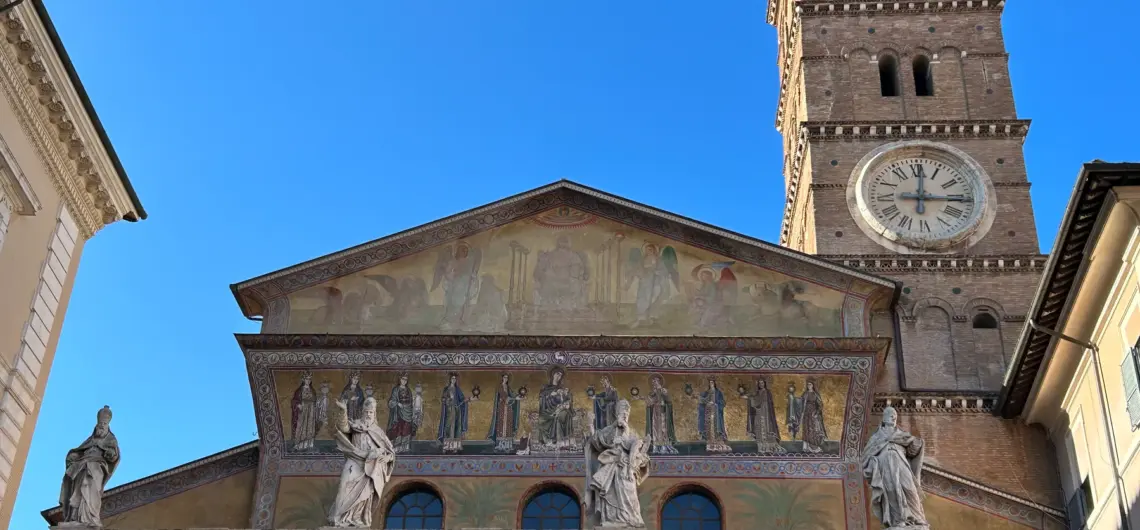
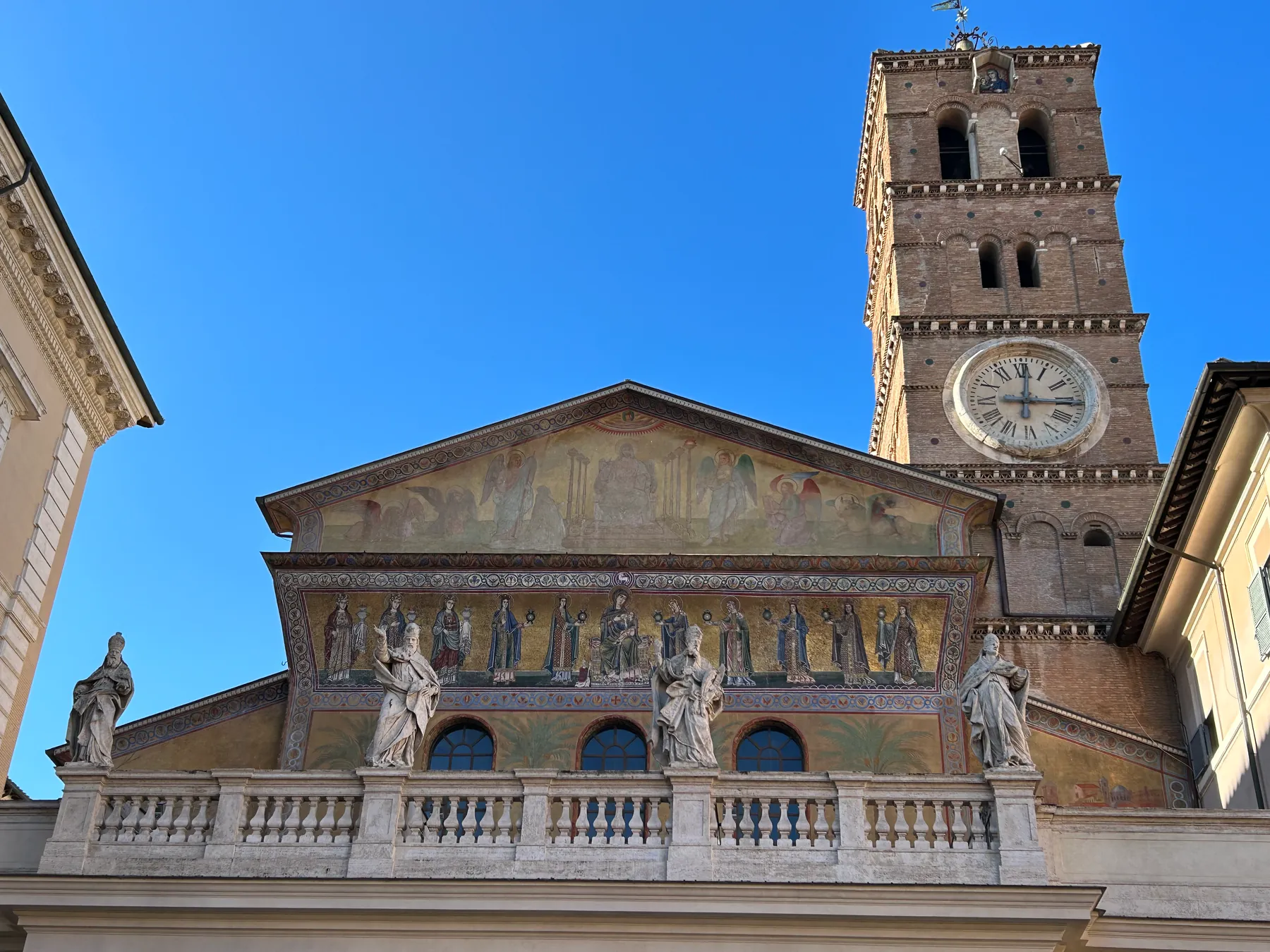
Facade mosaics and bell tower of Santa Maria in Trastevere, Rome. The Holy Sponge at Santa Maria in Trastevere is a sacred fragment of the sponge raised to the lips of Jesus during the Crucifixion. Preserved within one of Rome’s most ancient Marian basilicas, the relic connects this luminous church with the final moments of Christ’s Passion. What was the Holy Sponge? All four Gospels refer to Christ being offered wine during the Crucifixion. St John records that a sponge was filled with sour wine, placed upon hyssop and raised to His mouth. The episode belongs to the fulfilment of Christ’s sacrifice. After receiving the wine, Jesus declared, “It is finished”, bowed His head and gave up His spirit. Where is the Holy Sponge today? Fragments of the Holy Sponge have been venerated in the Church for centuries. Rome preserves this sacred tradition at Santa Maria in Trastevere, where the relic bears witness to the fulfilment of the Gospel account and the physical reality of Christ’s sacrifice. The Church’s careful preservation and veneration of the fragment carried the memory of the Holy Sponge across generations of Roman Catholics. Its devotional purpose is clear: to direct the pilgrim towards the Passion narrated in Scripture and towards the thirst endured by Christ for the salvation of souls. Why Santa Maria in Trastevere? Apse mosaics and ciborium of Santa Maria in Trastevere, Rome. Santa Maria in Trastevere is among Rome’s oldest churches dedicated to the Blessed Virgin Mary. Its celebrated mosaics, ancient fabric and long liturgical life make it one of the most beautiful Catholic settings in the city. The Holy Sponge tradition is easily missed amid the brilliance of the apse. Yet that contrast is spiritually suggestive: the humiliation of Calvary is contemplated within a church radiant with the glory of Christ
Facade mosaics and bell tower of Santa Maria in Trastevere, Rome.
The Holy Sponge at Santa Maria in Trastevere is a sacred fragment of the sponge raised to the lips of Jesus during the Crucifixion. Preserved within one of Rome’s most ancient Marian basilicas, the relic connects this luminous church with the final moments of Christ’s Passion.
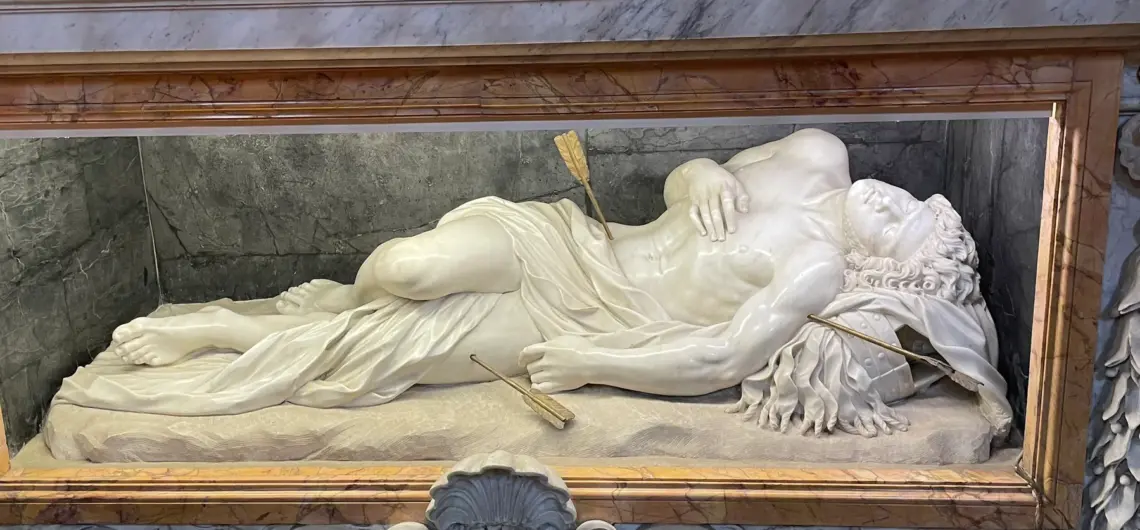
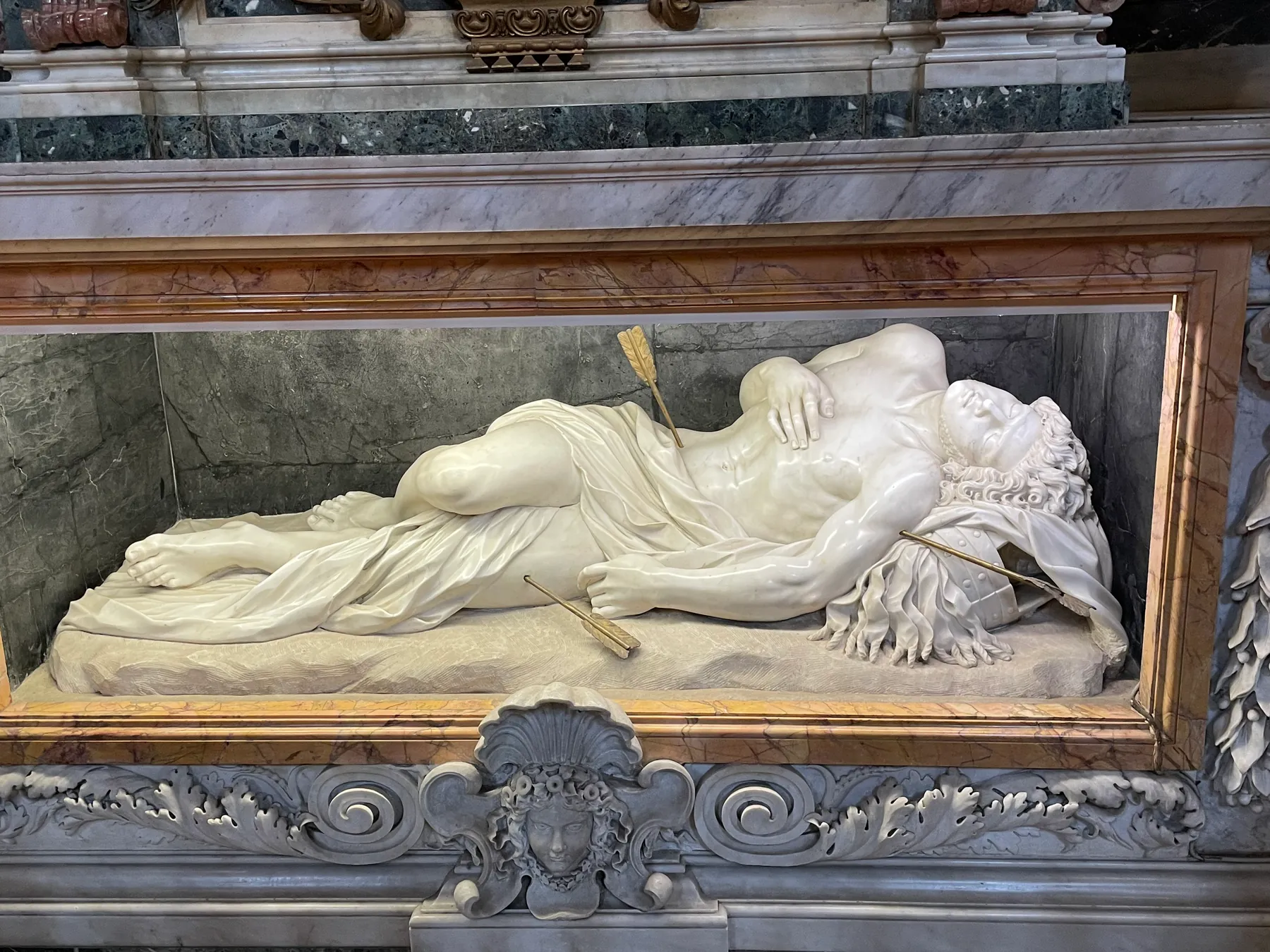
Saint Sebastian’s sculpture in the basilica that preserves the footprint tradition; this image does not show the footprint slab. The Quo Vadis footprints in Rome preserve the memory of St Peter’s encounter with the risen Christ on the Appian Way. While Peter was leaving the city during persecution, he asked, “Domine, quo vadis?”—“Lord, where are you going?” The marble slab miraculously bearing Christ’s footprints is preserved at the Basilica of St Sebastian Outside the Walls. What does “Quo Vadis” mean? Quo vadis? is Latin for “Where are you going?” The phrase comes from the traditional encounter between Christ and St Peter outside Rome. Peter, fearing martyrdom, was leaving the city. When he saw Christ, he asked where the Lord was going. Christ’s answer indicated that He was going to Rome to be crucified again. Peter understood this as a call to return and remain faithful to his own vocation, to accept suffering and the death he was called to. How is the Quo Vadis meeting preserved in Catholic tradition? The encounter belongs to the ancient Christian tradition recorded in the Acts of Peter and preserved in the devotional memory of Rome. For centuries it has helped Catholics understand the final fidelity and martyrdom of the Prince of the Apostles. The tradition expresses the apostolic call with striking clarity: discipleship requires fidelity to Christ, even at the cost of one’s life. Peter’s return to Rome completes the movement begun when he first left his nets and followed the Lord. Where are the footprints of Christ? A small church called Santa Maria in Palmis—better known as Domine Quo Vadis—stands near the traditional site of the meeting. It displays a copy of the footprint slab. The original marble slab associated with the tradition is preserved farther along the Appian Way at the Basilica
Saint Sebastian’s sculpture in the basilica that preserves the footprint tradition; this image does not show the footprint slab.
The Quo Vadis footprints in Rome preserve the memory of St Peter’s encounter with the risen Christ on the Appian Way. While Peter was leaving the city during persecution, he asked, “Domine, quo vadis?”—“Lord, where are you going?” The marble slab miraculously bearing Christ’s footprints is preserved at the Basilica of St Sebastian Outside the Walls.
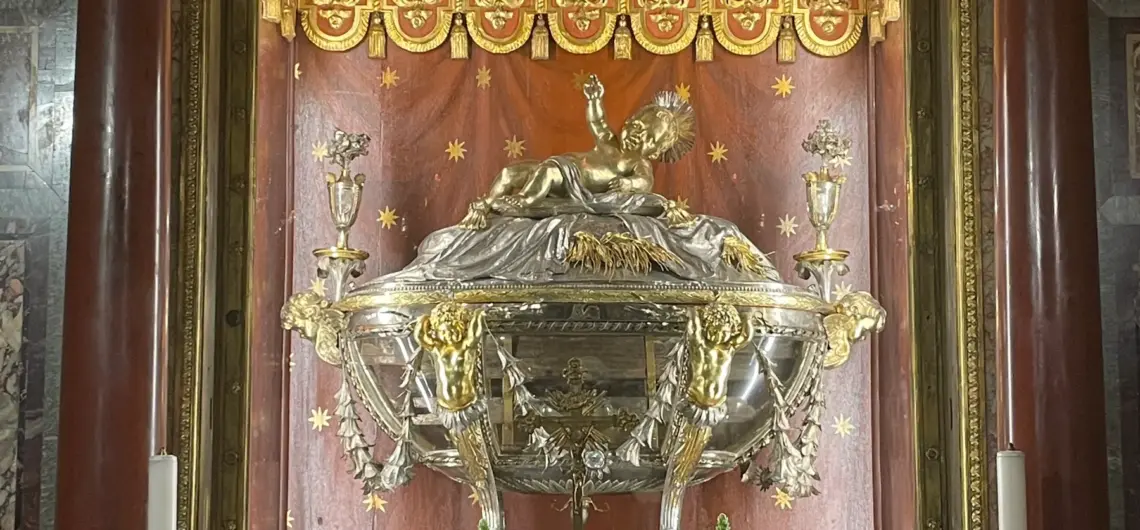
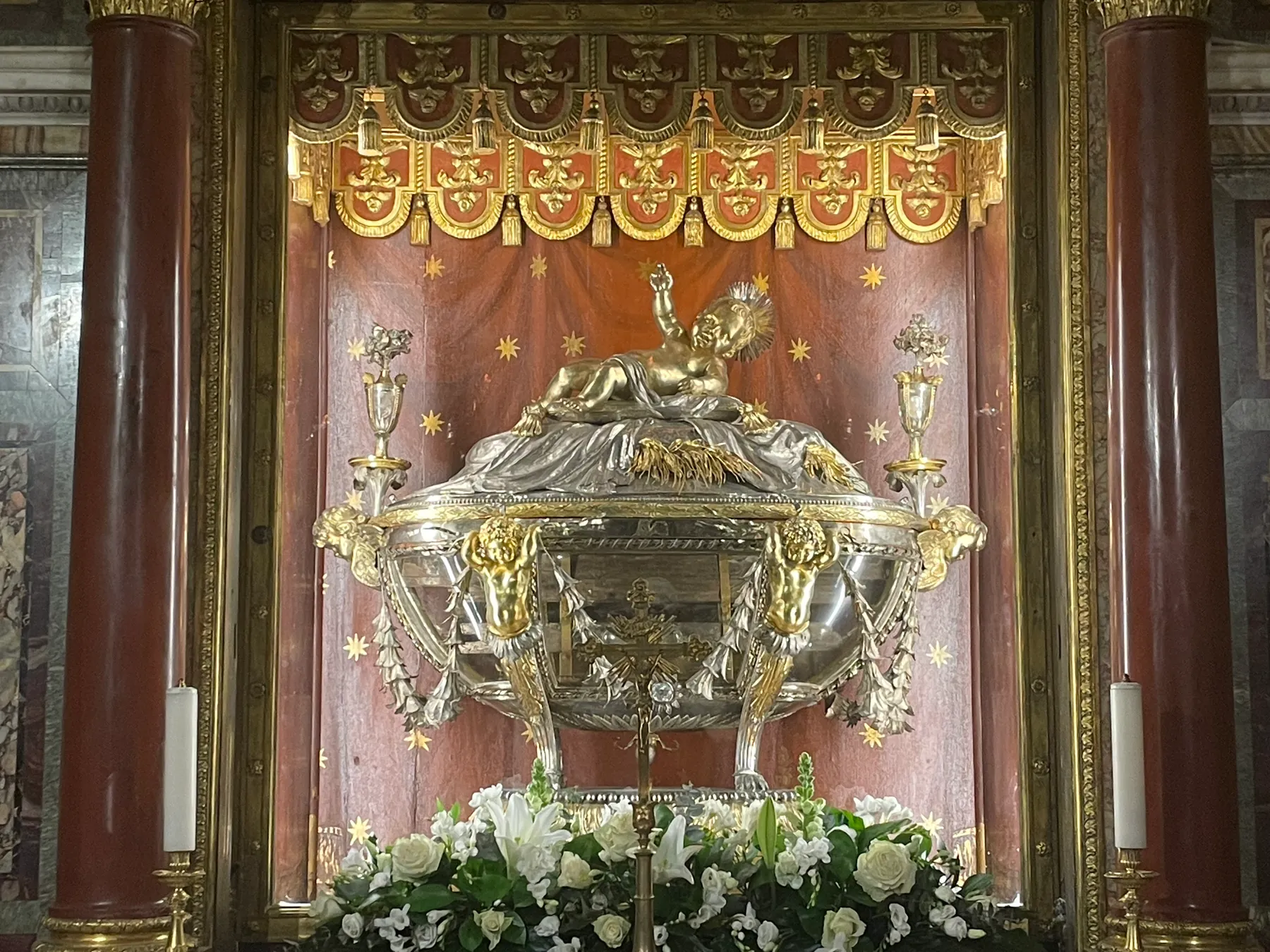
Sacred Crib reliquary beneath the high altar of St Mary Major, Rome. The Holy Crib at St Mary Major in Rome is venerated beneath the basilica’s high altar. These pieces of wood come from the manger in which the infant Jesus was laid at Bethlehem. Their presence gave the basilica a profound association with the Nativity and helped earn it the title “Bethlehem of the West”. What is the Holy Crib? The Holy Crib, or Sacra Culla, consists of pieces of wood traditionally connected with Christ’s manger. They are preserved within a precious reliquary in the confessio beneath the papal altar. For Catholic pilgrims, the relic directs attention to the reality of the Incarnation. The eternal Son of God entered human history not in imperial splendour but in the poverty and vulnerability of a child laid in a manger. How did the relic reach Rome? The Holy Crib has been associated with St Mary Major for many centuries. Historical accounts connect the relics’ arrival in the 7th century, when sacred objects from the Holy Land were sometimes transferred for protection. The Church has preserved and venerated the Holy Crib at St Mary Major for many centuries. Modern scientific analysis of the wood supports the ancient tradition and strengthens the historic connection between the relic, Bethlehem and the basilica. Why is St Mary Major associated with Bethlehem? The basilica’s relationship with the Nativity extends beyond the wooden relics. Its early Christian mosaics proclaim the identity of Christ and the dignity of the Blessed Virgin Mary, while its liturgical history repeatedly returned Roman pilgrims to the mystery of Bethlehem. The church was consequently known as St Mary at the Crib and the Pope would celebrate Christmas Midnight Mass at this Basilica over the relics for centuries. Rome allowed Western pilgrims to contemplate
Sacred Crib reliquary beneath the high altar of St Mary Major, Rome.
The Holy Crib at St Mary Major in Rome is venerated beneath the basilica’s high altar. These pieces of wood come from the manger in which the infant Jesus was laid at Bethlehem. Their presence gave the basilica a profound association with the Nativity and helped earn it the title “Bethlehem of the West”.
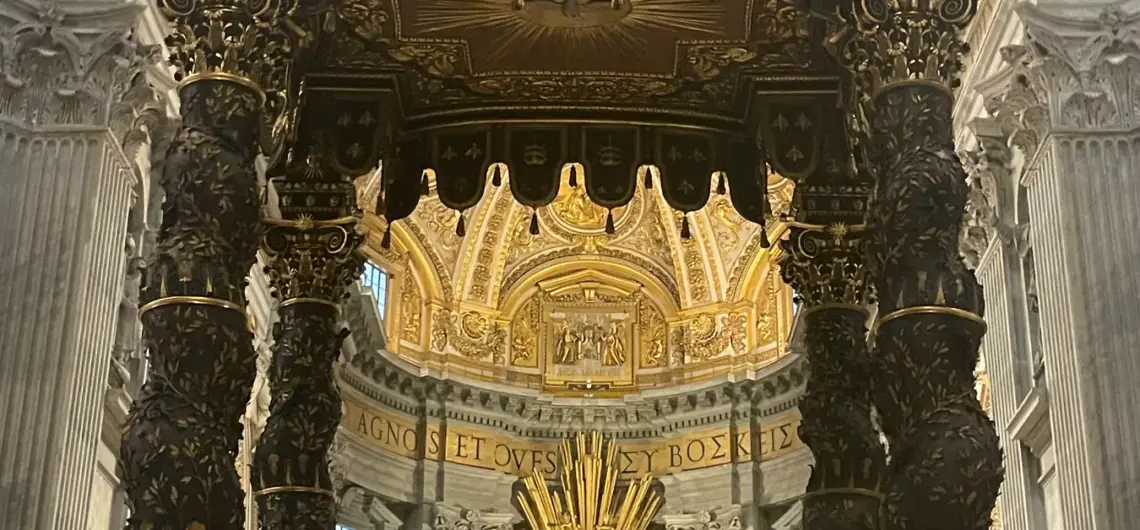
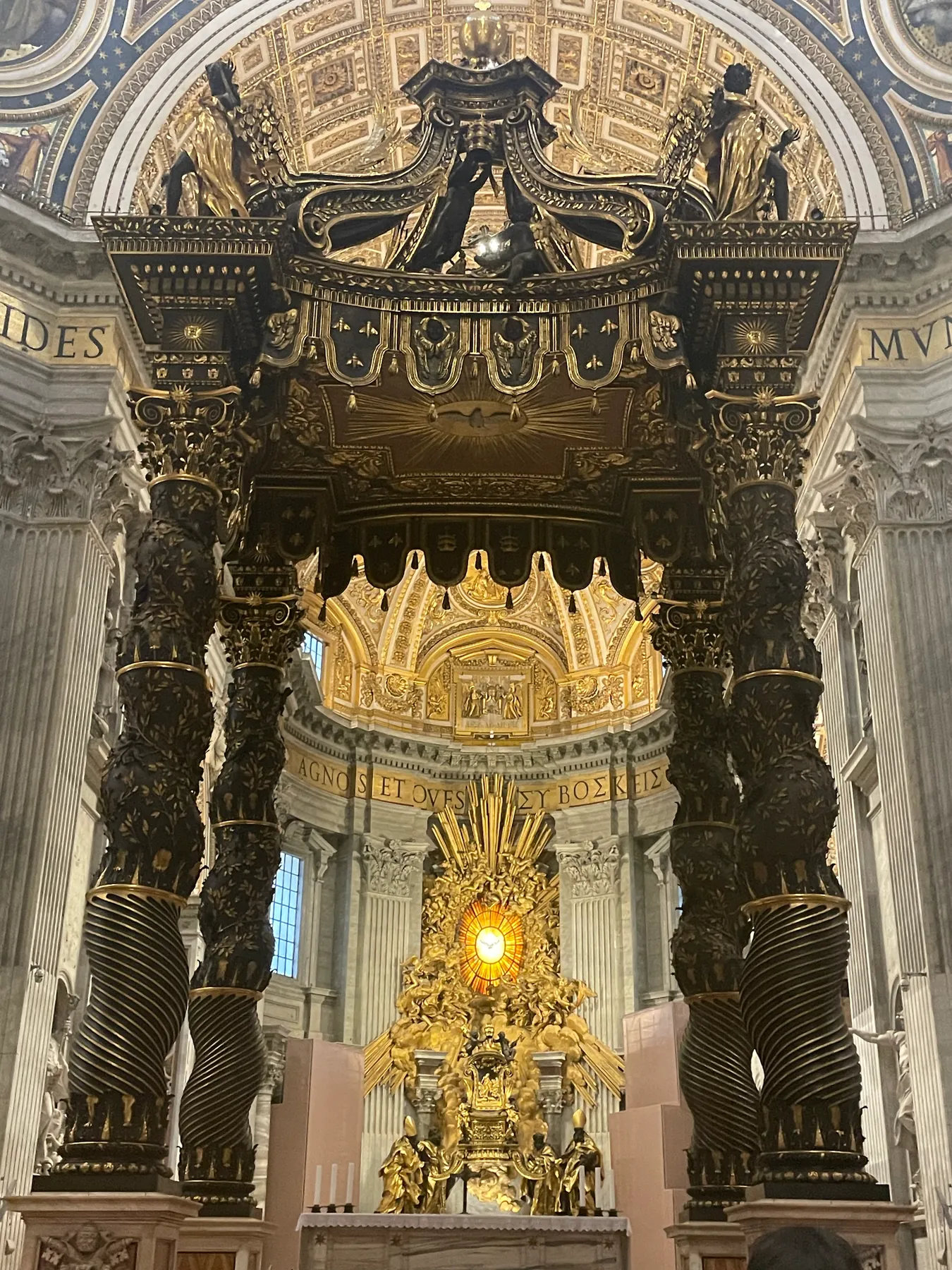
Bernini’s baldachin and the Chair of Saint Peter beyond it in St Peter’s Basilica, Vatican City. St Peter’s Basilica contains sacred traditions connected with St Peter himself and with the Passion of Jesus Christ. Beneath its splendour lies the tomb of St Peter, while the great crossing preserves the Holy Lance, Veronica’s Veil and a fragment of the True Cross. Most visitors notice the scale of the basilica. Far fewer understand how its relics shaped the building’s art, architecture and purpose. Is St Peter buried beneath the basilica? St Peter was martyred in Rome and buried on Vatican Hill. The basilica’s high altar stands directly over his tomb, giving physical expression to the Church’s continuity with the Apostle to whom Christ said: “You are Peter, and upon this rock I will build my Church.” Twentieth-century excavations beneath the basilica uncovered the Roman necropolis, the ancient place of Christian veneration and the remains identified with St Peter. This sacred tomb is the reason the basilica stands on Vatican Hill. The four great relic statues beneath the dome Four colossal statues stand in the piers supporting Michelangelo’s dome. They represent St Longinus, St Veronica, St Helena and St Andrew. The first three correspond to relic traditions directly associated with Christ’s Passion. The Holy Lance of St Longinus Statue of Saint Longinus holding a lance in St Peter’s Basilica, Vatican City. St John’s Gospel records that the soldier St Longinus pierced the side of Christ with a lance. A relic of the Holy Lance is safeguarded within St Peter’s, represented below by Bernini’s powerful statue of the saint. Veronica’s Veil Statue of Saint Veronica holding the veil in St Peter’s Basilica, Vatican City. During the Way of the Cross, St Veronica wiped the face of Jesus and received His sacred image upon her
Bernini’s baldachin and the Chair of Saint Peter beyond it in St Peter’s Basilica, Vatican City.
St Peter’s Basilica contains sacred traditions connected with St Peter himself and with the Passion of Jesus Christ. Beneath its splendour lies the tomb of St Peter, while the great crossing preserves the Holy Lance, Veronica’s Veil and a fragment of the True Cross.
Most visitors notice the scale of the basilica. Far fewer understand how its relics shaped the building’s art, architecture and purpose.
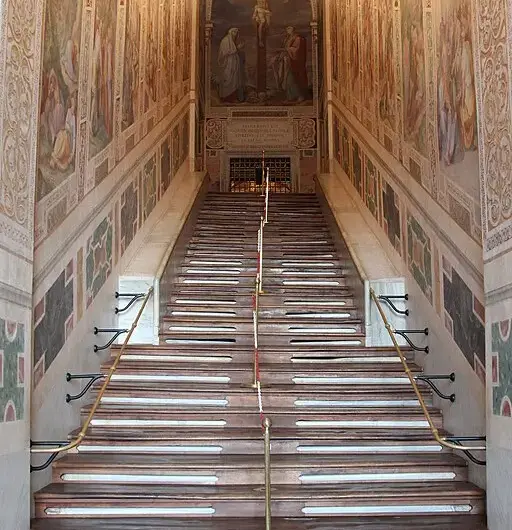
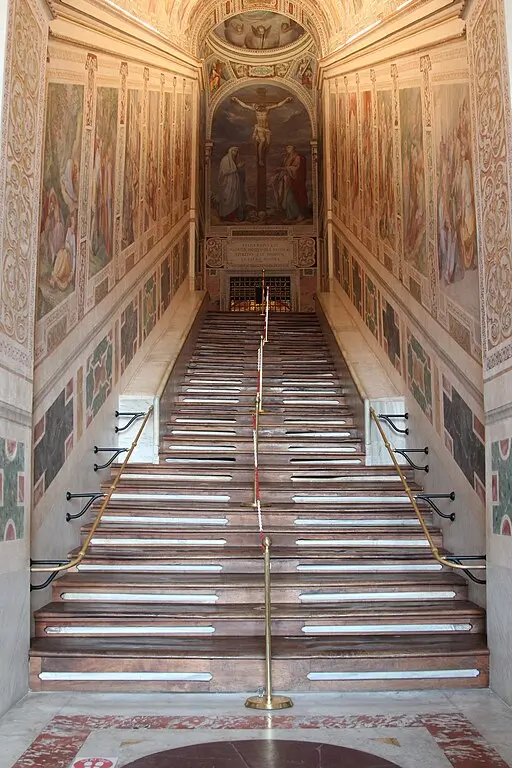
The Holy Stairs inside the Scala Santa sanctuary, Rome. The Holy Stairs in Rome, known as the Scala Santa, are 28 marble steps transported to Rome in the 4th century from the praetorium of Pontius Pilate in Jerusalem. According to Catholic Scripture and Tradition, Jesus ascended them during His Passion before being condemned to death. Today the steps stand in the Pontifical Sanctuary of the Holy Stairs, directly across from the Archbasilica of St John Lateran. What are the Holy Stairs? The central staircase consists of marble steps protected by a wooden covering. Pilgrims ascend this staircase only on their knees, traditionally praying and meditating upon the Passion of Christ as they proceed. Three of the steps also contain stains of blood which by tradition is the blood of Jesus, as he stood on the steps after His scourging to be judged again by Pilate. Other staircases run beside it, allowing visitors to reach the upper chapels without undertaking the kneeling devotion. This distinction matters: the central ascent is an act of prayer rather than an unusual tourist challenge. Did Jesus climb the Holy Stairs? Catholic Scripture and Tradition identify them with steps from Pilate’s praetorium in Jerusalem and attributes their translation to Rome to St Helena in the fourth century. Their later history in Rome is well established, while their precise earlier provenance is also well supported archaeologically. The sanctuary’s enduring importance also arises from the centuries of prayer offered there and from the way the devotion directs pilgrims contemplation towards Christ’s salvific Passion. Why do pilgrims climb the Scala Santa on their knees? The physical ascent expresses penance, humility and union with Christ’s suffering. Each step slows the pilgrim down. The devotion resists the temptation to consume sacred places quickly and instead demands attention, effort and prayer. Those
The Holy Stairs inside the Scala Santa sanctuary, Rome.
The Holy Stairs in Rome, known as the Scala Santa, are 28 marble steps transported to Rome in the 4th century from the praetorium of Pontius Pilate in Jerusalem. According to Catholic Scripture and Tradition, Jesus ascended them during His Passion before being condemned to death.
Today the steps stand in the Pontifical Sanctuary of the Holy Stairs, directly across from the Archbasilica of St John Lateran.
Cross-shaped reliquary with angels at Santa Croce in Gerusalemme, Rome. Relics of the True Cross are preserved principally at the Basilica of Santa Croce in Gerusalemme and St Peter’s Basilica. Their Roman history is closely connected with St Helena, the mother of Constantine, and with the transformation of Rome from an imperial capital into a Christian centre of pilgrimage. What is the True Cross? The True Cross is the name given in Catholic tradition to the cross upon which Jesus Christ was crucified. The Gospels describe the Crucifixion but do not record what immediately happened to the wood afterwards. Ancient Christian writers record the recovery of the Cross in Jerusalem during the fourth century by St Helena, who journeyed to the Holy Land after her son Constantine had granted legal toleration to Christianity. St Helena and the discovery of the Cross St Helena’s pilgrimage took place in a period when the sites of Christ’s death and Resurrection were being identified and monumentalised. The Church of the Holy Sepulchre was built in Jerusalem under Constantine, creating a permanent focus for Christian pilgrimage. Fourth- and fifth-century Christian writers preserved the account of St Helena’s discovery for the universal Church. Catholic devotion receives this sacred history as testimony to the real wood upon which Christ accomplished the salvation of the world. What the tradition expresses with unmistakable force is the early Christian conviction that the Incarnation and Passion occurred in real history—and that the physical places and objects connected with Christ mattered. Santa Croce in Gerusalemme Illuminated facade and monastery of Santa Croce in Gerusalemme, Rome. Santa Croce in Gerusalemme became the great Roman sanctuary of the Cross. The basilica arose within an imperial complex associated with Helena and was traditionally linked with earth brought from Jerusalem. Its Chapel of the Relics preserves
Cross-shaped reliquary with angels at Santa Croce in Gerusalemme, Rome.
Relics of the True Cross are preserved principally at the Basilica of Santa Croce in Gerusalemme and St Peter’s Basilica. Their Roman history is closely connected with St Helena, the mother of Constantine, and with the transformation of Rome from an imperial capital into a Christian centre of pilgrimage.
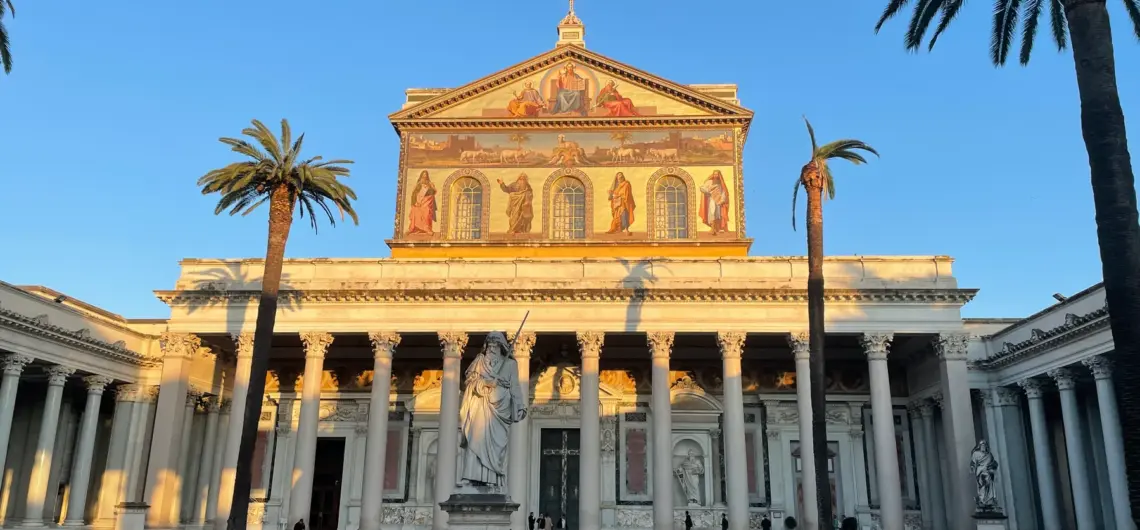
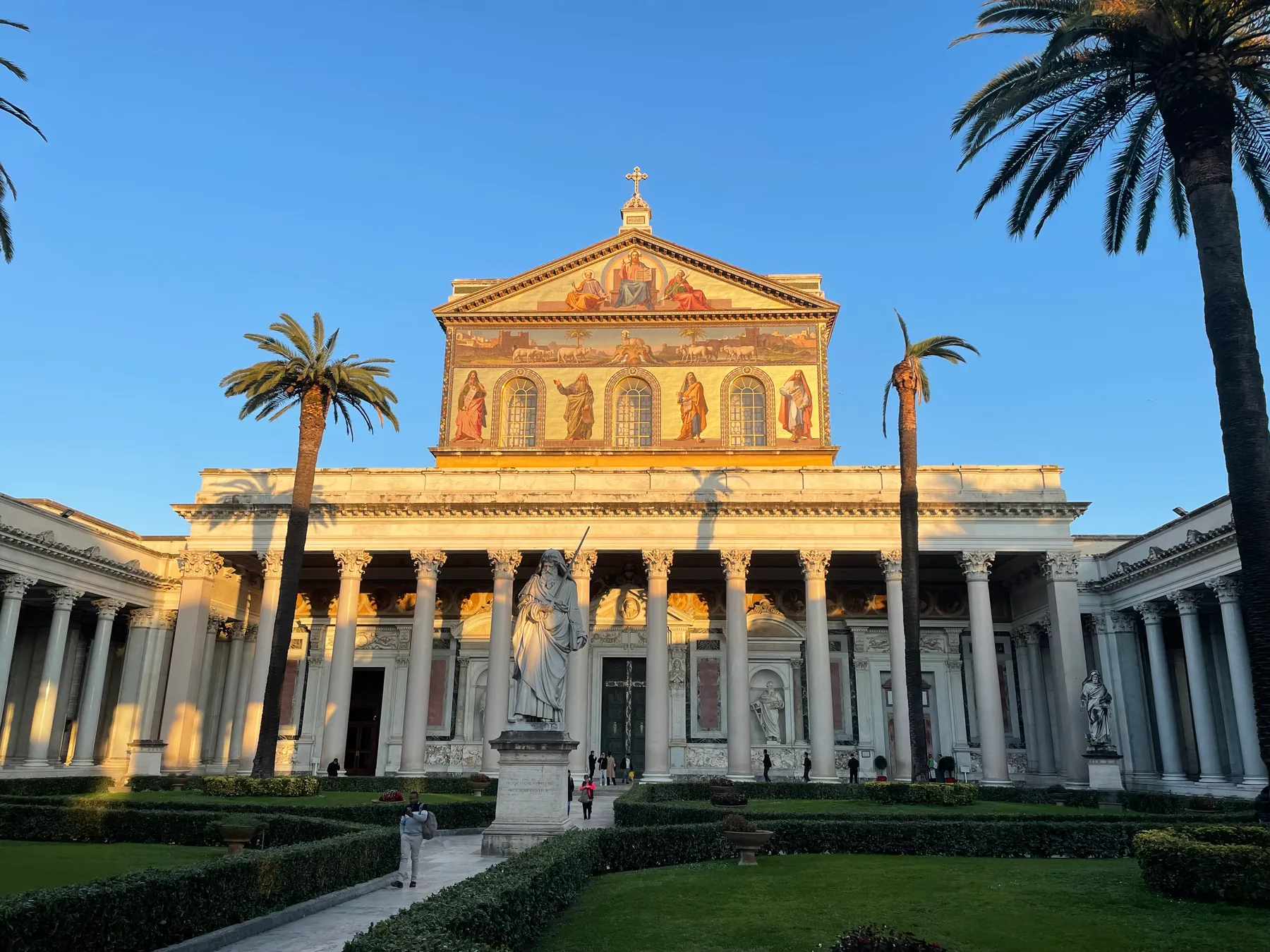
Courtyard and sunlit facade of St Paul Outside the Walls, Rome. Updated 20 August 2026 How many days for a Catholic pilgrimage to Rome? A well-planned Catholic Rome itinerary can work in one, two, three or four days. The right length depends upon whether you want a focused introduction, the four Major Basilicas, the relics and saints of Rome, or the fuller tradition of the Seven Pilgrim Churches. For most first-time Catholic pilgrims, three or four days gives the best balance of sacred history, guided visits, Mass and personal prayer. Those with only one day should choose one coherent Catholic theme rather than trying to rush through every famous church. Catholic Rome itinerary: the quick answer Time availableBest approachRecommended Crucis experienceBest for1 dayChoose one strong theme4 Major Basilicas Tour Rome in One Day or Via Crucis – Relics of Christ TourVisitors adding a Catholic day to a wider Rome holiday2 daysExplore a central Catholic theme at a less compressed pace4 Major Basilicas – 2 Day Rome PilgrimageShort pilgrimages and Catholic city breaks3 daysCombine the Major Basilicas with relics and another Catholic themeMajor Basilicas + Relics + Vocation – 3 Day Rome PilgrimageMost first-time pilgrims seeking breadth and balance4 daysMake Rome itself the centre of a fuller pilgrimage7 Pilgrim Churches – 4-Day Rome PilgrimagePilgrims drawn to Rome’s historic pilgrimage tradition The table gives high-level choices rather than a self-guided route. Church access, liturgies and security arrangements can change, and Crucis preserves the detailed order, interpretation and delivery of each pilgrimage for its guides and booked pilgrims. How many days do you need for a Catholic pilgrimage to Rome? One day is enough for a meaningful introduction. Two days allow greater depth. Three days works well for many first-time pilgrims, while four days makes possible a more complete encounter with Rome’s distinctive
Courtyard and sunlit facade of St Paul Outside the Walls, Rome.
Updated 20 August 2026
How many days for a Catholic pilgrimage to Rome? A well-planned Catholic Rome itinerary can work in one, two, three or four days. The right length depends upon whether you want a focused introduction, the four Major Basilicas, the relics and saints of Rome, or the fuller tradition of the Seven Pilgrim Churches.
For most first-time Catholic pilgrims, three or four days gives the best balance of sacred history, guided visits, Mass and personal prayer. Those with only one day should choose one coherent Catholic theme rather than trying to rush through every famous church.
Cross-shaped reliquary with angels at Santa Croce in Gerusalemme, Rome. Rome preserves an extraordinary collection of relics associated with the earthly life, Passion and Resurrection of Jesus Christ. According to Catholic tradition, these include wood from the Holy Crib, the Column of the Scourging, the Holy Stairs, fragments of the True Cross, a Holy Nail of the Crucifixion, 2 Thorns from the Crown of Thorns, the Holy Sponge and the footprints connected with Christ’s appearance to St Peter on the Appian Way. These sacred objects are found across several of Rome’s most important basilicas. They are not merely historical curiosities. For Catholic pilgrims, they offer tangible points of meditation upon the Incarnation, Passion and victory of Christ. Which relics of Jesus Christ are in Rome? RelicChurch in RomeMoment in Christ’s life Wood of the Holy CribSt Mary MajorThe Nativity Column traditionally associated with the Flagellation of ChristSanta PrassedeThe Passion The Holy StairsPontifical Sanctuary of the Holy StairsChrist judged by Pontius Pilate True Cross fragments, a Holy Nail of the Crucifixion, Thorns of the Crown of Thorns and the TitulusSanta Croce in GerusalemmeThe Crucifixion Relics of the Holy Lance that pierced His Sacred Heart, Veronica’s Veil and pieces of the True CrossSt Peter’s BasilicaThe Way of the Cross and Crucifixion A fragment of the Holy SpongeSanta Maria in TrastevereThe Crucifixion The original slab associated with the “Quo Vadis” footprintsSt Sebastian Outside the WallsAn apparition of the risen Christ to St Peter This list gives the principal locations, but each church has a much richer story. The historical setting, Catholic devotion and relationship between the relics become clearer when explored with a guide who understands the Church’s sacred tradition and their spiritual significance. Explore the principal sites with a practising Catholic guide on the Via Crucis – Relics of Christ Tour. Why
Cross-shaped reliquary with angels at Santa Croce in Gerusalemme, Rome.
Rome preserves an extraordinary collection of relics associated with the earthly life, Passion and Resurrection of Jesus Christ. According to Catholic tradition, these include wood from the Holy Crib, the Column of the Scourging, the Holy Stairs, fragments of the True Cross, a Holy Nail of the Crucifixion, 2 Thorns from the Crown of Thorns, the Holy Sponge and the footprints connected with Christ’s appearance to St Peter on the Appian Way.
These sacred objects are found across several of Rome’s most important basilicas. They are not merely historical curiosities. For Catholic pilgrims, they offer tangible points of meditation upon the Incarnation, Passion and victory of Christ.
Find traditional Latin Mass in Rome, where the Church was built with the blood of the early martyrs.
Looking for a Traditional Latin Mass in Rome? Start with Santissima Trinità dei Pellegrini, served by the Priestly Fraternity of St Peter, and the Institute of Christ the King’s Rome apostolate, whose published services are currently at the Immacolata dei Miracoli. The SSPX also publishes a timetable for its chapel in Via Urbana. At Sant’Anna al Laterano, Crucis Tours has locally confirmed Sunday Mass at 16:00. Other churches often included in Rome Latin Mass lists need a fresh check before you plan around them.
Looking for Mass in English in Rome? St Patrick’s, San Silvestro in Capite, Santo Spirito in Sassia and several other churches publish regular English-language services. Some options are seasonal, while the English Mass near St Peter’s tomb is monthly. Start with the timetable below, then check the church’s own notices for your travel date. Sources checked: 10 September 2026. All times are local to Rome. These are the schedules published by the churches and communities, rather than a guarantee that every future celebration will take place unchanged. Holy Week, Christmas, summer breaks and special events can affect arrangements. English Mass in Rome: quick timetable The nine places below currently publish an English Mass schedule. Term-time and summer exceptions are part of the timetable. San Clemente and the Gesù are discussed separately because we could not verify the regular English services previously listed here. Published English Mass times — Rome local time ChurchDays and timesCheck before visiting St Peter’s BasilicaFirst Saturday of the month, 07:15Monthly arrangement; check the dated list Santo Spirito in SassiaSundays and religious holidays, 09:00Special celebration notices Sant’Anna in VaticanoSunday/festive schedule, 15:30Suspended in July and August AngelicumMonday, Tuesday, Thursday and Friday, 12:25Only when classes are in session Domus AustraliaMonday–Friday and Sunday, 18:00Saturday Mass is in Italian St Patrick’sMonday–Friday and Saturday vigil, 18:00; Sunday, 09:00 and 10:30Holy-day times are announced separately San Silvestro in CapiteMonday–Saturday, 12:00; Sunday, 10:00 and 17:30Saturday evening vigil is in Italian Venerable English CollegeUsually Sunday, 10:00, and Wednesday, 18:30Term-time only; confirm the particular date St Alphonsus de LiguoriSundays/religious holidays, 15:30; Thursday, 17:00Check seasonal shrine notices Sant Alfonso is one of the churches discussed in this guide; the photograph shows its exterior, not a Mass in progress. Churches with published English Mass schedules St Peter’s Basilica: monthly English Mass The Pontifical North American College’s Visitors’ Office
Looking for Mass in English in Rome? St Patrick’s, San Silvestro in Capite, Santo Spirito in Sassia and several other churches publish regular English-language services. Some options are seasonal, while the English Mass near St Peter’s tomb is monthly. Start with the timetable below, then check the church’s own notices for your travel date.
Courtyard and sunlit facade of St Paul Outside the Walls, Rome. Rome, often called the Eternal City, has long been a destination for Christian pilgrims seeking spiritual renewal and a connection to the faith’s earliest roots. One of the most historically significant pilgrimage traditions in Rome is the 7 Pilgrim Churches route, popularized in the 16th century by St. Philip Neri. This sacred journey involves visiting seven of the city’s most important churches, each holding deep religious and historical significance. In this article, we’ll explore the origins of the 7 Pilgrim Churches of Rome pilgrimage, the life of St. Philip Neri, the churches included in the tradition, and how the practice has evolved in modern times. The Origins of the 7 Pilgrim Churches of Rome Pilgrimage Pilgrimage has been an essential part of Christian spirituality for centuries, with Rome being a prime destination due to its status as the heart of the Catholic Church and the burial site of many apostles and saints. The 7 Pilgrim Churches of Rome pilgrimage traces its origins to the early Christian practice of visiting the city’s 4 major basilicas, especially during the Jubilee Years established by Pope Boniface VIII in 1300. By the 16th century, pilgrimage had become more structured, and it was St. Philip Neri who revitalized and popularized the devotion as a way to deepen faith, foster community, and encourage spiritual renewal. The Life and Mission of St. Philip Neri A Saint of Joy and Devotion St. Philip Neri (1515-1595) was an Italian priest known for his deep spirituality, joyful personality, and commitment to serving the poor. Born in Florence, he moved to Rome in 1533, where he dedicated himself to prayer, study, and works of charity. His charismatic nature and ability to connect with people earned him the nickname “Apostle of
Courtyard and sunlit facade of St Paul Outside the Walls, Rome.
Rome, often called the Eternal City, has long been a destination for Christian pilgrims seeking spiritual renewal and a connection to the faith’s earliest roots. One of the most historically significant pilgrimage traditions in Rome is the 7 Pilgrim Churches route, popularized in the 16th century by St. Philip Neri. This sacred journey involves visiting seven of the city’s most important churches, each holding deep religious and historical significance.
In this article, we’ll explore the origins of the 7 Pilgrim Churches of Rome pilgrimage, the life of St. Philip Neri, the churches included in the tradition, and how the practice has evolved in modern times.
Facade and dome of St Peter’s Basilica seen from St Peter’s Square, Vatican City. Holy Door status checked 25 August 2026. The Holy Doors at St John Lateran, St Mary Major and St Paul Outside the Walls closed on 28 December 2025. St Peter's Holy Door closed on 6 January 2026. The doors remain visible, but pilgrims cannot currently pass through them. The next anticipated Jubilee of the Redemption is in 2033. “Upon this rock I will build my Church.” Matthew 16:18 Where should Catholics visit in Rome? As bucket-list destinations go, this ancient and magnificent city is in many people’s top ten, but for Catholic pilgrims its not about la cucina italiana and the Colosseum at dusk. The centre of the known world at the time of the early Church, Christians were persecuted here for their faith until the legalisation of Christianity in 313. 13 years later St Helena, mother of emperor Constantine, organised the safe transit of the most sacred relics of the faith from Jerusalem to the heart of the empire - Rome. Long before that however, Rome was the place where many of the earliest martyrs were born, lived and died, and as the seat of the Pope, it is one of the two great holy cities of the world alongside Jerusalem. For Catholics, a pilgrimage to Rome is a spiritual odyssey. Many will come with plans to see St Peter’s and the other Major Basilicas, many will come to walk in the footsteps of Saints Peter and Paul, the Pillars of the Church. Some may even seek to attend mass and catch a glimpse of the Pope himself, but none are prepared for the impact that this mind-blowing city has on their lives. So where exactly should Catholics visit in Rome? We’ve curated the following
Facade and dome of St Peter’s Basilica seen from St Peter’s Square, Vatican City.
Holy Door status checked 25 August 2026. The Holy Doors at St John Lateran, St Mary Major and St Paul Outside the Walls closed on 28 December 2025. St Peter’s Holy Door closed on 6 January 2026. The doors remain visible, but pilgrims cannot currently pass through them. The next anticipated Jubilee of the Redemption is in 2033.
“Upon this rock I will build my Church.” Matthew 16:18
Where should Catholics visit in Rome? As bucket-list destinations go, this ancient and magnificent city is in many people’s top ten, but for Catholic pilgrims its not about la cucina italiana and the Colosseum at dusk. The centre of the known world at the time of the early Church, Christians were persecuted here for their faith until the legalisation of Christianity in 313. 13 years later St Helena, mother of emperor Constantine, organised the safe transit of the most sacred relics of the faith from Jerusalem to the heart of the empire – Rome.
Long before that however, Rome was the place where many of the earliest martyrs were born, lived and died, and as the seat of the Pope, it is one of the two great holy cities of the world alongside Jerusalem.
For Catholics, a pilgrimage to Rome is a spiritual odyssey. Many will come with plans to see St Peter’s and the other Major Basilicas, many will come to walk in the footsteps of Saints Peter and Paul, the Pillars of the Church. Some may even seek to attend mass and catch a glimpse of the Pope himself, but none are prepared for the impact that this mind-blowing city has on their lives.
So where exactly should Catholics visit in Rome? We’ve curated the following list, in no particular order, of places that will stir the faith of those who have it buried deep in their heart and will inspire those who already feel close to the Lord.