

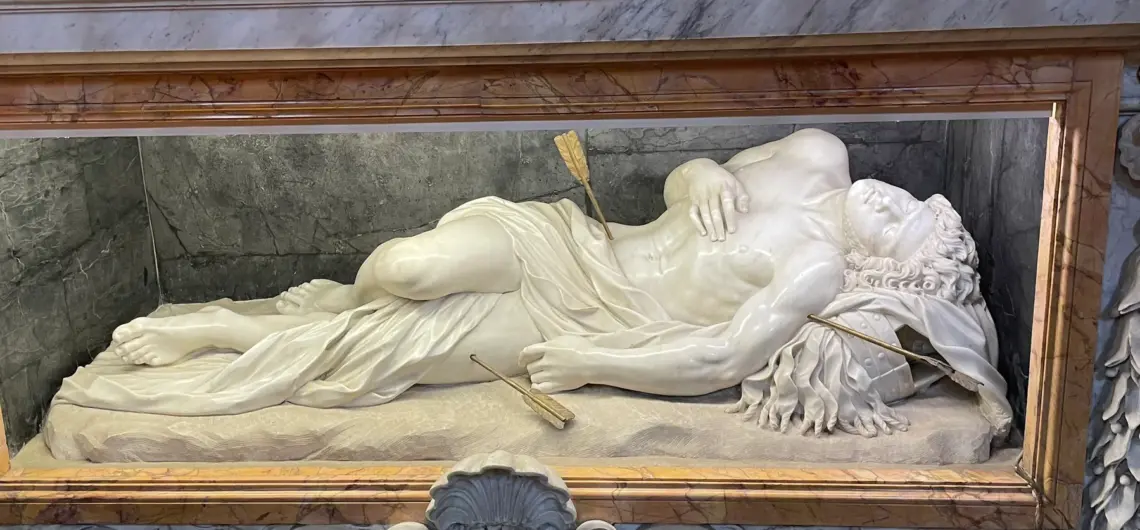
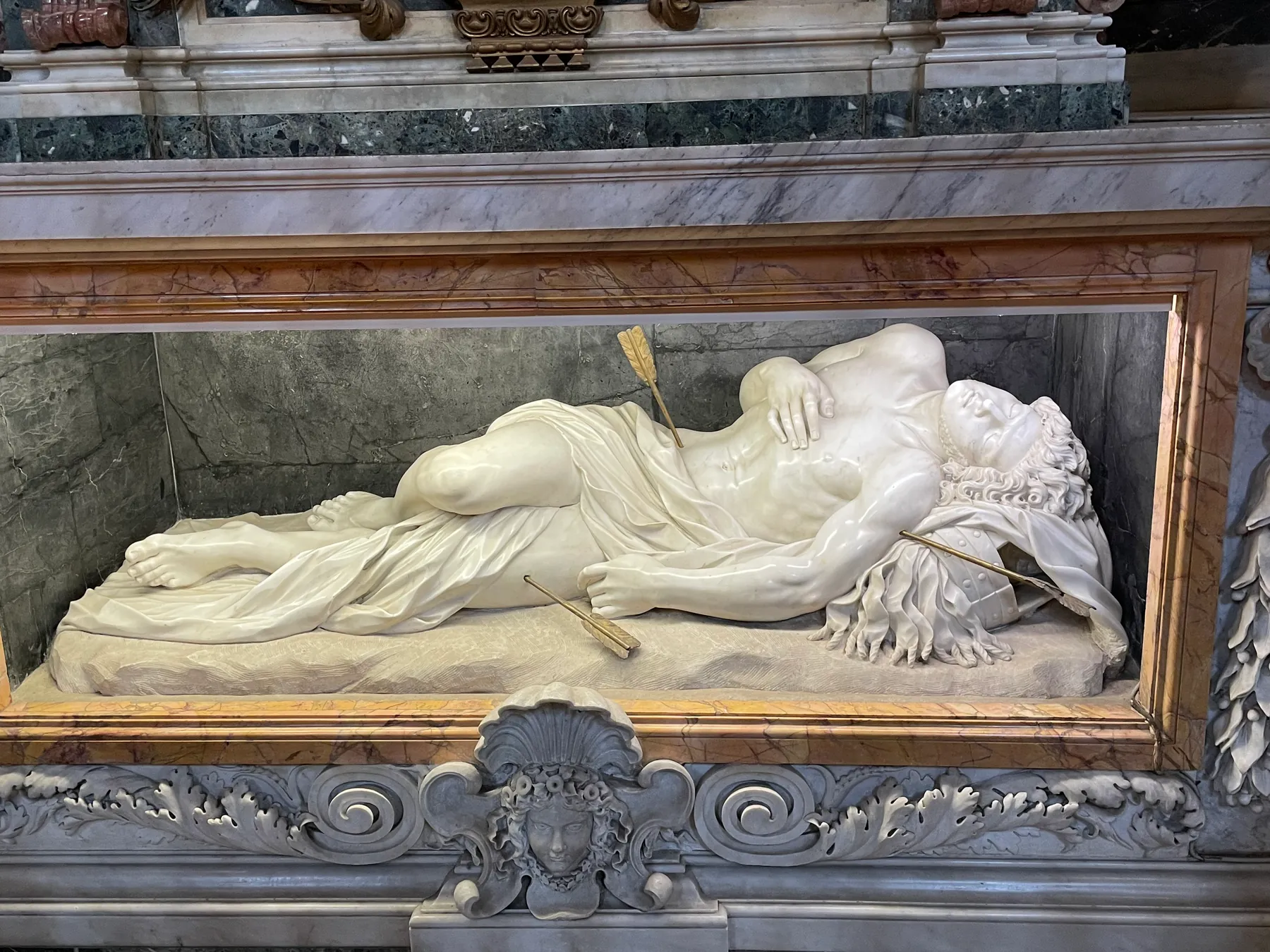
The Quo Vadis footprints in Rome preserve the memory of St Peter’s encounter with the risen Christ on the Appian Way. While Peter was leaving the city during persecution, he asked, “Domine, quo vadis?”—“Lord, where are you going?” The marble slab miraculously bearing Christ’s footprints is preserved at the Basilica of St Sebastian Outside the Walls.
What does “Quo Vadis” mean?
Quo vadis? is Latin for “Where are you going?” The phrase comes from the traditional encounter between Christ and St Peter outside Rome.
Peter, fearing martyrdom, was leaving the city. When he saw Christ, he asked where the Lord was going. Christ’s answer indicated that He was going to Rome to be crucified again. Peter understood this as a call to return and remain faithful to his own vocation, to accept suffering and the death he was called to.
How is the Quo Vadis meeting preserved in Catholic tradition?
The encounter belongs to the ancient Christian tradition recorded in the Acts of Peter and preserved in the devotional memory of Rome. For centuries it has helped Catholics understand the final fidelity and martyrdom of the Prince of the Apostles.
The tradition expresses the apostolic call with striking clarity: discipleship requires fidelity to Christ, even at the cost of one’s life. Peter’s return to Rome completes the movement begun when he first left his nets and followed the Lord.
Where are the footprints of Christ?
A small church called Santa Maria in Palmis—better known as Domine Quo Vadis—stands near the traditional site of the meeting. It displays a copy of the footprint slab.
The original marble slab associated with the tradition is preserved farther along the Appian Way at the Basilica of St Sebastian Outside the Walls. The basilica consequently connects the Quo Vadis story with the martyrs, the apostles and one of Rome’s most ancient pilgrimage routes.
Why are the Quo Vadis footprints venerated in Rome?
The Quo Vadis footprints are venerated because they recall a miraculous intervention of Christ at the decisive moment of St Peter’s Roman mission. The risen Lord did not abandon His Apostle to fear, but met him on the road and restored his courage.
The slab also joins the Appian Way to Rome’s wider landscape of relics. Like the chains of St Peter, the tombs of the martyrs and the sacred places of the apostles, it makes the history of Catholic Rome tangible to the pilgrim.
What do the footprints mean?
The footprints are not important merely because they are unusual. They express the direction of Christian discipleship. Peter was walking away from danger; the encounter turned him back towards his duty and, ultimately, martyrdom.
The question “Where are you going?” is therefore addressed to every pilgrim. A pilgrimage involves physical movement, but its deeper purpose is conversion: deciding whether one’s life is moving towards Christ or away from Him.
St Peter, martyrdom and the Appian Way
The Appian Way carried travellers, soldiers and merchants into Rome. Christian memory transformed it into a landscape of witness, burial and pilgrimage.
St Sebastian’s basilica and catacombs preserve several layers of this history. Their fuller relationship with Peter, Paul, the martyrs and Roman burial customs is far richer than the footprint tradition considered alone.
Visit the Quo Vadis footprints and St Sebastian
The St Sebastian Basilica with Catacombs Tour explores the basilica, its relics and its place within early Christian Rome with a practising Catholic guide.
The footprints also appear in our wider guide to the relics of Jesus Christ in Rome. St Sebastian is one of Rome’s Seven Pilgrim Churches. Pilgrims wishing to encounter all seven across a coherent journey can choose the 7 Pilgrim Churches – 4-Day Rome Pilgrimage.