

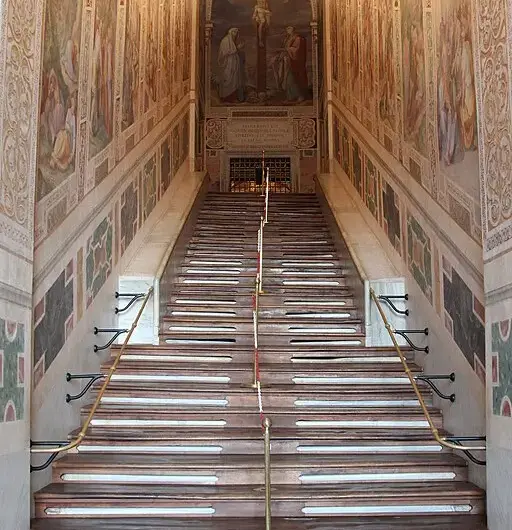
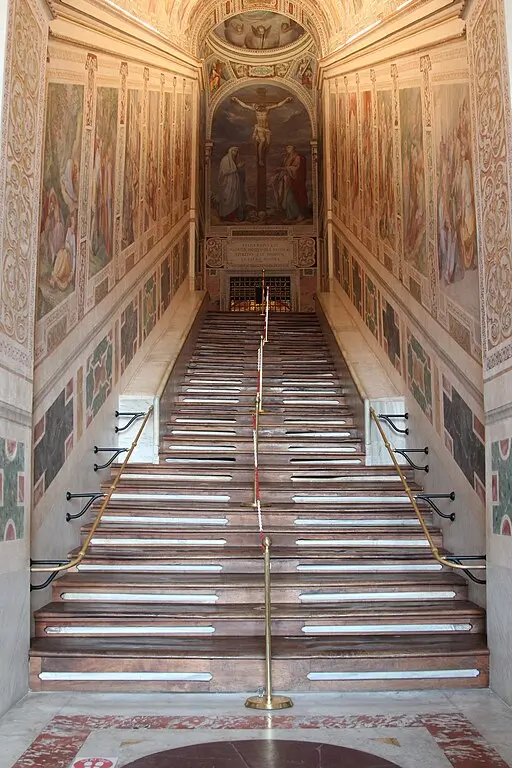
The Holy Stairs in Rome, known as the Scala Santa, are 28 marble steps transported to Rome in the 4th century from the praetorium of Pontius Pilate in Jerusalem. According to Catholic Scripture and Tradition, Jesus ascended them during His Passion before being condemned to death.
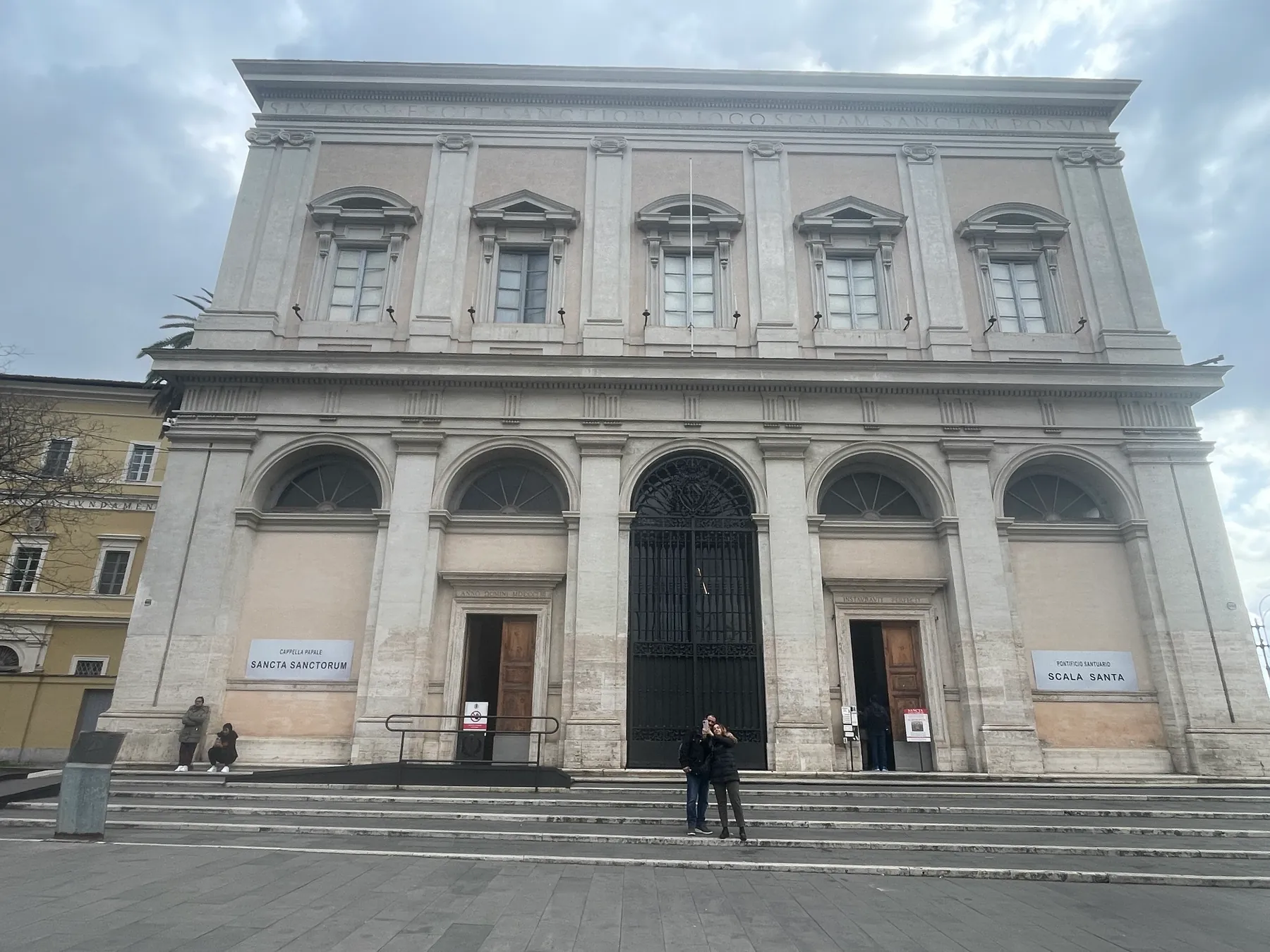
Today the steps stand in the Pontifical Sanctuary of the Holy Stairs, directly across from the Archbasilica of St John Lateran.
What are the Holy Stairs?
The central staircase consists of marble steps protected by a wooden covering. Pilgrims ascend this staircase only on their knees, traditionally praying and meditating upon the Passion of Christ as they proceed. Three of the steps also contain stains of blood which by tradition is the blood of Jesus, as he stood on the steps after His scourging to be judged again by Pilate.
Other staircases run beside it, allowing visitors to reach the upper chapels without undertaking the kneeling devotion. This distinction matters: the central ascent is an act of prayer rather than an unusual tourist challenge.
Did Jesus climb the Holy Stairs?
Catholic Scripture and Tradition identify them with steps from Pilate’s praetorium in Jerusalem and attributes their translation to Rome to St Helena in the fourth century. Their later history in Rome is well established, while their precise earlier provenance is also well supported archaeologically.
The sanctuary’s enduring importance also arises from the centuries of prayer offered there and from the way the devotion directs pilgrims contemplation towards Christ’s salvific Passion.
Why do pilgrims climb the Scala Santa on their knees?
The physical ascent expresses penance, humility and union with Christ’s suffering. Each step slows the pilgrim down. The devotion resists the temptation to consume sacred places quickly and instead demands attention, effort and prayer.
Those unable to ascend on their knees can still pray at the sanctuary. The value of the devotion lies in conversion of heart, not in physical performance for its own sake.
The Sancta Sanctorum
At the top of the complex stands the Sancta Sanctorum, once the private chapel of the popes. Its name means “Holy of Holies” and reflects the precious relics historically associated with it.
The chapel also contains the celebrated image of Christ known as the Acheropita—an icon traditionally described as “not made by human hands”. Its full history and place in Roman devotion reveal that the sanctuary is far more than a staircase.
What else should pilgrims visit nearby?
The Archbasilica of St John Lateran is immediately opposite. It is Rome’s cathedral, the ecclesiastical seat of the Bishop of Rome and the Mother Church of the world. It should not be treated as merely another basilica near the Scala Santa.
The relationship between the papal cathedral, the former Lateran Palace, the Holy Stairs and the Sancta Sanctorum is best understood as part of one Catholic landscape.
The St John Lateran Cathedral and Holy Steps Tour introduces this setting with a knowledgeable Catholic guide.
Practical advice for visiting the Holy Stairs
- Dress modestly because the Scala Santa is an active Catholic sanctuary.
- Maintain silence around those making the devotion.
- Do not photograph the stairs.
- Use the parallel stairs if you are not ascending the central staircase on your knees.
- Allow time for prayer rather than treating the visit as a quick photograph.
Opening arrangements and access to particular areas may change during liturgies, restoration or special events.
The Holy Stairs and the relics of Christ’s Passion
The Scala Santa forms part of Rome’s wider geography of the Passion. Other churches preserve traditions connected with the Flagellation, the Cross, the Holy Nail, the Crown of Thorns and the inscription placed above Christ.
These connections can be explored on the Via Crucis – Relics of Christ Tour. The guide supplies the historical and spiritual interpretation deliberately not reproduced in a short online article.