Updated 20 August 2026 San Clemente in Rome is one of the clearest places in the city to encounter the continuity of Catholic history. Near the Colosseum, a twelfth-century basilica stands above a fourth-century church and first-century Roman buildings. Descending through the complex is therefore not simply an archaeological experience: it is a journey from imperial Rome, through the age of the early Church, into the public and enduring worship of Catholic Rome. The Basilica of St Clement matters because its layers bring together apostolic memory, persecution, pagan Rome, Christian freedom, sacred art and the veneration of saints. Few churches allow pilgrims to see so vividly how the Catholic faith took root in Rome and remained present through the centuries. Explore San Clemente with an expert Catholic guide on the St Clement’s Basilica Underground Tour. San Clemente Rome: key facts QuestionAnswerWhere is San Clemente?About five minutes on foot from the Colosseum, on the road towards St John LateranWho is the basilica dedicated to?Pope St Clement I, an early successor of St PeterWhat are its principal levels?The present twelfth-century basilica, a fourth-century basilica and first-century Roman buildingsWhy is it important to Catholic history?It preserves evidence of Christian worship, sacred art and devotion across many centuriesWhich saints are especially connected with it?St Clement, St Ignatius of Antioch and St CyrilWho rediscovered the buried basilica?The Irish Dominican Fr Joseph Mullooly began the excavations in 1857 Who was Pope St Clement? The basilica takes its name from Pope St Clement I, traditionally counted among the earliest successors of St Peter. He lived close to the Apostolic Age and is remembered as one of the Apostolic Fathers: Christian writers whose lives and teaching form a bridge between the Apostles and the generations that followed them. That connection gives San Clemente a significance deeper than its
Updated 20 August 2026
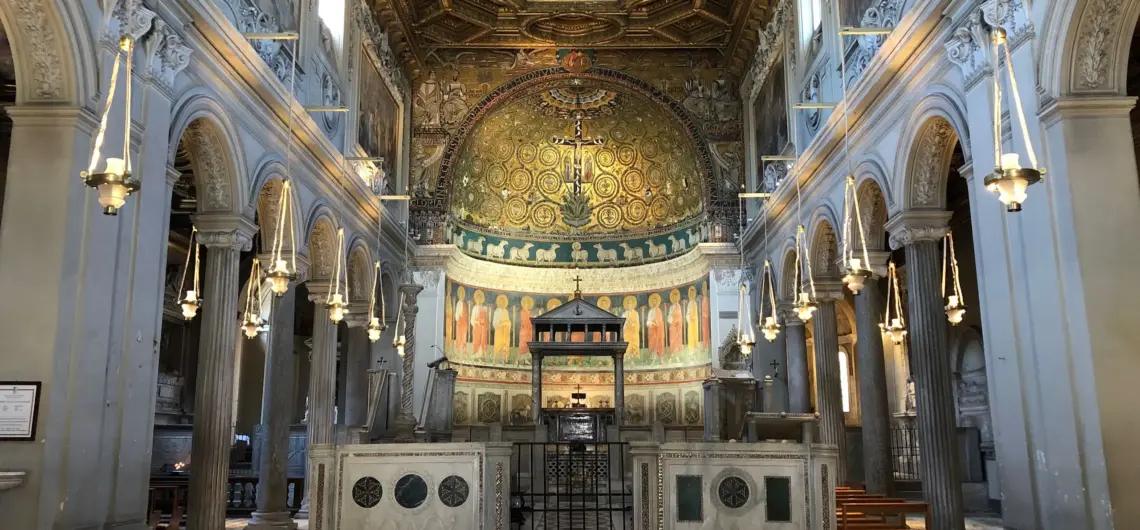
San Clemente in Rome is one of the clearest places in the city to encounter the continuity of Catholic history. Near the Colosseum, a twelfth-century basilica stands above a fourth-century church and first-century Roman buildings. Descending through the complex is therefore not simply an archaeological experience: it is a journey from imperial Rome, through the age of the early Church, into the public and enduring worship of Catholic Rome.
The Basilica of St Clement matters because its layers bring together apostolic memory, persecution, pagan Rome, Christian freedom, sacred art and the veneration of saints. Few churches allow pilgrims to see so vividly how the Catholic faith took root in Rome and remained present through the centuries.