

Updated 20 August 2026
San Clemente in Rome is one of the clearest places in the city to encounter the continuity of Catholic history. Near the Colosseum, a twelfth-century basilica stands above a fourth-century church and first-century Roman buildings. Descending through the complex is therefore not simply an archaeological experience: it is a journey from imperial Rome, through the age of the early Church, into the public and enduring worship of Catholic Rome.
The Basilica of St Clement matters because its layers bring together apostolic memory, persecution, pagan Rome, Christian freedom, sacred art and the veneration of saints. Few churches allow pilgrims to see so vividly how the Catholic faith took root in Rome and remained present through the centuries.
Explore San Clemente with an expert Catholic guide on the St Clement’s Basilica Underground Tour.
San Clemente Rome: key facts
| Question | Answer |
|---|---|
| Where is San Clemente? | About five minutes on foot from the Colosseum, on the road towards St John Lateran |
| Who is the basilica dedicated to? | Pope St Clement I, an early successor of St Peter |
| What are its principal levels? | The present twelfth-century basilica, a fourth-century basilica and first-century Roman buildings |
| Why is it important to Catholic history? | It preserves evidence of Christian worship, sacred art and devotion across many centuries |
| Which saints are especially connected with it? | St Clement, St Ignatius of Antioch and St Cyril |
| Who rediscovered the buried basilica? | The Irish Dominican Fr Joseph Mullooly began the excavations in 1857 |
Who was Pope St Clement?
The basilica takes its name from Pope St Clement I, traditionally counted among the earliest successors of St Peter. He lived close to the Apostolic Age and is remembered as one of the Apostolic Fathers: Christian writers whose lives and teaching form a bridge between the Apostles and the generations that followed them.
That connection gives San Clemente a significance deeper than its architecture. The site stands within the memory of the earliest Church of Rome, when fidelity to Christ could demand martyrdom and when the structures of Christian worship were still developing under the shadow of imperial power.
The first-century buildings include the traditional family home of St Clement. Here the memory of the Apostolic Church converges with the early Christian title church, the ancient basilica and the living Catholic church above.
Why do the layers beneath San Clemente matter?
Rome is a city built upon itself, but at San Clemente that familiar phrase becomes tangible. The visitor can move down from the present basilica into an earlier Christian church and then deeper into Roman structures from the first centuries of the Empire.
- The upper basilica presents the mature sacramental and artistic world of medieval Catholic Rome.
- The lower basilica preserves the space, frescoes and liturgical memory of an earlier Christian community.
- The Roman level reveals the physical setting in which Christianity first spread through the capital of the Empire.
These are not three unrelated attractions stacked on top of one another. Together they show continuity amid change. Buildings were altered, street levels rose and artistic languages developed, yet the memory of St Clement and the worship of Christ endured.
A window into the world of early Christianity in Rome
The lowest accessible areas contain Roman buildings constructed in the first centuries after Christ. They evoke the urban world known by the first Christians: dense neighbourhoods, public buildings, private houses and religious cults existing beside one another near the heart of imperial power.
For Catholic pilgrims, this setting helps rescue early Christianity from abstraction. The Church in Rome did not begin as a collection of later monuments. It began among real communities confessing Christ within the ordinary and often hostile world of the Empire. San Clemente allows visitors to stand within that environment rather than merely imagine it.
What does the Mithraeum reveal?
One of the Roman spaces was adapted around the end of the second century for the worship of Mithras. Its survival beneath a Christian basilica offers striking evidence of Rome’s religious landscape before Christianity became legally established.
The contrast should not be reduced to a theatrical contest between two underground religions. It is more historically useful—and more spiritually serious—to recognise the different world in which the Gospel was preached. The early Church grew among established cults, social loyalties and imperial traditions. Christianity’s eventual public presence in Rome was neither automatic nor inevitable from a human point of view.
The fourth-century basilica and the emergence of public Christian worship
By around the year 400, the earlier Christian complex had been transformed into a basilica. This lower church belongs to the period in which Christianity had emerged from persecution and could worship with increasing public visibility.
The change in scale matters. A Christian community once living within imperial Rome now possessed a substantial sacred building with a nave, aisles, sanctuary and liturgical furnishings. Later additions—including a baptistry, sacristy and important frescoes—show that this was not merely a historical shell. It was a place where Catholics were baptised, instructed, celebrated the sacred liturgy and honoured the saints.
The surviving medieval frescoes also make the buried basilica one of Rome’s most important records of early medieval Christian art. They deserve more than a quick photograph: their subjects, placement and historical setting reveal how the faith was taught and remembered before widespread literacy.
The present basilica: Catholic continuity made visible
The lower church was abandoned around 1100 as the ground level of Rome had risen. A new basilica was built above it, incorporating marble and liturgical elements from the earlier church.
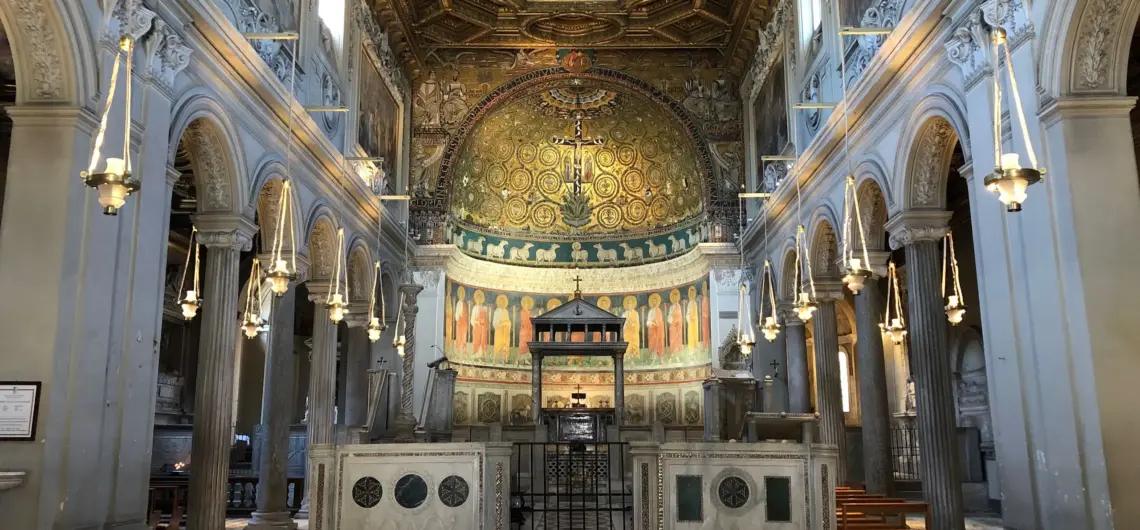
Its apse mosaic, ancient marble choir enclosure and Cosmatesque pavement belong to a world very different in appearance from the Roman chambers below. Nevertheless, the essential story is continuity. The same Catholic Church that remembered St Clement in late antiquity continued to worship above the buried basilica in the Middle Ages and still worships there today.
The apse presents the Cross not as an isolated instrument of execution but as the source of life within the Church. Its theology is communicated through a carefully ordered field of biblical and symbolic imagery. A visitor can admire its beauty immediately; understanding why that imagery belongs together requires slower Catholic interpretation.
St Clement, St Ignatius and St Cyril
San Clemente is not only an archaeological site. It is a place of pilgrimage and the veneration of saints.
- St Clement of Rome connects the basilica with the generation immediately following the Apostles.
- St Ignatius of Antioch, the great bishop and martyr brought to Rome in the early second century, is honoured here with St Clement.
- St Cyril, Apostle to the Slavs and co-patron of Europe, died in Rome and was buried at San Clemente. His tomb remains a destination for pilgrims.
These saints widen the meaning of the church. San Clemente belongs not merely to Roman history, but to the history of the universal Church: apostolic succession, martyrdom, missionary work and the transmission of the faith across peoples and languages.
The Irish Dominicans and the rediscovery of the ancient basilica
San Clemente has been entrusted to the Dominicans for centuries and became an important home for the Irish Dominican Province during periods of persecution in Ireland. In 1857, the prior, Fr Joseph Mullooly OP, began excavating beneath the present church and uncovered the forgotten fourth-century basilica. Further work revealed the still earlier Roman buildings below.
The discovery transformed modern understanding of the site. It also adds a distinctly Catholic dimension to the history of archaeology at San Clemente: a religious community responsible for the living basilica helped recover the physical memory of the earlier Church beneath it.
Why visit San Clemente with a Catholic guide?
San Clemente can be visited independently, but its significance is easy to fragment. Without a clear framework, the Roman buildings, Mithraeum, buried basilica, medieval frescoes, relics and apse mosaic can become a succession of impressive but disconnected objects.
A Catholic guide restores the unity of the site by showing how its archaeology and sacred tradition illuminate the Apostolic Church, the end of persecution, the development of public worship, the communion of saints and the continuity of Catholic Rome.
Crucis Tours deliberately reserves the detailed interpretation of particular artworks, inscriptions and spaces for the guided visit. The St Clement’s Basilica Underground Tour is an approximately one-hour Catholic experience including entrance to the excavations. It is designed for pilgrims who want to understand what the site means, not simply pass through its levels.
San Clemente or the Roman catacombs?
Both illuminate early Christianity, but they do so differently. Rome’s catacombs primarily reveal Christian burial, commemoration and faith in the resurrection outside the ancient city walls. San Clemente stands within the urban fabric and shows successive places of life and worship beneath a functioning basilica.
For visitors with limited time, San Clemente offers an unusually concentrated introduction to the movement from imperial Rome to public Catholic worship. Those wanting a broader pilgrimage can continue on the Early Christianity Tour of Rome, which connects San Clemente with other places central to the emergence of Christian Rome.
Frequently asked questions about San Clemente Rome
Is San Clemente close to the Colosseum?
Yes. The basilica is in Piazza di San Clemente, approximately five minutes on foot from the Colosseum and on the route towards the Archbasilica of St John Lateran.
How many levels does San Clemente have?
Visitors commonly experience three principal historical levels: the present twelfth-century basilica, the buried fourth-century basilica and the first-century Roman buildings below. Within those levels are structures and additions from several different periods.
Is San Clemente an active Catholic church?
Yes. It remains a living basilica with regular Catholic worship, not merely a museum or archaeological attraction. Visitors should dress and behave appropriately for a sacred place.
Are the excavations included in the Crucis tour?
Yes. Entrance tickets to the excavations are included in the St Clement’s Basilica Underground Tour, together with an expert Catholic guide.
Which tour is best for understanding early Christian Rome?
Choose the one-hour St Clement tour for a focused visit to the basilica and excavations. Choose the longer Early Christianity Tour if you want to connect San Clemente with other major sites in the development of Catholic Rome.
Walk through the history of Catholic Rome
At San Clemente, Rome’s layers do more than reveal an ancient city. They reveal a Church living through different ages: rooted in apostolic memory, tested in a pagan empire, worshipping publicly after persecution and handing on the same Catholic faith through sacred liturgy, art and the veneration of saints.
Check dates and availability for the St Clement’s Basilica Underground Tour, or compare all Catholic tours in Rome.