

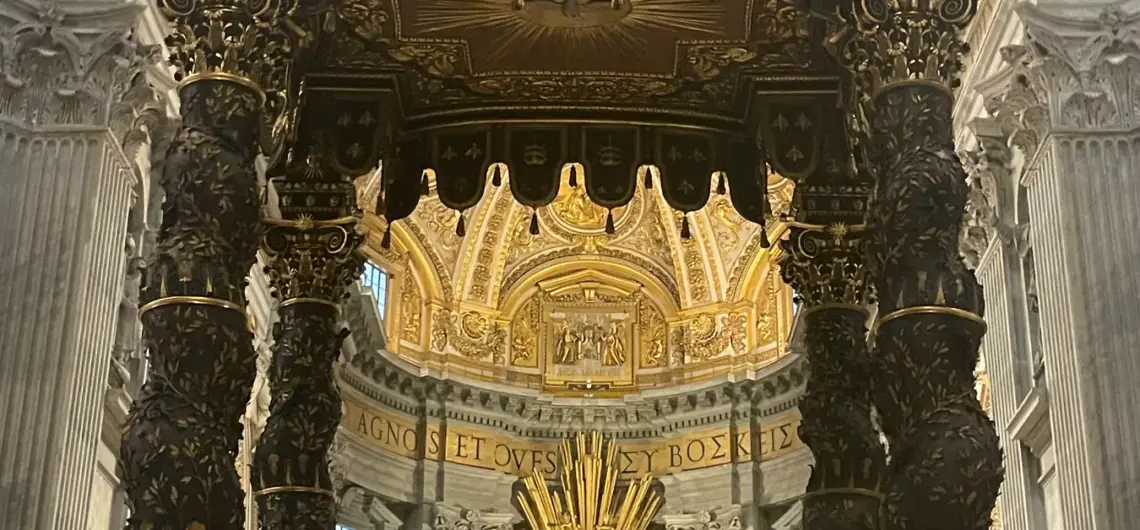
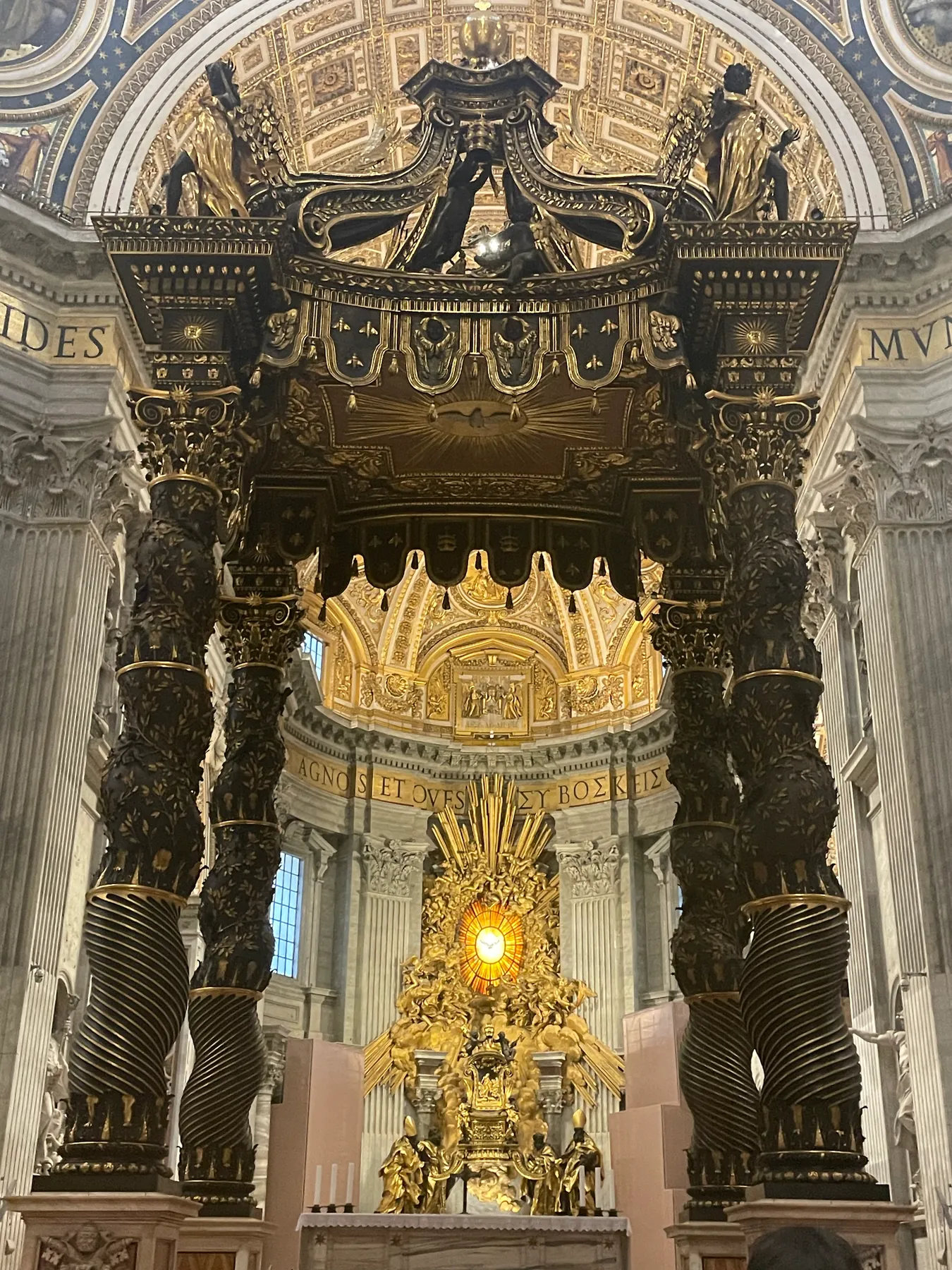
St Peter’s Basilica contains sacred traditions connected with St Peter himself and with the Passion of Jesus Christ. Beneath its splendour lies the tomb of St Peter, while the great crossing preserves the Holy Lance, Veronica’s Veil and a fragment of the True Cross.
Most visitors notice the scale of the basilica. Far fewer understand how its relics shaped the building’s art, architecture and purpose.
Is St Peter buried beneath the basilica?
St Peter was martyred in Rome and buried on Vatican Hill. The basilica’s high altar stands directly over his tomb, giving physical expression to the Church’s continuity with the Apostle to whom Christ said: “You are Peter, and upon this rock I will build my Church.”
Twentieth-century excavations beneath the basilica uncovered the Roman necropolis, the ancient place of Christian veneration and the remains identified with St Peter. This sacred tomb is the reason the basilica stands on Vatican Hill.
The four great relic statues beneath the dome
Four colossal statues stand in the piers supporting Michelangelo’s dome. They represent St Longinus, St Veronica, St Helena and St Andrew. The first three correspond to relic traditions directly associated with Christ’s Passion.
The Holy Lance of St Longinus
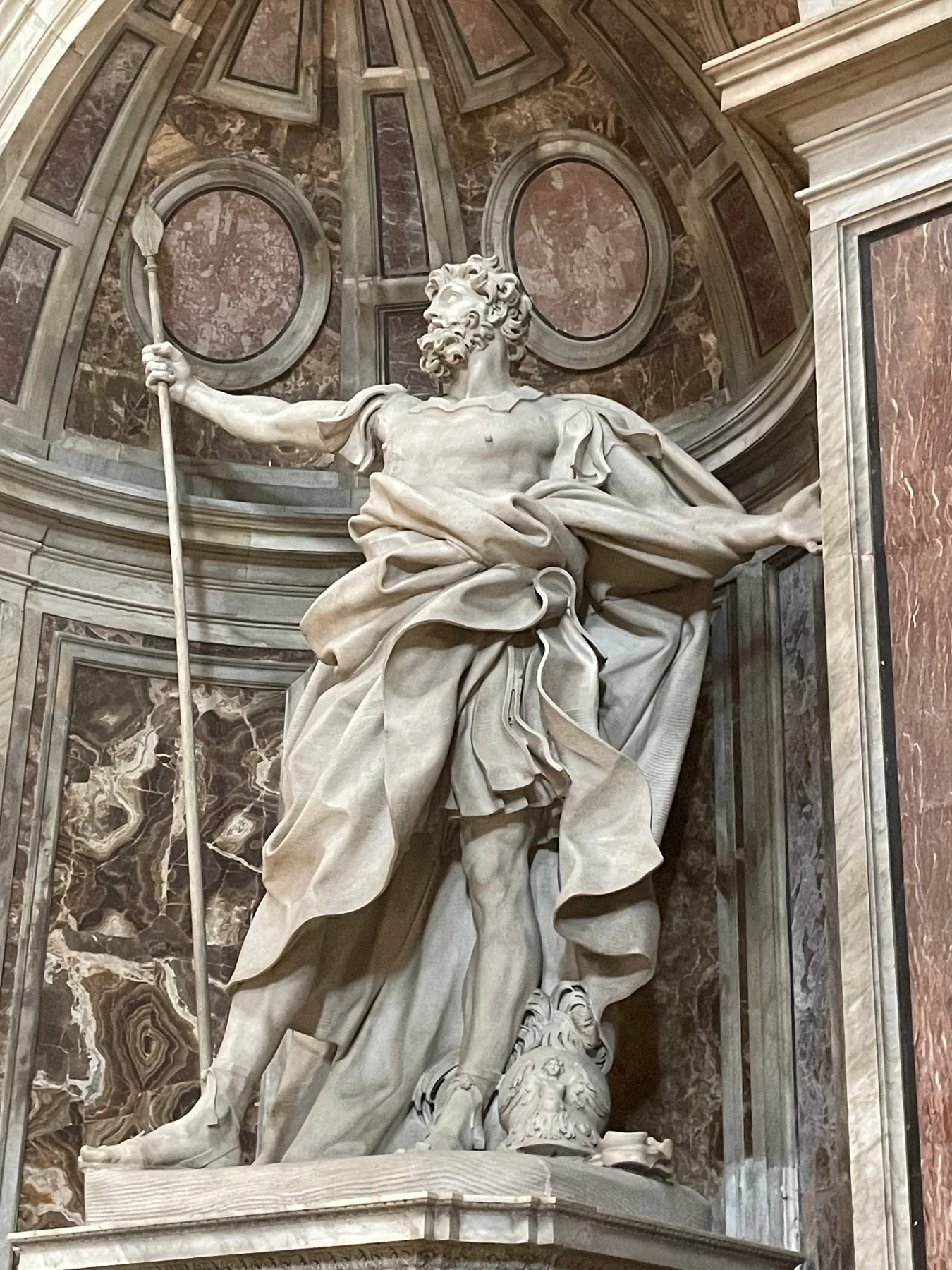
St John’s Gospel records that the soldier St Longinus pierced the side of Christ with a lance. A relic of the Holy Lance is safeguarded within St Peter’s, represented below by Bernini’s powerful statue of the saint.
Veronica’s Veil
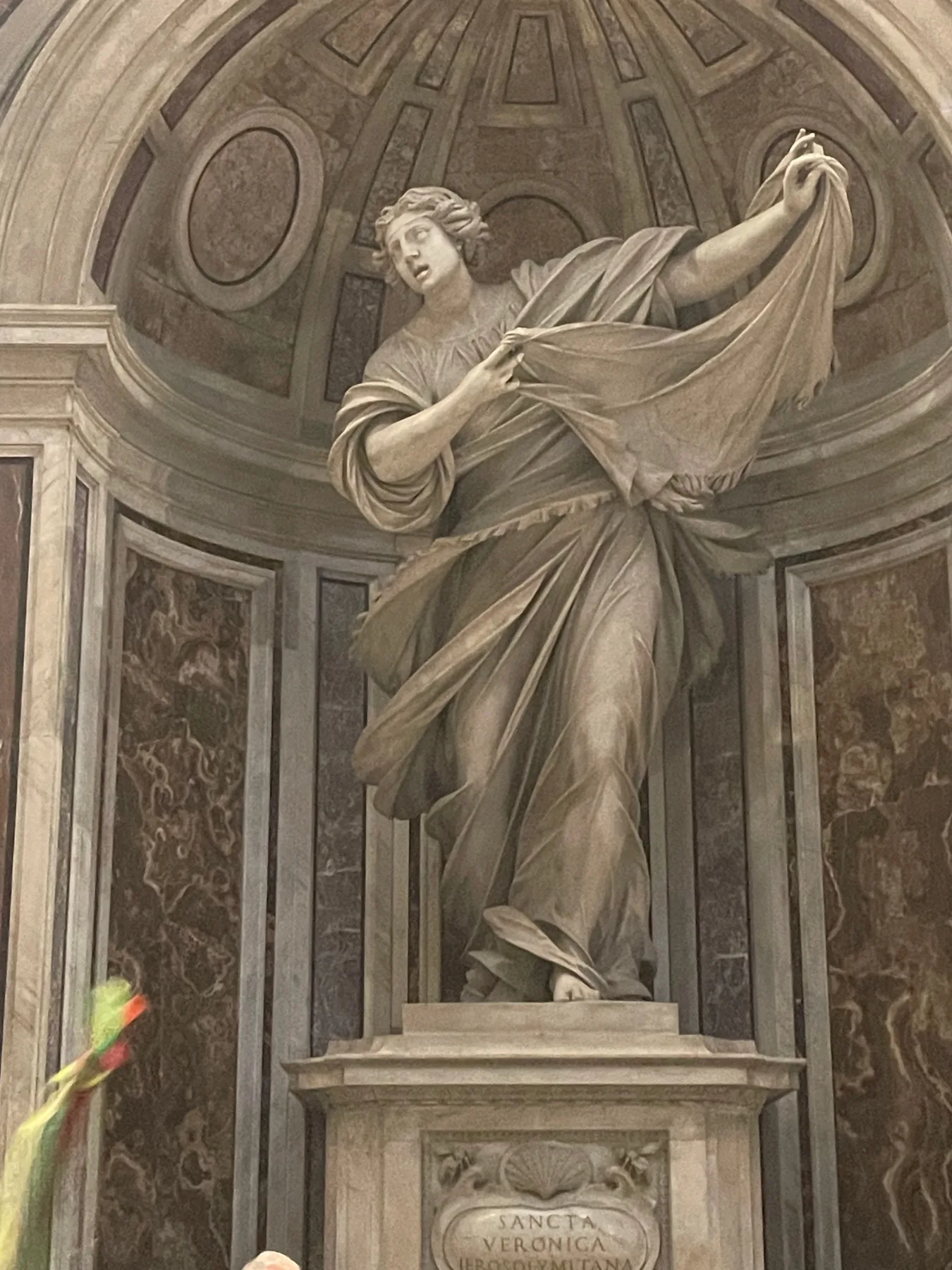
During the Way of the Cross, St Veronica wiped the face of Jesus and received His sacred image upon her veil. The relic of that veil became one of medieval Rome’s greatest objects of pilgrimage.
Veronica’s loving act and the sacred veil have inspired generations of Catholics to contemplate the Holy Face of Christ and His suffering upon the road to Calvary.
The True Cross and St Helena
St Helena discovered the True Cross in Jerusalem. A fragment of the Cross is preserved within the basilica, while further Passion relics are venerated at Santa Croce in Gerusalemme.
St Andrew
The fourth statue represents St Andrew, Peter’s brother and an Apostle of Christ. The relic history associated with him differs from the three Passion relic traditions, but his place completes the devotional programme beneath the dome.
Can visitors see the Passion relics?
The relics are safeguarded in the upper reliquary spaces and are not ordinarily approached as museum exhibits. Particular relics may be shown in connection with the Church’s liturgical calendar, but ordinary visitors should not expect close daily viewing.
Their presence can still be read in the statues, inscriptions and entire design of the crossing. This is one reason a guided Catholic interpretation differs so greatly from a general architectural visit.
Other saints and relics in St Peter’s Basilica
The basilica contains the tombs or relics of numerous popes and saints. Their locations reflect different periods of Church history and different forms of Catholic sanctity.
A complete catalogue would be lengthy and would still fail to explain why particular memorials occupy particular places. The more important question is how St Peter’s presents the communion of saints around the Apostle’s tomb and the altar of sacrifice.
Why take a Catholic tour of St Peter’s?
Artistic facts alone cannot explain St Peter’s Basilica. Its architecture is ordered around the Mass, the papacy, martyrdom, relics and the Catholic understanding of the Church.
The St Peter’s Basilica Catholic Tour is a standalone pilgrimage tour focused upon the basilica rather than the Vatican Museums. A knowledgeable, practising Catholic guide explains the spiritual meaning behind details that general visitors frequently miss.
Pilgrims wishing to place the basilica within the wider Roman tradition can also visit it as part of the 4 Major Basilicas in 1 Day Tour.