

Updated and verified: 24 August 2026 · Official Vatican links and practical details can change, so always recheck the Holy See calendar before travelling.
The two most reliable ways to see Pope Leo XIV in Rome are the Wednesday General Audience and the Sunday Angelus in St Peter’s Square. General Audiences usually require a free ticket; the Sunday Angelus normally does not. Papal Masses and special celebrations offer further opportunities, but dates, venues and ticket arrangements vary.
This Catholic guide explains how to see Pope Leo XIV, how to request official tickets without paying a fee, what each event is really like, and how to plan a visit responsibly. It also introduces Robert Francis Prevost—Chicago-born missionary, Augustinian friar, Bishop of Rome and the first pope from the United States—and the Roman churches that illuminate his office and vocation.
How to see Pope Leo XIV in Rome: the quick answer
| Opportunity | Usual pattern | Ticket? | Best for |
|---|---|---|---|
| General Audience | Wednesday morning, often at 10:00 | Yes—official tickets are free | Catechesis, prayers and seeing the Pope among pilgrims |
| Angelus or Regina Caeli | Sunday at 12:00, normally from the Apostolic Palace window | Usually no | A shorter appearance, Gospel reflection and blessing |
| Papal Mass or liturgy | Major feasts and announced celebrations | Depends on the event; official tickets are free | Worshipping with the Holy Father at a solemn celebration |
| Special audience or public event | Announced individually | Varies | Pilgrimage groups, jubilees and particular Catholic communities |
First rule: consult the official calendar of Pope Leo XIV before arranging your day. General Audiences can be moved, suspended or held in the Paul VI Audience Hall, and the Holy Father may be away from Rome on an apostolic journey or pastoral visit.
1. Attend Pope Leo XIV’s Wednesday General Audience
For most Catholic pilgrims, the Wednesday General Audience is the fullest and most dependable public encounter with Pope Leo XIV. It is not a private audience and it is not normally a Mass. It is a gathering of the universal Church around the Successor of St Peter for prayer, catechesis, greetings and the Apostolic Blessing.
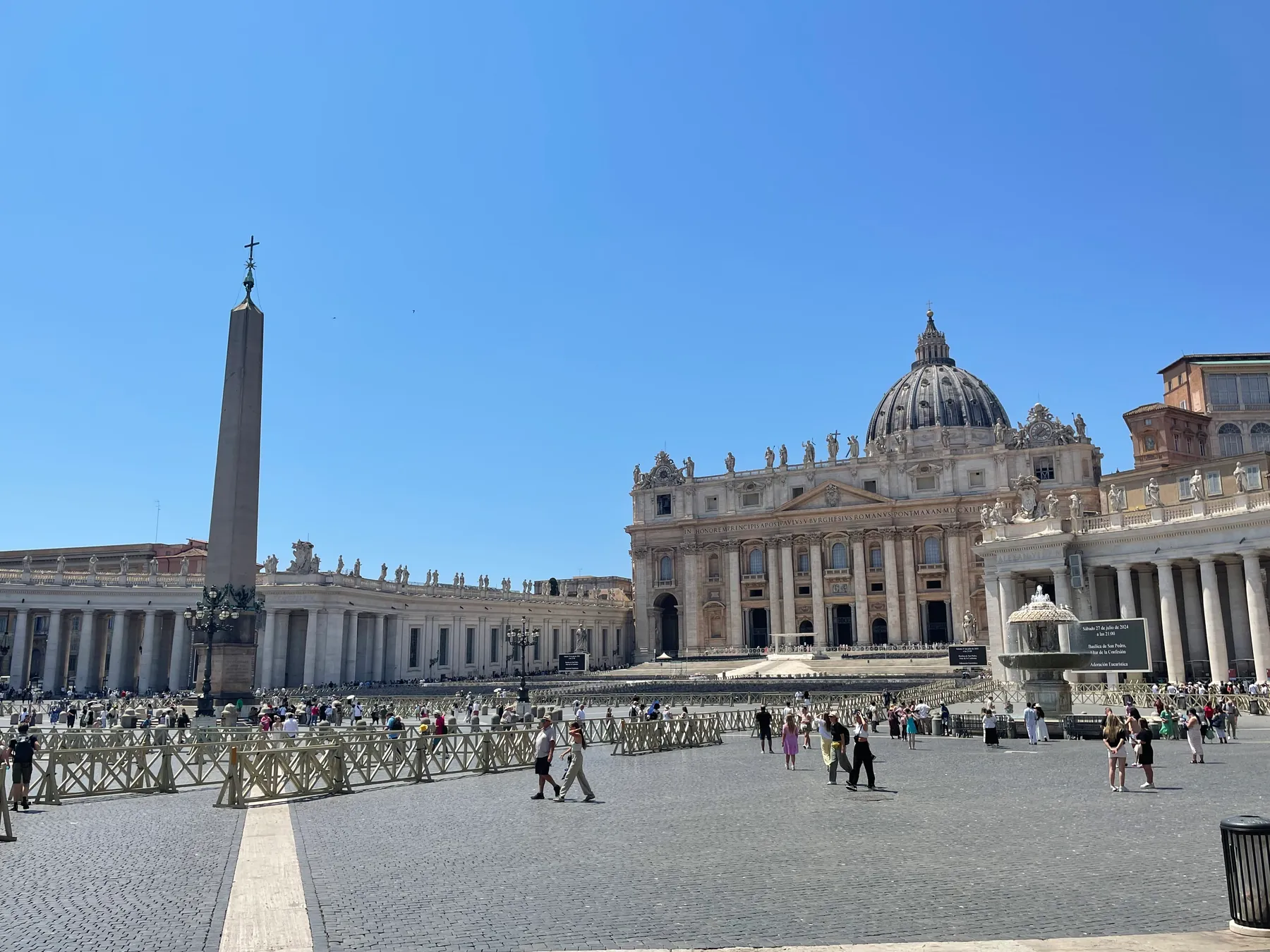
The audience commonly begins at 10:00, although the precise time and venue must be verified for the chosen date. In suitable weather it is often held in St Peter’s Square. At other times it may take place in the Paul VI Audience Hall. Larger gatherings can extend across more than one Vatican venue.
How to obtain free Papal Audience tickets
- Open the Holy See’s official page for participation in audiences and pontifical celebrations.
- Under Lay Faithful, follow the official booking access provided by the Prefecture of the Papal Household.
- Select the available audience or celebration and submit the requested details for your party.
- Follow the confirmation and collection instructions issued by the Vatican. Procedures can change, so rely on the instructions for your particular event rather than an old travel post.
Papal Audience tickets are always free. Vatican News confirms this explicitly, as does the Holy See’s booking page. A commercial company may legitimately charge for a guided experience, transport or administration, but nobody is selling the Vatican ticket itself. Be cautious of any listing that makes a free admission ticket appear to be a paid Vatican product.
What happens at a General Audience?
The Holy Father normally offers a catechesis rooted in Scripture and Catholic doctrine. Summaries and greetings may be given in several languages, pilgrims pray the Our Father, and the Pope imparts his blessing. When circumstances permit, he may pass through sections of the assembly in the popemobile before the formal audience begins. The route, pace and proximity are never guaranteed.
Bring religious articles that you wish to have blessed, such as Rosaries or holy medals. The blessing is imparted to those present and to their devotional objects; you do not need to hold each object up or obtain an individual blessing.
How early should you arrive?
Allow generous time for Vatican security and for finding the correct entrance or sector. The sensible arrival time depends on the venue, season, group size and the instructions attached to your ticket. A ticket provides admission to the event; it does not promise a particular seat or a close view of the Pope. Pilgrims should plan patiently and avoid treating the occasion as a race for position.
2. See Pope Leo XIV at the Sunday Angelus
The simplest way to see Pope Leo XIV is often the Sunday Angelus. At 12:00 noon, when he is in Rome and the event is scheduled, the Pope normally appears at the window of his study in the Apostolic Palace overlooking St Peter’s Square. He gives a short reflection on the Sunday Gospel, prays the Angelus with the faithful, offers greetings and imparts his blessing.
During the Easter season the prayer is the Regina Caeli rather than the Angelus. The form changes; the essential character remains a public Marian prayer with the Bishop of Rome and the pilgrims gathered in the square.
A ticket is not ordinarily required for the Angelus. Entering St Peter’s Square is free, although security controls or crowd-management measures may apply. The appearance is much shorter than a General Audience and the Pope remains at the window, so it is best for pilgrims who want a simple public encounter rather than an extended audience.
Do not assume that every Sunday follows the normal pattern. The Angelus may be prayed from another location when the Pope is travelling or staying at Castel Gandolfo, and an exceptional liturgy can alter the schedule. Verify the event on the Holy See calendar shortly before your visit.
3. Attend a Papal Mass or liturgical celebration
A Papal Mass is the most explicitly liturgical way to be present with the Holy Father. Celebrations may take place in St Peter’s Basilica, St Peter’s Square or another Roman basilica, particularly on major feasts, canonisations and important moments in the life of the Church.
The Holy See publishes a separate calendar of pontifical liturgical celebrations. Ticket arrangements differ by event, but the Vatican states that official tickets for the Holy Father’s liturgical celebrations are free. Clergy wishing to concelebrate use a separate official process from the one provided for the lay faithful.
A Papal Mass should not be approached merely as the chance to photograph a famous person. Catholics come to worship Christ in the Holy Sacrifice of the Mass, in communion with the visible shepherd of the universal Church. The Pope’s presence is significant because his office serves the Church’s unity in the faith handed down from the Apostles.
Which option is best?
- Choose the General Audience if seeing Pope Leo XIV is a major purpose of your pilgrimage and you want the fullest public encounter.
- Choose the Sunday Angelus if your itinerary is less flexible or you prefer a shorter, unticketed appearance.
- Choose a Papal Mass if an announced celebration coincides with your visit and your priority is Catholic worship.
- Keep a second opportunity in mind when possible. Papal schedules necessarily change, and no responsible planner can guarantee the Pope’s presence before the Vatican confirms it.
What to know before going to the Vatican
Dress with respect
A Papal Audience is a Catholic event, even when it is held outdoors. Dress modestly and respectfully. Clothing that covers shoulders and knees is the safest standard, especially if you also intend to enter St Peter’s Basilica. Comfortable footwear is sensible because the Vatican precinct is large and standing may be required.
Expect security
Access to Vatican events involves security screening. Carry only what you need and follow the current instructions on your ticket or the official event page. Prohibited items and access arrangements can change according to the venue and occasion.
Weather and venue matter
St Peter’s Square offers little protection from strong Roman sun or rain. The Paul VI Audience Hall is indoors, but a ticket for an audience does not allow the visitor to choose the venue. Check the forecast, bring water where permitted and follow official directions.
Families, groups and pilgrims with accessibility needs
Families and parish groups are warmly represented at Papal Audiences. When requesting tickets, give accurate group information and use any accessibility fields or contact instructions provided by the Prefecture. Do not wait until arrival to disclose needs that affect access or seating.
Who is Pope Leo XIV?
Pope Leo XIV is Robert Francis Prevost, born in Chicago, Illinois, on 14 September 1955. Elected on 8 May 2025, he is the 267th Successor of St Peter, the first pope from the United States and the first Augustinian pope in the history of the Church.
His American birth is only one part of his story. After joining the Order of St Augustine, he studied theology and canon law, was ordained a priest in Rome on 19 June 1982, and served for many years as a missionary and pastor in Peru. He became a naturalised Peruvian citizen in 2015. He later served as Bishop of Chiclayo, Prior General of the Augustinians and Prefect of the Dicastery for Bishops before his election to the Apostolic See.
| Birth name | Robert Francis Prevost |
|---|---|
| Born | 14 September 1955, Chicago, Illinois |
| Religious order | Order of St Augustine (O.S.A.) |
| Priestly ordination | 19 June 1982, Chapel of St Monica, Rome |
| Elected pope | 8 May 2025 |
| Papal name | Leo XIV |
| Motto | In Illo uno unum — “In the One, we are one” |
| Languages listed by the Holy See | English, Spanish, Portuguese, French and Italian |
Why did Robert Prevost choose the name Leo XIV?
Pope Leo XIV explained his principal reason two days after his election. Pope Leo XIII had addressed the social question of the first industrial revolution in the 1891 encyclical Rerum Novarum. The new Pope chose the name Leo as the Church confronted another technological transformation, particularly artificial intelligence, with new questions about human dignity, justice and labour.
The name therefore joins continuity with a present duty. Leo XIII’s pontificate was far broader than a single document: the Catholic Encyclopedia’s biography of Pope Leo XIII records his defence of Catholic education, his promotion of Thomistic philosophy, his Scriptural teaching and his concern for the Church across the world. Leo XIV’s choice directs Catholics to that inheritance while asking how perennial truth should illuminate genuinely new circumstances.
In May 2026 Pope Leo XIV published the encyclical Magnifica Humanitas, applying Catholic social doctrine to digitalisation, artificial intelligence, robotics and the dignity of the human person. The document makes the meaning of his chosen name still clearer.
What does Pope Leo XIV’s motto mean?
His motto is In Illo uno unum: “In the One, we are one.” It comes from St Augustine’s exposition of Psalm 127 and expresses the unity of Christians in the one Christ. Pope Leo retained the motto he had used as a bishop.
His coat of arms also bears the Augustinian emblem of a heart pierced by an arrow above a book, recalling the conversion of St Augustine through the Word of God. The blue field and white lily carry Marian significance. Together, the motto and arms place communion in Christ, the Word of God, conversion and devotion to Our Lady at the centre of his public identity.
“Peace be with you all!”
Pope Leo XIV’s first greeting from the central loggia of St Peter’s Basilica, 8 May 2025
His first words deliberately echoed the risen Christ. He then identified himself as “an Augustinian, a son of Saint Augustine” and recalled the saint’s teaching: with the faithful he is a Christian; for them he is a bishop. That is the correct Catholic frame for seeing the Pope—not celebrity, but the pastoral office of the Bishop of Rome in service to Christ and His Church.
Pope Leo XIV’s Rome: three places that explain his office
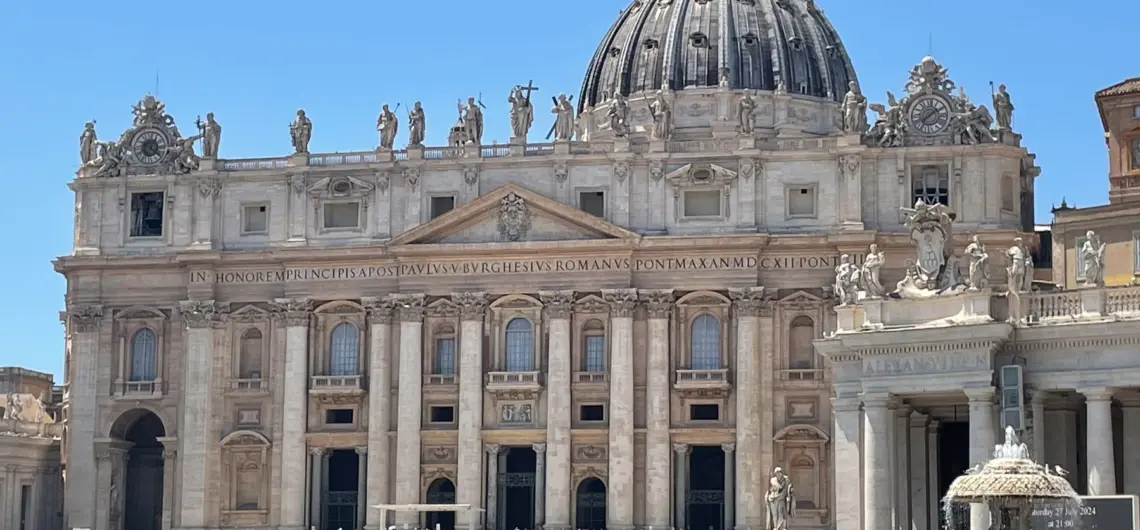
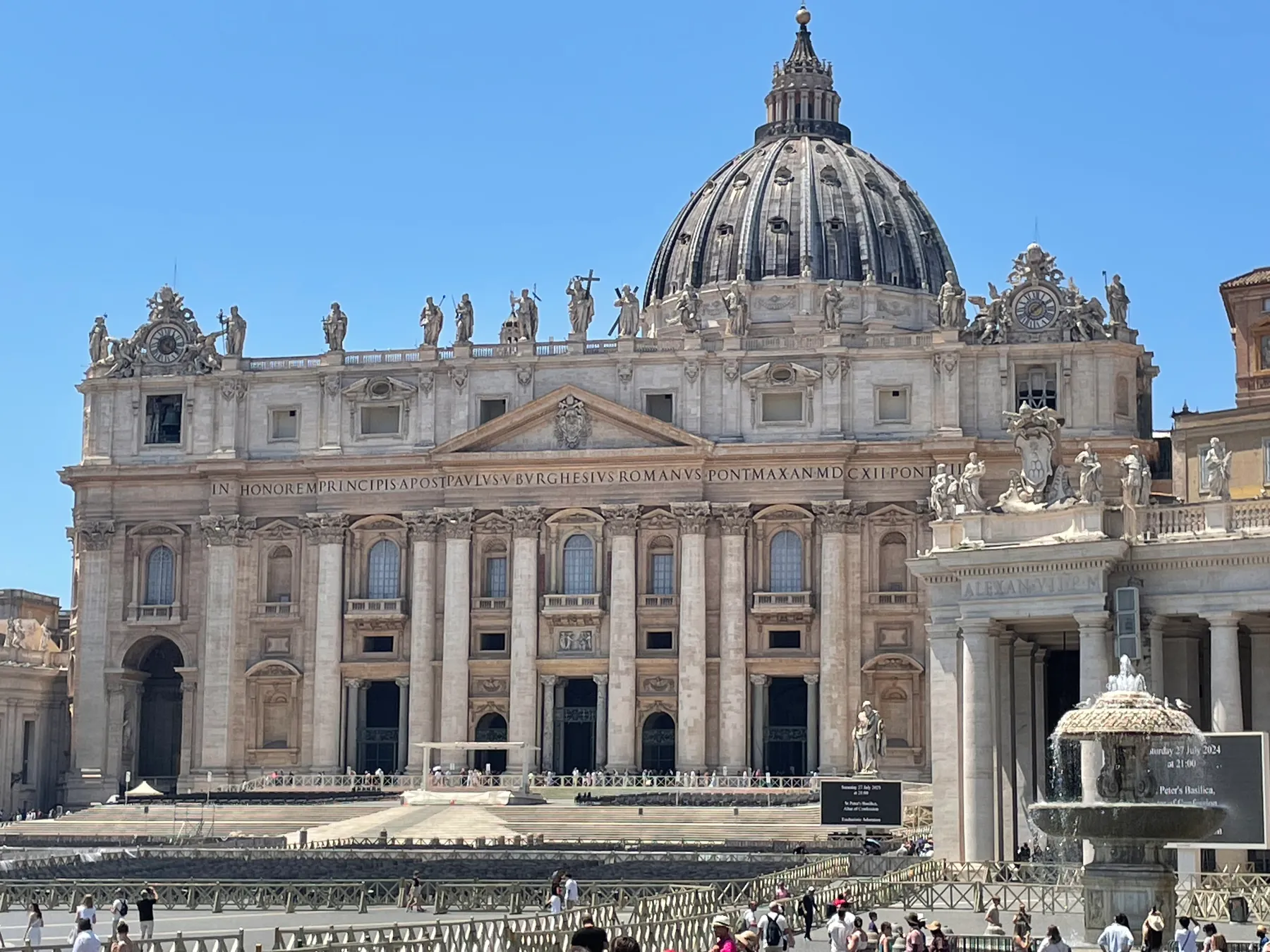
St Peter’s Basilica and Square
St Peter’s is the visible centre of most pilgrim encounters with the Pope. The basilica rises above the tomb of St Peter, the Apostle to whom Christ said: “You are Peter, and on this rock I will build my church” (Matthew 16:18). The General Audience and Angelus are not isolated attractions: they take their meaning from apostolic succession, the martyrdom of Peter and the Church’s unity.
Crucis Tours’ St Peter’s Basilica Catholic Tour explores that Scriptural, historical and devotional meaning with a practising Catholic guide. It is the natural companion to a Papal Audience or Angelus, allowing pilgrims to understand the basilica rather than merely pass through it.
St John Lateran: the Pope’s cathedral
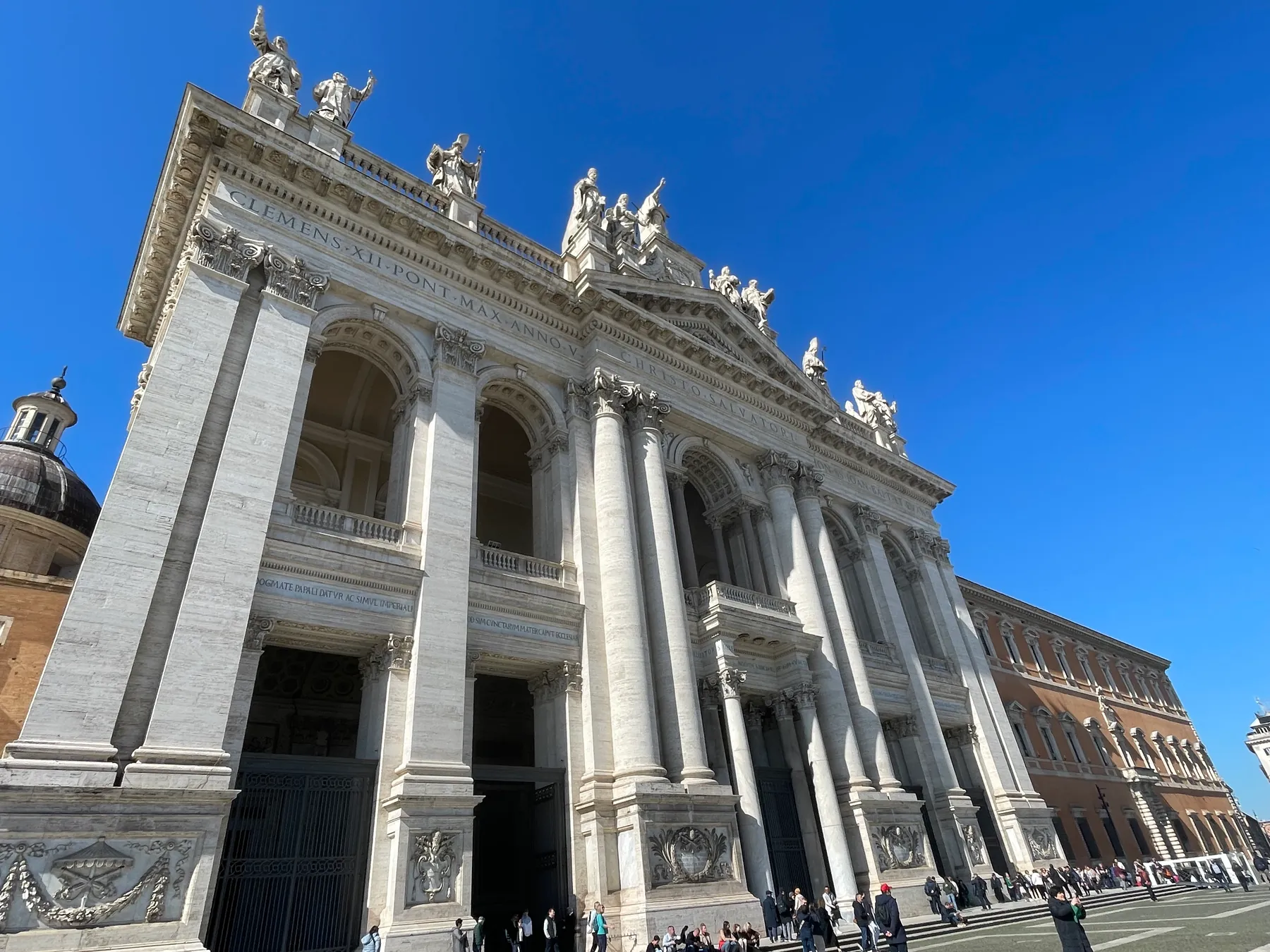
St Peter’s is the most famous papal basilica, but St John Lateran is the cathedral of the Bishop of Rome. Pope Leo XIV formally took possession of his cathedra there on 25 May 2025. Understanding this distinction answers a common question: the Pope’s episcopal seat is at the Lateran, even though his residence and most familiar public appearances are at the Vatican.
The Chapel and College of St Monica
As a young Augustinian priest, Robert Prevost lived at the International College of St Monica while studying canon law at the Angelicum. He was ordained to the priesthood in the Chapel of St Monica in 1982, and the church later became his cardinalatial title. This quieter Augustinian connection helps pilgrims understand the life of prayer, study, community and mission that preceded his election.
Can you meet Pope Leo XIV personally?
Attendance at a General Audience does not mean a private meeting, handshake or photograph. Individual encounters are limited and cannot be promised by a tour operator, ticket or particular seat. Requests for special audiences pass through ecclesiastical and diplomatic channels and are not a normal tourist booking.
A public audience is nevertheless a genuine encounter with the Pope’s teaching and blessing. For a Catholic pilgrim, its value does not depend on personal recognition. One comes as a member of the Church, to pray with fellow Catholics from many nations and to receive the word offered by the Successor of Peter.
Frequently asked questions about seeing Pope Leo XIV
Is Pope Leo XIV at the Vatican every Wednesday?
No. Wednesday is the customary day for a General Audience, but audiences can be suspended, moved or omitted when the Pope is travelling or the calendar requires it. Check the official Holy See calendar for the exact date.
Are tickets to see Pope Leo XIV free?
Official tickets for General Audiences and papal liturgical celebrations are free. Use the Holy See booking page and never confuse a free Vatican ticket with a separately priced guided service.
Do I need a ticket for the Sunday Angelus?
Normally, no. The faithful usually enter St Peter’s Square without an event ticket for the Angelus or Regina Caeli. Security and access controls still apply, and exceptional events can change the arrangements.
What time is the Pope’s Sunday Angelus?
It is customarily at 12:00 noon Rome time. Confirm the date, time and location on the Holy See calendar, especially during apostolic journeys and summer periods.
Can I attend Mass celebrated by Pope Leo XIV?
Yes, when a public papal liturgy is announced and admission is available. Consult the official calendar of pontifical celebrations and follow the ticket instructions for that event.
Where does Pope Leo XIV live?
Since March 2026, Pope Leo XIV has occupied the papal apartment in the Apostolic Palace. It includes the study whose window overlooks St Peter’s Square and from which the Sunday Angelus is commonly led. He may also spend periods at the papal residence in Castel Gandolfo.
Is Pope Leo XIV the first American pope?
Yes. The Holy See identifies him as the first pope from the United States of America. He is also a naturalised citizen of Peru and the first member of the Order of St Augustine elected pope.
Where will Pope Leo XIV be buried?
No burial place for the living Pope should be assumed, and we found no official public announcement of one as of 24 August 2026. Many—but not all—Roman pontiffs are buried at St Peter’s. Our pillar guide, Where Are the Popes Buried?, explains the papal tombs and relics found across Rome’s basilicas and historic churches.
Plan a Catholic visit, not merely a sighting
Seeing Pope Leo XIV can be a memorable grace within a Roman pilgrimage, but it is most fruitful when placed inside the life of the Church. Pray at the tomb of St Peter. Attend Holy Mass. Go to Confession. Listen to the Pope’s catechesis. Then enter the basilica with enough understanding to recognise why generations of Catholics have come to Rome in communion with the Apostolic See.
If your schedule includes a Wednesday audience or Sunday Angelus, consider pairing it with the St Peter’s Basilica Catholic Tour. Crucis Tours provides Catholic catechesis through the basilica’s Scripture, sacred art, relics and history—without reducing the Vatican to a checklist of famous objects.
Official sources and further reading
- Holy See: participation in General Audiences and pontifical celebrations
- Holy See: official calendar of Pope Leo XIV
- Holy See: official biography of Pope Leo XIV
- Holy See: Pope Leo XIV’s first Urbi et Orbi blessing
- Holy See: Pope Leo XIV explains his choice of name
- Vatican News: motto and coat of arms
- Catholic Encyclopedia: Pope Leo XIII