

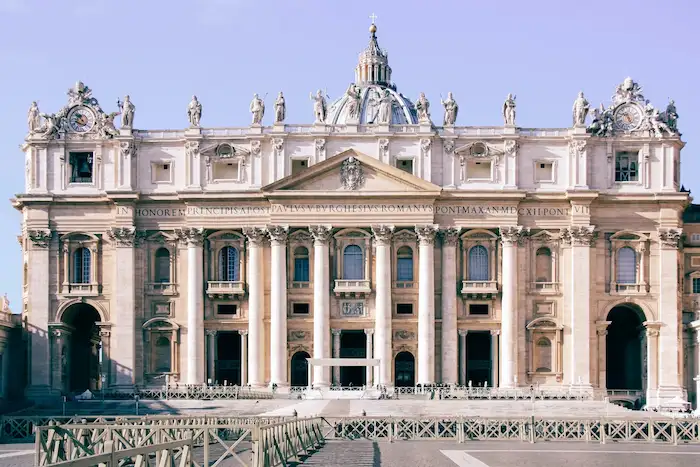
Where are the popes buried? Most of the surviving papal tombs are in Rome, above all in St Peter’s Basilica. Yet the burial places of the successors of St Peter form a sacred map extending across the Eternal City—from the Vatican Grottoes to St John Lateran, St Mary Major, St Lawrence Outside the Walls, San Clemente and the ancient catacombs.
The quick answer
Approximately 91 popes are buried in St Peter’s Basilica and the Vatican Grottoes. Others rest at St John Lateran, St Mary Major, Santa Maria sopra Minerva, St Lawrence Outside the Walls, St Paul Outside the Walls and churches beyond Rome. The earliest popes were commonly buried near the martyrs in Rome’s catacombs; some were later translated to churches, while other tombs were lost through fire, rebuilding, persecution or the passage of centuries.
For Catholics, these are not merely the graves of important historical figures. They are places of prayer beside the mortal remains of bishops who carried the burden of the Petrine office—some saints, some martyrs and all part of the visible succession linking the Church of today with the Apostles.
Planning a Roman pilgrimage around the living Successor of St Peter? See our guide to how to see Pope Leo XIV in Rome, including the Wednesday General Audience, Sunday Angelus and free official ticket links.
Where are the popes buried in Rome—and why?
The Pope is the Bishop of Rome and successor of St Peter. From the age of persecution, Christians desired burial close to the martyrs, especially Peter and Paul, whose blood consecrated the Church of Rome. Burial near an Apostle expressed communion with his witness and hope in the resurrection of the body.
Rome consequently possesses not one papal cemetery but a constellation of sacred places. The location of a papal tomb often reflects a pontiff’s particular devotion, the political circumstances of his death, the church he built or restored, or the turbulent history of the city itself.
| Church or sacred site | Why it matters | What pilgrims encounter |
|---|---|---|
| St Peter’s Basilica | The tomb of St Peter and principal papal burial church | Approximately 91 popes in the basilica and Vatican Grottoes |
| St John Lateran | The Cathedral of Rome and mother church of the world | Six surviving papal monuments and the memory of others lost in fires |
| St Mary Major | Rome’s great Marian basilica | Eight papal burials, including St Pius V and Pope Francis |
| St Lawrence Outside the Walls | Ancient pilgrim basilica beside the martyr St Lawrence | Early papal burials and the tomb of Blessed Pius IX |
| Santa Maria sopra Minerva | Rome’s Dominican church and a major papal burial site | Five papal tombs, together with St Catherine of Siena and Fra Angelico |
| Santa Prassede | Ninth-century basilica of translated martyr relics | Relics of Pope St Celestine I and the Column of the Scourging |
| San Clemente | Basilica of Pope St Clement I | Relics of the early pope beneath the high altar |
| Roman catacombs | Original burial world of the persecuted Church | The Crypt of the Popes and other early papal burial traditions |
St Peter’s Basilica: the principal burial place of the popes
St Peter’s Basilica stands over the tomb of the Apostle whom Christ made the rock of His Church. The present basilica and its Constantinian predecessor were built because Christians already venerated Peter’s burial place on Vatican Hill. Papal burial beside St Peter therefore makes a profound theological statement: the successor rests beside the Apostle whose office he inherited.
The official basilica records that approximately 91 popes are buried within St Peter’s and the Vatican Grottoes. Some have monumental tombs in the upper basilica; others rest in the grottoes beneath its floor. Among the most visited are St Pius X, St John XXIII and St John Paul II. The grottoes also preserve the tombs of many other pontiffs close to the confessio and the sacred memory of St Peter.
The Vatican Grottoes and the Necropolis are not the same
Visitors sometimes confuse three different levels. The upper church is the basilica seen by ordinary visitors. Beneath it are the Vatican Grottoes, containing chapels and papal tombs. Deeper still is the ancient Vatican Necropolis, the Roman cemetery in which the tomb of St Peter was identified. Access to the Necropolis requires a separately arranged Scavi visit; the Grottoes form part of the ordinary basilica pilgrimage when open.
Discover the apostolic meaning, sacred art and papal history of the basilica on the St Peter’s Basilica Catholic Tour, or visit all four Major Basilicas with private transport on the 4 Major Basilicas Tour Rome in One Day.
St John Lateran: papal tombs in the Cathedral of Rome
Many visitors assume St Peter’s is the cathedral of the Pope. In fact, the Archbasilica of St John Lateran is the Cathedral of Rome: the church containing the cathedra, or teaching seat, of the Bishop of Rome. Its full title proclaims it the Mother and Head of all the churches of the City and the World.
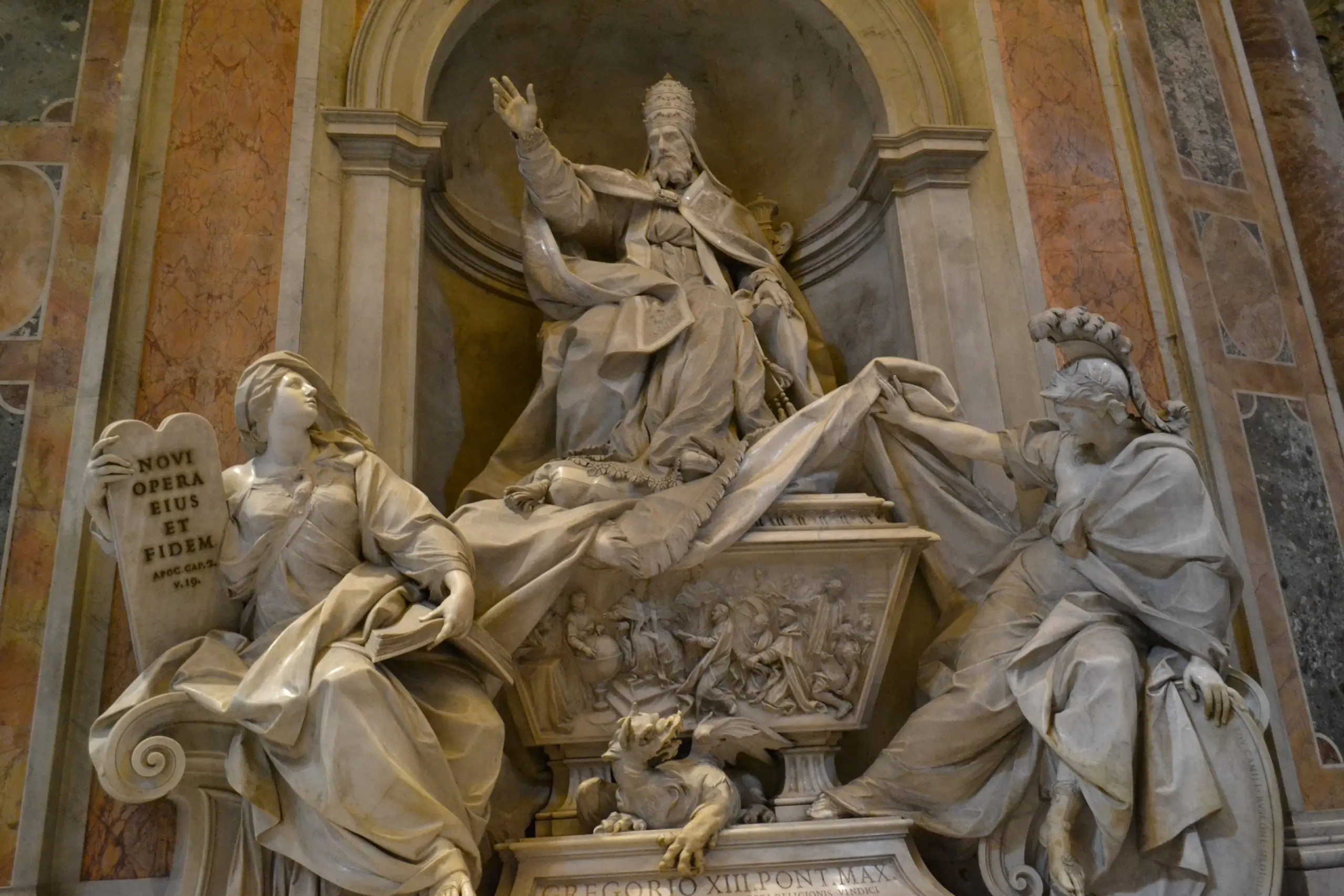
Six papal tombs remain visible in the basilica: Alexander III, Sergius IV, Innocent III, Martin V, Clement XII and Leo XIII. The bronze effigy of Martin V lies before the confessio, while the great monuments of Innocent III and Leo XIII recall two very different ages of the papacy.
The Lateran once contained further papal tombs, but fires in 1308 and 1361 devastated the medieval basilica. Other monuments disappeared during rebuilding. The surviving tombs are therefore only part of a much larger history of popes, councils, coronations and the government of the Church from the Lateran Palace.
A Catholic pilgrim should know: St John Lateran is not simply another impressive basilica. It is the Pope’s cathedral, the highest-ranking church in the Catholic world and a visible sign of his office as Bishop of Rome.
Explore its papal tombs, apostolic relics, mosaics and cathedral identity on the St John Lateran – Cathedral of Rome & Holy Stairs Tour.
St Mary Major: the popes buried beside Our Lady
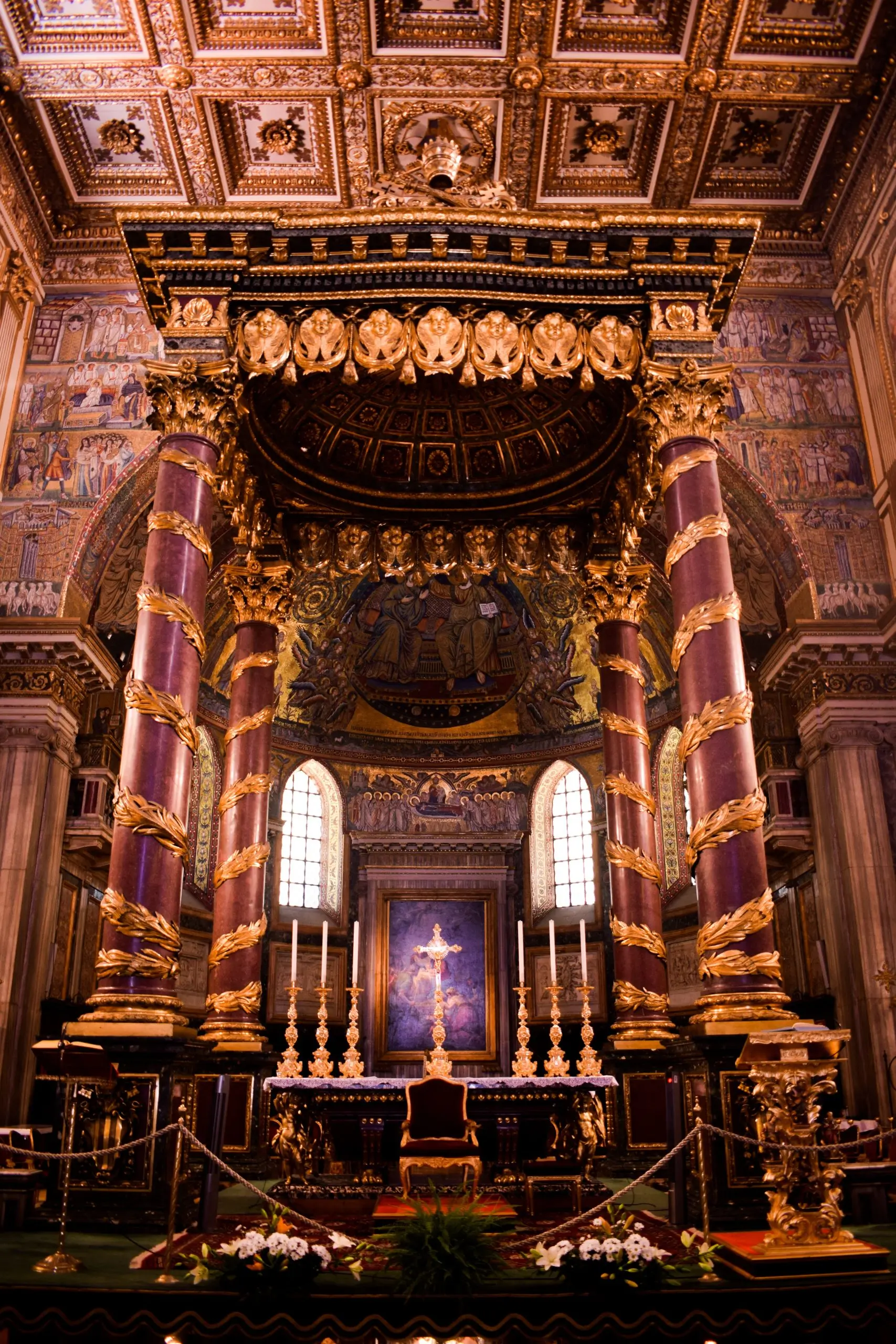
The Basilica of St Mary Major is the greatest Marian church of Rome and one of the four Major Basilicas. Eight popes are buried here: Honorius III, Nicholas IV, St Pius V, Sixtus V, Clement VIII, Paul V, Clement IX and Francis. Not every original monument survives intact, but the basilica remains one of Rome’s principal papal burial churches.
The Sistine and Pauline Chapels contain the imposing monuments of the popes who transformed the basilica during the Catholic Reformation. St Pius V rests in the Sistine Chapel, close to the relics of the Holy Crib. Across the nave, the Pauline Chapel enshrines the miraculous icon of the Salus Populi Romani, painted according to Catholic tradition by St Luke.
Pope Francis became the first pope in more than a century to be buried outside the Vatican when he was interred at St Mary Major in 2025. His simple tomb stands in a side aisle between the Pauline and Sforza Chapels. Whatever a pilgrim’s interest in an individual pontificate, the deeper significance of the basilica is Marian: the successors of Peter rest beneath the maternal gaze of Our Lady in the church known for centuries as the “Bethlehem of the West”.
The St Mary Major Basilica Tour reveals the basilica’s papal monuments, early Christian mosaics, Holy Crib and devotion to the Blessed Virgin Mary.
St Lawrence Outside the Walls: early popes and Blessed Pius IX
St Lawrence Outside the Walls is built around the tomb of the great Roman deacon and martyr. Several early popes were associated with burial at this sacred complex, while its most prominent later papal tomb belongs to Blessed Pius IX, whose long pontificate witnessed the definition of the Immaculate Conception, the First Vatican Council and the loss of the Papal States.
Pius IX chose to be buried near St Lawrence rather than at St Peter’s. His tomb, surrounded by rich mosaics, makes the basilica essential to any fuller study of the papacy in Rome. The church also preserves the relics of St Lawrence and St Stephen, joining papal history to the witness of the Church’s deacons and martyrs.
Visit this often-overlooked papal and martyrial basilica on the St Lawrence Pilgrim Church Tour or as part of the complete 7 Pilgrim Churches – 4-Day Rome Pilgrimage.
Santa Maria sopra Minerva: five popes in Rome’s Dominican church
Only a short walk from the Pantheon stands Santa Maria sopra Minerva, Rome’s great Dominican church and one of the most important papal burial places outside the Major Basilicas. Its relatively restrained façade conceals a soaring interior associated with the preaching, scholarship and reforming life of the Order of Preachers.
Five popes are buried at Santa Maria sopra Minerva: Leo X, Clement VII, Paul IV, Urban VII and Benedict XIII. The Medici popes Leo X and Clement VII face one another in the choir near the high altar. Paul IV rests in the Carafa Chapel, Urban VII in the Chapel of the Annunciation and Benedict XIII in the Chapel of St Dominic.
The tombs span the sixteenth to the eighteenth centuries and turn the basilica into a concentrated history of Renaissance and Baroque papal Rome. Urban VII’s pontificate lasted only twelve days, while the monuments of Leo X and Clement VII recall the splendour and crises of the Medici age. Benedict XIII’s burial is particularly fitting in a Dominican church because he belonged to the Order of Preachers.
Papal history is only part of the basilica’s Catholic importance. The body of St Catherine of Siena, Doctor of the Church and fearless counsellor of popes, rests beneath the high altar; her head is venerated in Siena. The Dominican painter Blessed Fra Angelico is also buried here, and Michelangelo’s Risen Christ stands near the sanctuary.
See the church in its Catholic context: Santa Maria sopra Minerva forms part of Crucis Tours’ Counter-Reformation Baroque Rome Tour, where sacred art is explained as catechesis and Catholic renewal rather than as decoration alone.
Santa Prassede: Pope St Celestine I and the great translation of relics
Santa Prassede is easily overlooked beside the scale of nearby St Mary Major, yet it is one of Rome’s richest churches of relics and early Christian memory. Pope St Paschal I rebuilt the basilica in the ninth century and brought the remains of many martyrs from vulnerable suburban catacombs into the safety of the city’s churches.
Among the papal relics associated with Santa Prassede are those of Pope St Celestine I, who governed the Church from 422 to 432. He defended the faith against Nestorianism and supported the Council of Ephesus, at which the Blessed Virgin Mary was solemnly confessed as Theotokos, the Mother of God.
The Catholic Encyclopedia records that St Celestine was first buried in the Catacomb of Priscilla and that Pope St Paschal I translated his body to Santa Prassede in 820. It also notes that Mantua has advanced a competing claim to his relics. This is a valuable example of why an authoritative guide must distinguish an original burial place, a recorded medieval translation and later competing traditions without treating Catholic veneration dismissively.
Santa Prassede also preserves magnificent ninth-century mosaics and the revered Column of the Scourging, traditionally associated with the Passion of Christ. The basilica therefore brings together the martyrs, the papacy, Marian doctrine and the physical relics through which Catholic pilgrims contemplate the Incarnation and Passion.
Visit Santa Prassede within the wider story of Christ’s Passion on the Via Crucis – Relics of Christ Tour.
Pope St Clement I at San Clemente
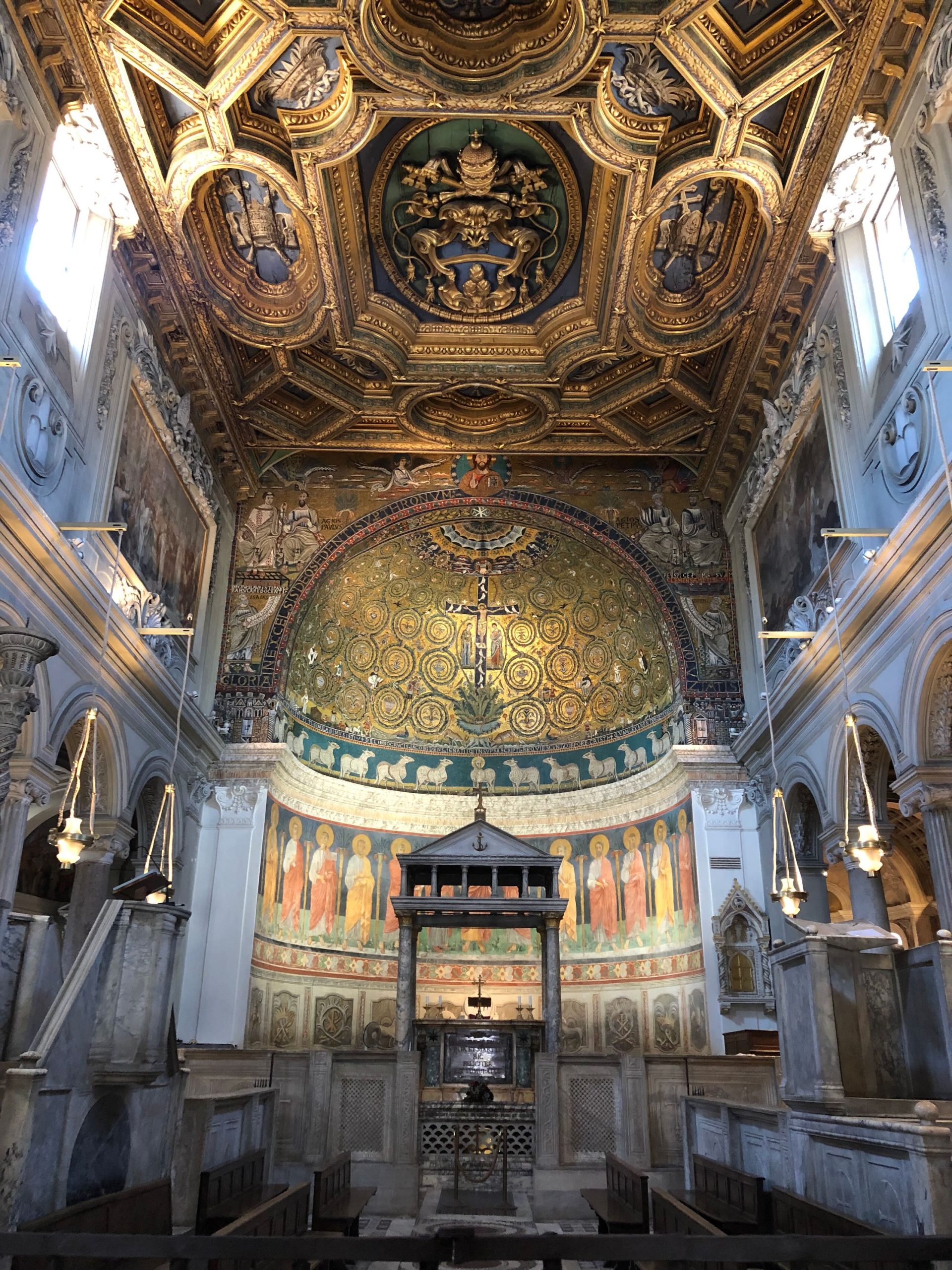
San Clemente requires careful language. Pope St Clement I was not originally buried beneath the present Roman basilica. Catholic tradition records his martyrdom in the Crimea, where he was cast into the sea with an anchor. In the ninth century, Sts Cyril and Methodius recovered his relics and brought them to Rome. Pope Adrian II received them, and they were solemnly interred at San Clemente.
The relics of the early pope are preserved beneath the high altar. His basilica descends through successive layers of Catholic history: the present twelfth-century church, a fourth-century basilica and Roman structures reaching back towards the Apostolic Age. Few places express the continuity of the Church of Rome so powerfully.
Descend through this extraordinary Christian history on St Clement’s Basilica – Apostolic Rome Underground Tour.
St Sebastian and the papal relics of the Appian Way
St Sebastian Outside the Walls is famous for the martyr’s tomb, its ancient catacombs and the Memoria Apostolorum, where St Peter and St Paul were once venerated together. Its Chapel of Relics also preserves traditions associated with early popes, including relics of St Callixtus, St Stephen and St Fabian.
Here again, “buried” and “venerated” must not be used interchangeably. The basilica’s papal relics may have been translated from earlier burial places. Their presence nevertheless connects St Sebastian with the persecuted Church, the successors of Peter and the ancient Christian landscape of the Appian Way.
The St Sebastian Catacombs Tour combines the basilica, the authorised underground visit, the martyr’s tomb and the apostolic memory of this historic site.
The Crypt of the Popes and Rome’s catacombs
Before popes were buried beneath monumental basilicas, many were laid to rest in the catacombs among the martyrs and faithful of Rome. The most celebrated concentration is the Crypt of the Popes in the Catacomb of St Callixtus, sometimes called the “little Vatican” of the early Church. Nine popes and several bishops of the third century were buried in or associated with this sacred chamber.
The Catacomb of Priscilla also received a remarkable succession of pontiffs. Ancient records associate it with Popes Marcellinus, Marcellus I, Sylvester I, Liberius, Siricius, Celestine I and Vigilius. Other popes were buried in the catacombs of Domitilla, St Agnes and elsewhere.
Many early remains were subsequently translated within Rome, especially when catacombs became unsafe or vulnerable to desecration. A pope’s original burial site, present resting place and principal place of veneration may consequently be different locations.
Other churches in Rome containing papal bodies or relics
Rome’s papal remains are far more widely dispersed than most visitors realise. Some churches contain complete papal burials with surviving monuments; others preserve bodies or relics translated from the catacombs. The table below concentrates on locations that can be presented responsibly, while indicating where an ancient tradition requires qualification.
| Church | Pope or papal remains | What the evidence indicates |
|---|---|---|
| Santa Maria in Trastevere | Innocent II; ancient associations with Callixtus I and Julius I | Innocent II was transferred here from the Lateran. Earlier papal relic traditions should be described with appropriate historical qualification. |
| Sant’Ignazio | Gregory XV | His remains were transferred to the Jesuit church in the seventeenth century; the great monument was completed in the early eighteenth century. |
| Sant’Andrea della Valle | Pius II and Pius III | The two Renaissance popes were translated here from Old St Peter’s; a further tradition concerns relics of Pope St Caius. |
| Santa Maria dell’Anima | Adrian VI | The last non-Italian pope before St John Paul II was transferred here from Old St Peter’s in 1533. |
| Santa Maria in Monserrato degli Spagnoli | Callixtus III and Alexander VI | The remains of the two Borgia popes are preserved together after surviving the demolition of Old St Peter’s. |
| Santa Francesca Romana | Gregory XI | His tomb recalls the pope who returned the papacy from Avignon to Rome. |
| San Salvatore in Lauro | Eugene IV | His tomb was moved here from Old St Peter’s before the basilica’s demolition. |
| Santa Maria in Aracoeli | Honorius IV | His medieval papal tomb was transferred from Old St Peter’s to the Capitoline church. |
| Santa Maria degli Angeli e dei Martiri | Pius IV | He was moved from Old St Peter’s and buried beneath the altar of the church he commissioned from Michelangelo. |
| Sant’Agnese in Agone | Innocent X | The Pamphilj pope rests in the Baroque church on Piazza Navona, close to his family palace. |
| Basilica of the Twelve Holy Apostles | Clement XIV | His remains were transferred here in 1802 beneath Antonio Canova’s monument. |
| San Marco Evangelista al Campidoglio | Pope St Mark | His relics were translated from the Catacomb of Balbina and are traditionally preserved beneath the high altar. |
| San Marcello al Corso | Pope St Marcellus I | The church preserves the relics of the early fourth-century pope to whom it is dedicated. |
| San Martino ai Monti | Pope St Martin I and other papal relic traditions | The Catholic Encyclopedia records that the greater part of St Martin I’s relics was brought to this basilica; the church also preserves traditions concerning several earlier popes. |
| Santi Vincenzo e Anastasio at Trevi | The praecordia of 22 popes | These are preserved hearts and internal organs rather than papal skeletons, retained from the former embalming custom. |
Santa Maria in Trastevere: papal memory in medieval Rome
Pope Innocent II rebuilt Santa Maria in Trastevere in the twelfth century and was eventually buried in the basilica he had renewed. The church’s earlier history is bound to Popes Callixtus I and Julius I, although the location and translation of early relics require more careful wording than the securely documented tomb of Innocent II.
The basilica’s papal history sits naturally beside its great Marian mosaics, ancient liturgy and relic of the Holy Sponge. Crucis Tours visits it on the Medieval Rome Walking Tour – Religious Life & Vocation, which follows the development of Catholic religious life through the churches of the Aventine and Trastevere.
Sant’Ignazio: the tomb of Gregory XV in Jesuit Rome
Pope Gregory XV is buried in Sant’Ignazio beside the memory of his cardinal-nephew Ludovico Ludovisi. The monumental ensemble belongs to the spectacular Jesuit interior crowned by Andrea Pozzo’s illusionistic ceiling and painted dome. Pilgrims can encounter this church on the focused St Ignatius Church Tour, the Baroque Art and Architecture Tour, or the Counter-Reformation Baroque Rome Tour.
A tomb monument is not always a burial place: Michelangelo’s famous monument to Julius II stands in San Pietro in Vincoli, but Julius II’s actual remains are in St Peter’s Basilica. Likewise, a surviving inscription may mark a historical burial even when the present location of the remains is uncertain. This guide does not treat every papal effigy or cenotaph as evidence that papal bones lie beneath it.
Are all the popes buried in Rome?
No. Although Rome contains by far the greatest concentration of papal tombs, not every pope died or was buried in the city. The Avignon popes provide obvious examples, and individual pontiffs rest in churches in France, Germany and other parts of Italy. Some died in exile or while travelling. For a number of early popes, the precise location of the tomb is no longer known.
Nor does a list of surviving monuments tell the whole story. Tombs were destroyed during invasions, fires and rebuilding projects. Remains were moved, monuments replaced and inscriptions lost. The history of papal burial is therefore also a history of the sufferings and endurance of the Church of Rome.
The papal tombs as a Catholic pilgrimage
A papal tomb should never become merely another item to photograph. Catholics visit the dead to pray, to remember the Communion of Saints and to profess faith in the resurrection. The artistic magnificence of a monument may reveal how an age understood the Petrine office, but marble and bronze finally yield to the same truth proclaimed at every Christian grave: earthly glory passes, and every soul awaits the judgement and mercy of God.
Rome allows the pilgrim to encounter the papacy across its whole history: persecuted bishops in the catacombs, medieval pontiffs at the Lateran, Catholic Reform popes at St Mary Major, modern successors of Peter at the Vatican, and the relics of Pope St Clement in one of the city’s most ancient basilicas.
Encounter the Catholic history of the popes in Rome
Crucis Tours brings together sacred history, Catholic tradition, art and prayer with practising Catholic guides. Choose a focused basilica tour or follow the papal and apostolic story across Rome’s great pilgrimage churches.
Frequently asked questions about papal tombs
How many popes are buried in St Peter’s Basilica?
Approximately 91 popes are buried in St Peter’s Basilica and the Vatican Grottoes, according to the official basilica. This makes St Peter’s the principal papal burial church.
Which popes are buried at St John Lateran?
The six surviving papal tombs belong to Alexander III, Sergius IV, Innocent III, Martin V, Clement XII and Leo XIII. The basilica historically contained additional papal tombs that were destroyed or lost.
How many popes are buried at St Mary Major?
Eight popes are buried or historically interred at St Mary Major: Honorius III, Nicholas IV, St Pius V, Sixtus V, Clement VIII, Paul V, Clement IX and Francis.
Is Pope St Clement buried at San Clemente?
His relics are preserved beneath the high altar of San Clemente. Catholic tradition records that he was martyred in the Crimea and that Sts Cyril and Methodius recovered his remains and brought them to Rome in the ninth century.
Which popes are buried at Santa Maria sopra Minerva?
Five popes are buried in Santa Maria sopra Minerva: Leo X, Clement VII, Paul IV, Urban VII and Benedict XIII. Their tombs are distributed through the choir and several chapels of the Dominican basilica.
Which pope’s relics are at Santa Prassede?
Pope St Celestine I’s body was originally buried in the Catacomb of Priscilla. The Catholic Encyclopedia records that Pope St Paschal I translated it to Santa Prassede in 820, while also noting a competing claim from Mantua.
Can visitors enter the Vatican Grottoes?
The Vatican Grottoes are normally accessible from within St Peter’s Basilica when open, although access can change because of liturgies, security or maintenance. The deeper Vatican Necropolis requires a separately arranged Scavi visit.
What is the best tour for seeing papal tombs in Rome?
The Four Major Basilicas Tour provides the broadest single-day introduction to papal Rome. For greater depth, combine it with St Clement, St Sebastian and St Lawrence, or undertake the complete Seven Pilgrim Churches pilgrimage.
Authoritative sources and further reading
- Official St Peter’s Basilica: how many popes are buried in the basilica?
- Official Archbasilica of St John Lateran: chapels and monuments
- Basilica of San Clemente: Pope St Clement and the translation of his relics
- The Holy See: the Christian catacombs of Rome
- Basilica of Santa Maria sopra Minerva: Chapel of St Dominic and the papal burials
- Catholic Encyclopedia: Pope St Celestine I and the translation to Santa Prassede
- Catholic Encyclopedia: Pope St Martin I and his relics at San Martino ai Monti
- Catholic Encyclopedia: Pope Innocent II and Santa Maria in Trastevere
- EWTN Vatican: historical overview of papal burial sites
Church access, tomb locations and visitor arrangements can change. This guide distinguishes, wherever necessary, between an original burial place, a present tomb and translated relics. Updated 24 August 2026.